

Why Your Boat’s Wake Is Stirring Up My Favorite Fishing Hole

Summary:
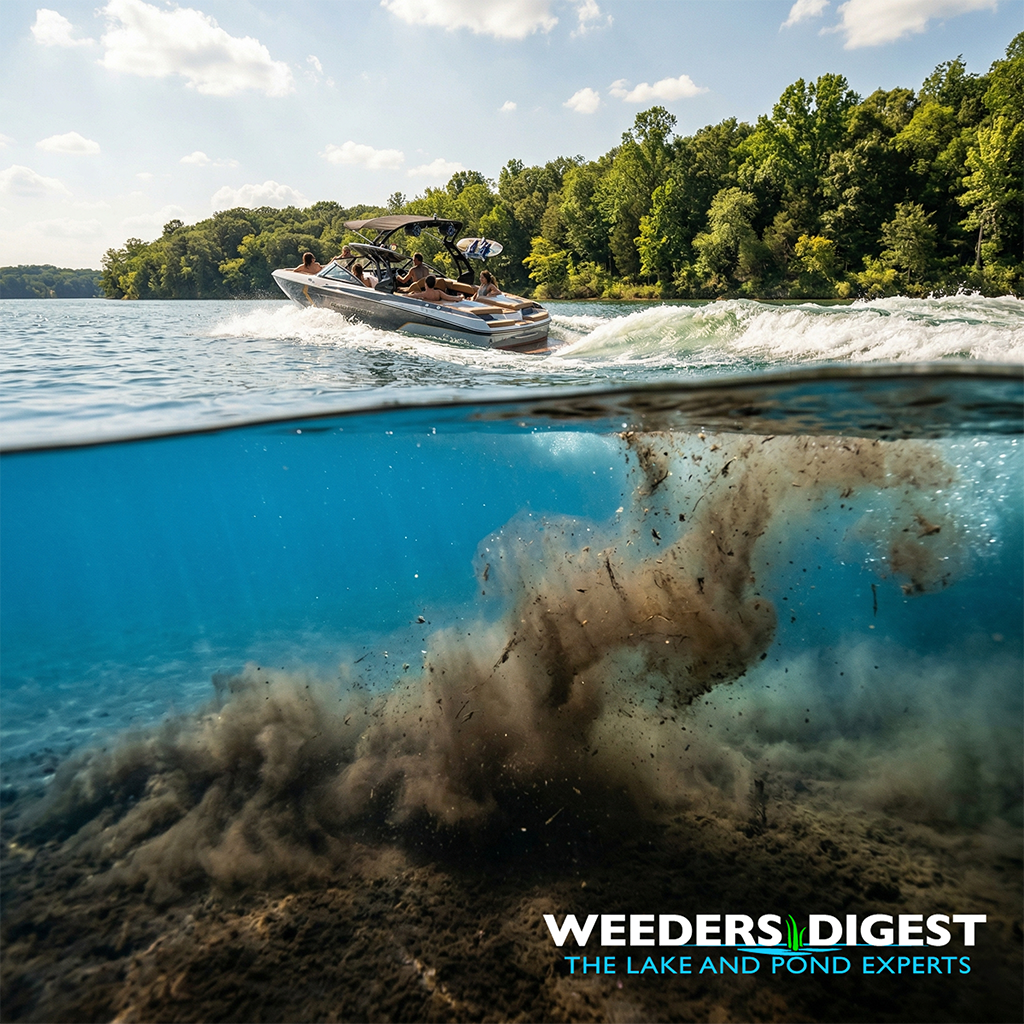
If you have ever noticed the water near your shoreline turning cloudy or "mucky" after a busy weekend of boating, you are seeing the direct impact of boat wakes on your lake’s health. While it might just look like a bit of mud, that cloudiness is actually a mixture of decayed organic matter, silt, and nutrients being ripped off the bottom. I have spent years studying how these waves interact with the lake bed, and the reality is that the energy from a heavy wake travels much deeper than most people realize.
When a large boat passes by, especially one designed for wakeboarding or surfing, it creates a powerful wave that carries significant energy. As that wave moves toward the shallower areas of your lake, it eventually touches the bottom. This contact acts like a giant underwater rake, pulling up the soft "muck" that has settled over decades. Instead of staying tucked away on the lake floor, those particles are now floating throughout the water column, making the water look dirty and potentially ruining the clarity you enjoy.
Beyond just the aesthetics, this suspended muck is a major headache for the entire ecosystem. It can smother the eggs of the fish you love to catch and block the sunlight that your beneficial native plants need to grow. Understanding how your boat's energy affects the shoreline is the first step in keeping our lakes clear and healthy for everyone. It is a delicate balance between enjoying the water and protecting the very environment that makes the lake a special place to be.
The Science Behind It:
The suspension of benthic sediments, frequently referred to as "muck," due to motorized watercraft is a function of orbital wave motion and turbulent energy dissipation. When a vessel moves through the water, it displaces a volume of fluid, creating a wake train consisting of divergent and transverse waves. According to research published by the University of Minnesota, the energy contained within these waves is proportional to the square of the wave height. In the case of high-displacement hulls or wake-specialized watercraft, the vertical wave height and subsequent energy density are significantly greater than those produced by traditional fishing or cruising vessels.
As these waves propagate into shallower littoral zones, the circular orbits of the water particles—which characterize deep-water waves—become elliptical and eventually interface with the lake bed. This interaction creates bed shear stress. When the shear stress exerted by the wave exceeds the critical shear stress required for the entrainment of the specific sediment type, resuspension occurs. In many temperate lakes, the "muck" layer consists of fine-grained silts and highly flocculent organic matter which possess very low settling velocities, allowing them to remain in the water column for extended periods after the initial disturbance.
Furthermore, the propulsion systems of heavy watercraft contribute to this phenomenon through "propwash." In shallow environments, the high-velocity jet of water from a propeller or an impeller can penetrate several feet deep, directly scouring the benthic zone. This mechanical agitation not only lofts inorganic silts but also liberates sequestered nutrients, particularly phosphorus, which is often bound to sediment particles. Research from the Journal of Environmental Management indicates that this internal loading of nutrients can trigger localized algal blooms, further decreasing secchi disk transparency and altering the trophic state of the nearshore environment.
The persistence of this suspended material is governed by Stokes' Law, which relates the settling rate of a particle to its diameter and density. Because lake muck is often composed of fine organic detritus with a density only slightly higher than water, even minor thermal currents or subsequent smaller wakes can prevent these particles from resettling. This leads to a chronic state of turbidity in high-traffic areas. This persistent suspension limits the euphotic zone, negatively impacting submerged aquatic vegetation (SAV) by reducing the light available for photosynthesis, which can lead to a shift from plant-dominated clear water states to turbid, algae-dominated states.
Sources / References:
- University of Minnesota St. Anthony Falls Laboratory: Characterization of Wake Waves
- Journal of Environmental Management: Impact of boat-generated waves on littoral zones