

Why Your Lake Bottom Feels Mucky: Is It Just Clay or Something More?

Summary:
When you wade into your lake, the sensation under your feet can tell you a lot about the health of your shoreline. If you feel a firm, slick, and somewhat heavy material that holds its shape, you are likely standing on a natural clay bottom. Clay is a geological feature, a mineral-based soil that has been part of the lake's structure since its formation. It is stable, relatively inert, and provides a solid foundation for the water body.
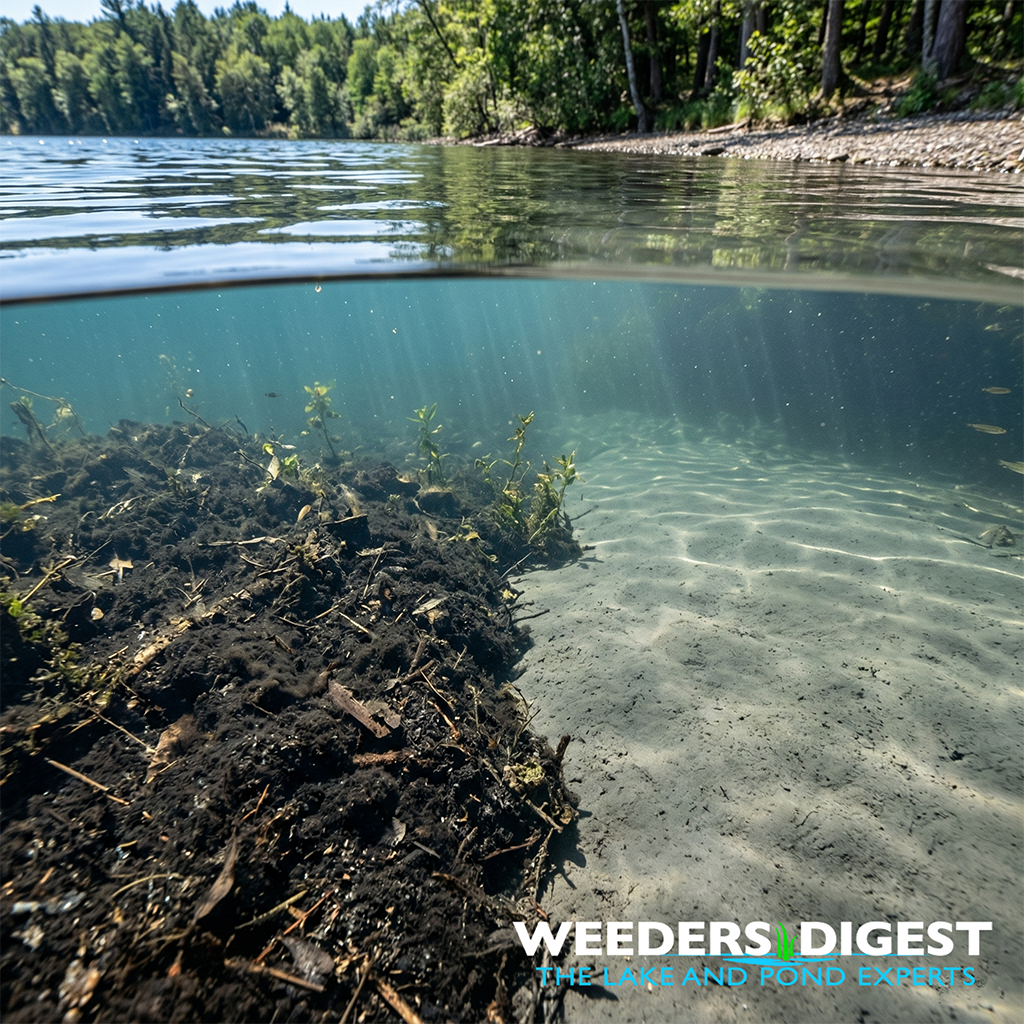
On the other hand, if your feet sink into a soft, dark, and often foul-smelling "goo," you are dealing with organic lake sludge, commonly known as muck. Unlike clay, sludge is not a permanent soil type but rather a collection of decomposing matter. It is made up of dead algae, fish waste, fallen leaves, and runoff that has settled at the bottom. While clay is a part of the earth, sludge is a byproduct of the biological life cycle within the water.
Distinguishing between the two is vital for any pond or lake owner. Clay is generally desirable for structural integrity and water retention, whereas an accumulation of organic sludge can lead to oxygen depletion and excessive weed growth. Understanding whether your lake floor is "growing" or simply "resting" helps you determine if you need to intervene with management strategies or simply enjoy the natural geology of your property.
The Science Behind It:
The differentiation between organic sludge and natural clay bottoms is defined by their chemical composition and physical origin. Clay consists of hydrous aluminum phyllosilicates, characterized by extremely fine particle sizes—typically less than $0.002\text{ mm}$ in diameter. According to research from the University of Florida’s IFAS Extension, these mineral particles are products of long-term geological weathering. Because of their microscopic, plate-like structure and ionic charge, clay particles pack together tightly, creating a dense, anaerobic, and nearly impermeable barrier that prevents water seepage.
In contrast, organic sludge, or "gyttja," is a biological legacy. It is primarily composed of autochthonous and allochthonous organic matter in various stages of decay. This material has a high carbon content and a much lower density than mineral soils. A study published in the journal Hydrobiologia notes that as organic matter accumulates, microbial decomposition—specifically by aerobic and anaerobic bacteria—becomes the dominant process at the sediment-water interface. This process consumes dissolved oxygen, often leading to localized hypoxia which further slows the breakdown of the material, causing the "muck" layer to thicken over time.
Physical behavior also serves as a key scientific marker. Clay exhibits high plasticity and cohesion; when compressed, it stays compressed. Organic sludge, however, is highly flocculent and porous. It holds a significant volume of interstitial water, which is why it feels "fluffy" or easily disturbed when stepped on. From a limnological perspective, the presence of sludge indicates a high rate of nutrient loading, particularly phosphorus and nitrogen, which are sequestered within the organic matrix and can be rereleased into the water column through internal loading.
Furthermore, the odor profile of these two substances differs due to their chemical pathways. Natural clay is largely odorless or possesses a faint earthy scent. Organic sludge frequently undergoes anaerobic digestion, a process that produces hydrogen sulfide ($H_{2}S$) and methane ($CH_{4}$) gas as byproducts. This results in the characteristic "rotten egg" smell associated with disturbed lake sediments. While clay provides a stable substrate for specific benthic organisms, thick layers of organic sludge can shift the entire ecological balance of a pond, favoring species tolerant of low-oxygen environments.
Sources / References:
- University of Florida IFAS Extension: Circular 1075/FA021: Phosphorus in Northern Everglades Wetlands
- Journal of Limnology / ResearchGate: Sediment Organic Matter Fractionation and its Impact on Lake Ecosystems