

Why Your Lake Doesn’t Stay Dirty: My Guide to Nature’s Filtration System
 |

Summary:
If you have ever stood on a dock and wondered why a lake doesn't eventually turn into a stagnant bowl of soup, you are witnessing one of nature's most impressive engineering feats. Lakes are not just sitting pools of water; they are living, breathing ecosystems that possess a remarkable ability to process waste and maintain clarity through a series of natural "cleaning" cycles. I have spent years studying these water bodies, and it never ceases to amaze me how effectively they manage their own health when the balance is right.
This natural purification happens through a combination of physical settling, chemical reactions, and the hard work of microscopic organisms. Much like how our own bodies filter toxins, a lake uses its plants, beneficial bacteria, and even the wind to scrub the water clean. When sediment enters the water, gravity eventually pulls it to the bottom, while tiny microbes break down organic "muck" before it can cause problems.
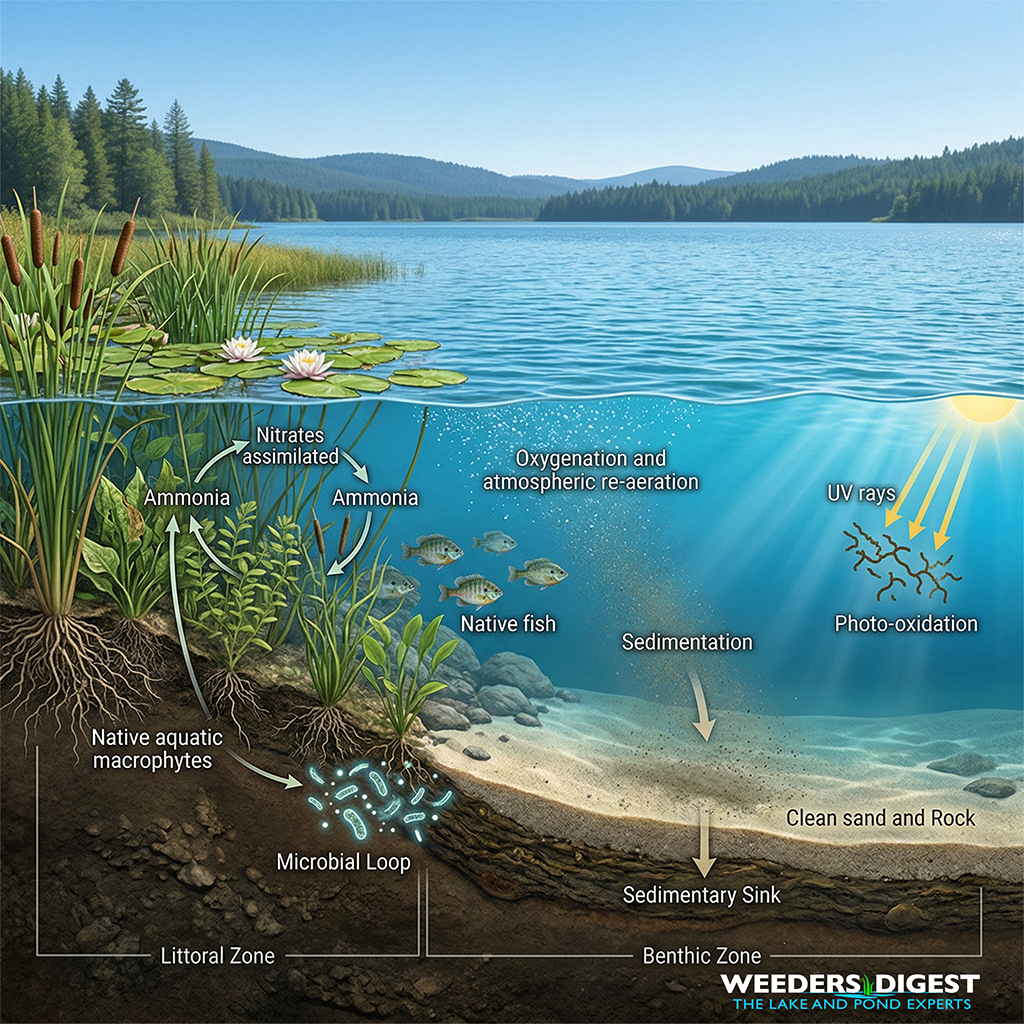
You can think of the lake's edge—the shallow area with all the weeds and reeds—as the lake's kidneys. These plants act as a physical buffer, trapping debris and absorbing excess nutrients that would otherwise fuel ugly Algae blooms. It is a delicate dance between the biology of the water and the physics of the environment, all working together to keep your favorite swimming hole clear and vibrant.
Understanding these processes is the first step in being a good steward of the water. When we respect these natural filters, the lake does the heavy lifting for us, ensuring the water remains a beautiful asset for your property rather than a maintenance headache.
The Science Behind It:
The self-purification capacity of lacustrine ecosystems is governed by the principles of limnology, specifically through physical, chemical, and biological pathways. One of the primary physical mechanisms is sedimentation, where the reduction in water velocity allows suspended solids to precipitate out of the water column. According to research published via the University of Minnesota Extension, this process is critical for sequestering phosphorus, as this nutrient often binds to soil particles. Once buried in the benthic zone, these nutrients are effectively "locked" away from the euphotic zone, provided the hypolimnion remains oxygenated to prevent internal loading.
Biodegradation serves as the primary biological cleaning mechanism, driven largely by aerobic bacteria and actinomycetes. These microorganisms oxidize dissolved organic matter (DOM) into simpler inorganic compounds like carbon dioxide and water. This microbial loop is essential for processing the nitrogen cycle, where nitrifying bacteria convert ammonia—a byproduct of fish waste and decaying matter—into nitrites and then nitrates, which are subsequently assimilated by aquatic macrophytes or released as nitrogen gas through denitrification in anaerobic sediments.
Aquatic macrophytes and periphyton also play a vital role in nutrient bio-extraction. These plants act as biological "sinks," absorbing nitrogen and phosphorus directly from the water column and sediment to fuel their growth. Research cited in Limnology and Oceanography highlights that healthy littoral zones—the shallow areas near the shore—serve as complex filters where physical straining meets high-intensity biological uptake. The presence of a diverse plant community increases the surface area for beneficial biofilm development, further enhancing the breakdown of organic pollutants.
Furthermore, the process of photo-oxidation provides a chemical cleaning layer. Ultraviolet (UV) radiation from sunlight penetrates the upper layers of the water (the epilimnion), breaking down complex aromatic compounds and certain pathogens. This solar disinfection, combined with atmospheric re-aeration driven by wind-induced turbulence, ensures that dissolved oxygen levels remain sufficient for aerobic decomposition. When these systems are in equilibrium, the lake functions as a closed-loop treatment facility, maintaining homeostatic clarity through these integrated biogeochemical cycles.
Sources / References:
- University of Minnesota Extension: Understanding Lake Ecology
- EPA:Clean Water Act and Lake Health Parameters