

Why Your Lake Is a Jungle While Your Neighbor’s Is Crystal Clear
 |
Summary:
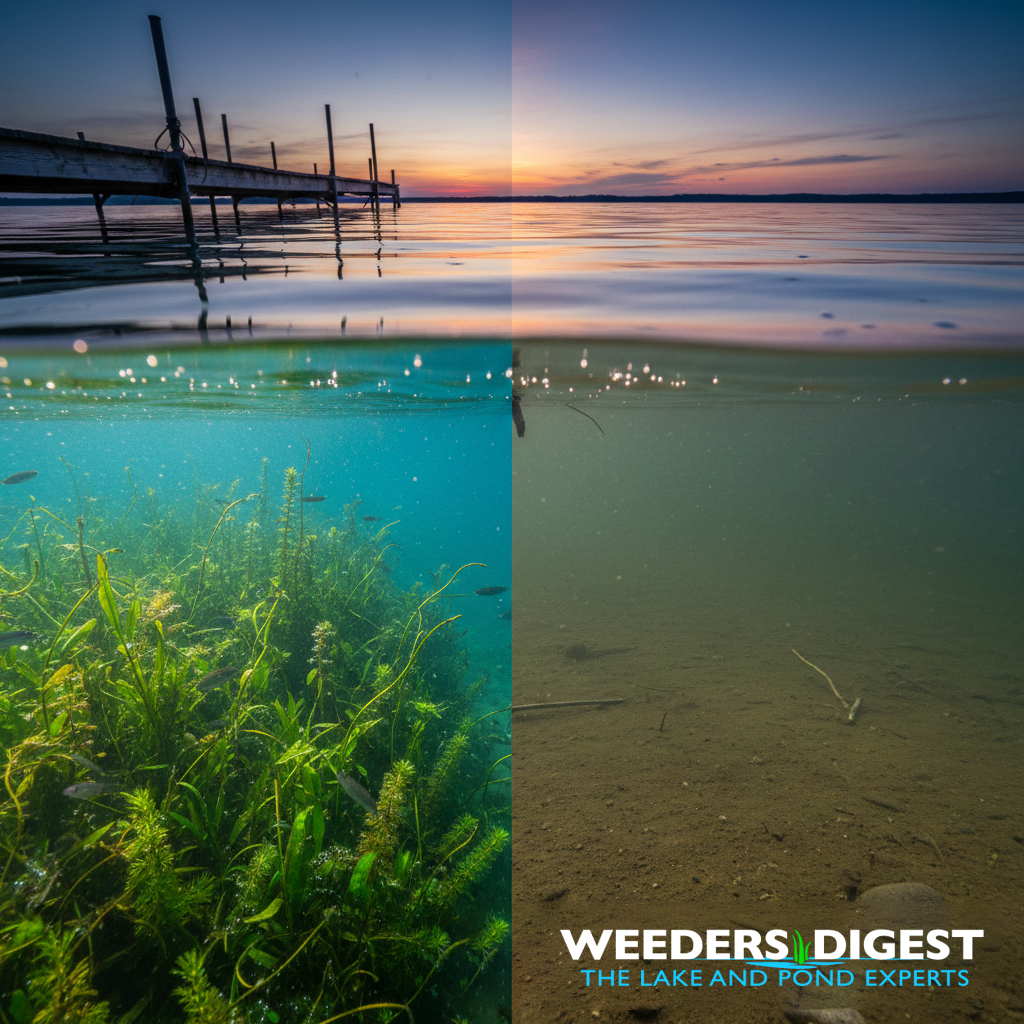
Have you ever wondered why your boat propeller gets tangled in thick "lake weeds" while the beach down the road stays perfectly clear? It’s a common frustration for many of us who live on the water, and the answer isn't just bad luck. Think of your lake like a giant underwater garden. Just like the flowers in your backyard, aquatic plants need specific "food" and the right environment to grow. If your shoreline has the perfect mix of soft soil, shallow water, and plenty of sunlight, it’s going to be a magnet for vegetation.
The presence of these plants, which we often call weeds but scientists call "macrophytes," is actually a sign that your lake is full of life. Some lakes have sandy or rocky bottoms where plants struggle to take root, while others are deep and dark, preventing sunlight from reaching the floor. When a lake is shallow and fed by runoff from lawns or farms, it becomes a high-energy buffet for plants.
Another big factor is who else is living in the water. Some lakes have "ecosystem engineers"—like certain fish or even tiny organisms—that either eat the plants or stir up the mud so much that plants can't see the sun. In other cases, an invasive species might move in, acting like a playground bully that takes over the entire neighborhood because it has no natural enemies to keep it in check.
Understanding your lake is the first step toward managing it. Whether you have a lush underwater forest or a barren sandy bottom depends on a complex dance between the chemistry of the water, the shape of the lake bed, and the history of the surrounding land. It is a delicate balance where even a small change in water clarity or nutrient levels can turn a clear swimming hole into a dense aquatic meadow.
The Science Behind It:
The distribution and abundance of aquatic macrophytes are primarily dictated by the interaction of light availability, sediment composition, and nutrient loading, a framework often referred to as the trophic state of a water body. Light attenuation is the most significant limiting factor for submerged plants; as depth increases or turbidity rises, the euphotic zone—the layer where photosynthesis is possible—shrinks. According to research published in Hydrobiologia, the maximum colonization depth of macrophytes is directly correlated with Secchi disk transparency, meaning clearer lakes allow for deeper and more expansive weed beds.
Sediment characteristics act as the physical and chemical substrate for root development. Lakes with high depositional rates of organic matter provide a nutrient-rich, flocculent medium that favors opportunistic species. Conversely, high-energy shorelines with significant wave action often result in coarse, sandy, or rocky substrates that are inhospitable to root attachment. This physical "sorting" explains why windswept points may be barren while protected bays are choked with vegetation. The presence of specific minerals, such as iron or calcium, can also sequester phosphorus, making it unavailable to plants even if it is present in the water column.
Nutrient stoichiometry, particularly the levels of nitrogen and phosphorus, drives the biomass of these systems. In many temperate lakes, phosphorus is the limiting nutrient. When anthropogenic runoff introduces excess phosphorus, the system may undergo a regime shift. However, a paradoxical relationship exists: in "clear-water states," macrophytes actually help maintain clarity by stabilizing sediments and outcompeting algae for nutrients. If the plants are removed or the nutrient load becomes too high, the lake may flip into a "turbid-state" dominated by phytoplankton, where the water becomes pea-soup green and the lack of light kills off the bottom-dwelling plants.
Biological interactions further complicate this ecology. Invasive species, such as Myriophyllum spicatum (Eurasian Watermilfoil), can dominate a system because they possess specialized growth strategies, like canopy formation, which allows them to shade out native competitors. Furthermore, the "top-down" influence of fish populations plays a role. Benthivorous fish like common carp can increase turbidity through bioturbation, effectively suppressing macrophyte growth through light limitation. This complex interplay of abiotic filters and biotic feedback loops determines why one basin may remain oligotrophic and plant-poor while another becomes highly productive.
Sources / References:
- University of Florida IFAS: Aquatic Plant Management: Why do we have aquatic plants?