

Why Your "Lake Weed" Problem Might Be the Best Thing for Your Water
Summary:
The biggest myth I encounter in my years of managing waterfronts is the idea that a "clean" lake bottom—one completely stripped of vegetation—is the hallmark of a healthy ecosystem. Many homeowners look at a patch of pondweed and see a nuisance that needs to be eradicated to achieve a pristine, swimming-pool look. In reality, a lake without plants is often a lake in crisis, teetering on the edge of becoming a turbid, algae-choked mess.
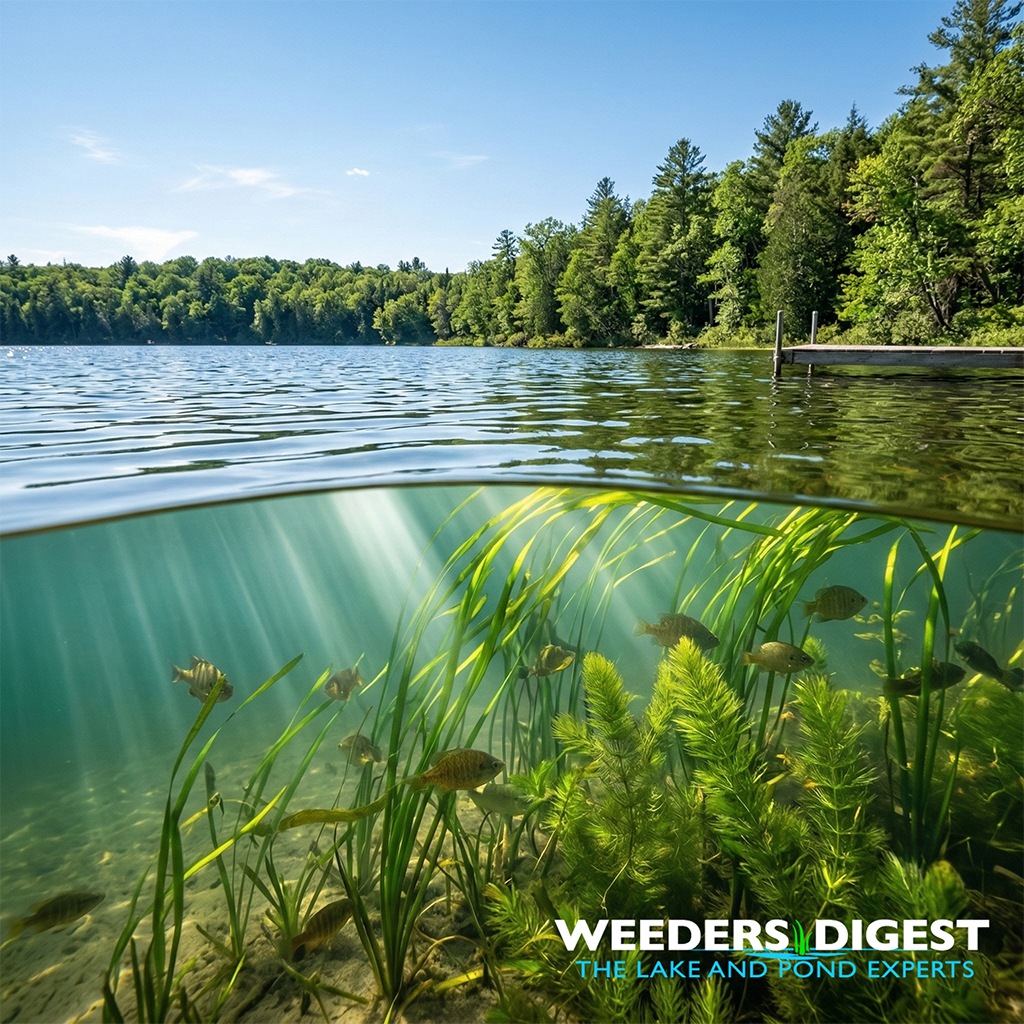
When you remove all the "weeds" (which we professionals prefer to call Macrophytes), you aren't just clearing a path for your boat; you are removing the lake's primary filtration system. These plants are the heavy lifters of the aquatic world, locking up nutrients that would otherwise fuel toxic cyanobacteria blooms. Without them, the water clarity usually plummets, and the fish populations you enjoy—like bass and bluegill—lose the "nurseries" and hunting grounds they need to survive.
Understanding your lake means shifting your perspective from seeing plants as an enemy to seeing them as a protective shield. While invasive species certainly require management, a diverse community of native plants is actually what keeps your water clear, your shoreline stable, and your property value high. The goal shouldn't be a sterile environment, but a balanced one.
The Science Behind It:
The misconception that aquatic vegetation is detrimental to water quality ignores the fundamental limnological principle of "Alternative Stable States." Shallow lake theory suggests that these ecosystems generally exist in one of two conditions: a clear-water state dominated by submerged macrophytes, or a turbid-water state dominated by phytoplankton (algae). According to research published in Frontiers in Plant Science, aquatic macrophytes play a critical role in maintaining the clear-water state by outcompeting algae for limiting nutrients like phosphorus and nitrogen. When vegetation is removed or suppressed, the ecosystem often undergoes a catastrophic regime shift toward turbidity.
The mechanism for this stability is multifaceted. Submerged plants provide a physical anchor for sediments, preventing wind-induced resuspension of nutrients from the lake bed. Furthermore, many species of macrophytes engage in allelopathy, releasing biochemical compounds that actively inhibit the growth of competing algae. As noted by the University of Florida's IFAS Extension, these plants also serve as a vital refuge for large-bodied zooplankton, such as Daphnia. These organisms are the primary grazers of algae; by providing a "hiding spot" from predatory fish, macrophytes indirectly ensure that the algae population remains under biological control.
From a structural standpoint, the architecture of native aquatic plants is essential for biodiversity. The intricate stems and leaves create a complex three-dimensional habitat that supports periphyton—the biofilm of algae and microbes that forms the base of the aquatic food web. Research in the journal Hydrobiologia emphasizes that the loss of this structural complexity leads to a decline in macroinvertebrate diversity, which subsequently impacts the recruitment and growth rates of higher-trophic-level organisms like centrarchid fish.
Ultimately, the "myth" of the weed-free healthy lake fails to account for the nutrient-buffering capacity of these organisms. In a nutrient-rich environment, the absence of macrophytes does not result in clear water; instead, it creates a vacuum that is rapidly filled by opportunistic phytoplankton. This shift not only reduces water clarity but can lead to hypoxic conditions (low oxygen) during algae die-offs, threatening the entire biological community. Therefore, preservation and strategic management—rather than total eradication—remain the gold standard for sustainable lake ecology.
Sources / References:
- https://edis.ifas.ufl.edu/publication/FA163
- https://www.frontiersin.org/articles/10.3389/fpls.2021.681105/full