

Why Your Septic System Might Be The Secret Reason For Your Lake's Algae Bloom
 |
Summary:
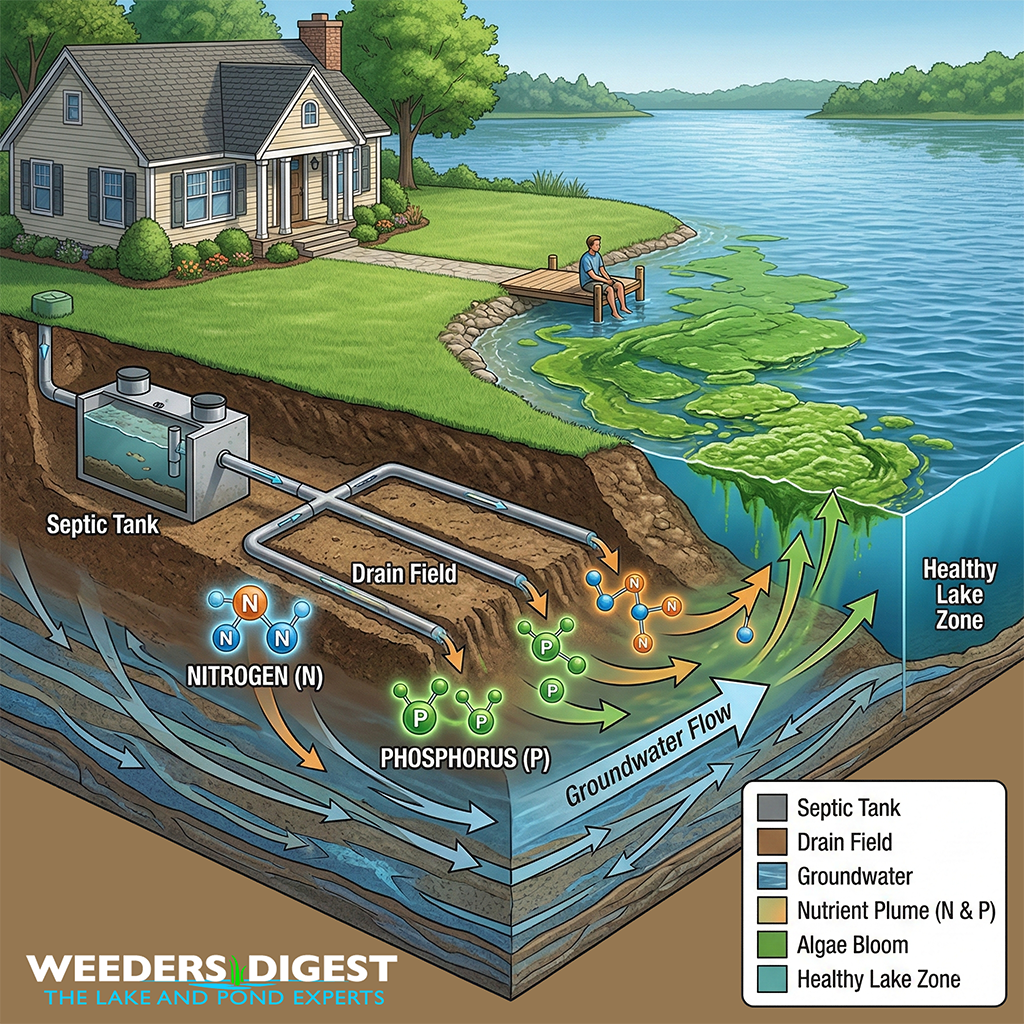
If you live on a lake or near a pond, you might be surprised to learn that your own backyard could be fueling those unsightly green mats of algae. While we often think of septic systems as "set it and forget it" infrastructure, they are actually living biological filters. When these systems are old, poorly maintained, or installed in the wrong kind of soil, they stop effectively trapping nutrients. Instead of being filtered out, substances like phosphorus and nitrogen leak into the groundwater and eventually make their way into your lake.
Once these nutrients reach the water, they act like a high-strength liquid fertilizer for aquatic plants and algae. What started as a small leak in a drain field can quickly turn into a full-scale algae bloom that ruins your view and makes swimming unpleasant. Understanding the connection between your home’s waste management and the health of your shoreline is the first step in protecting your property value and the local ecosystem. It isn't just about whether the toilet flushes; it's about what happens to that water once it leaves the pipes and enters the environment.
The Science Behind It:
Onsite wastewater treatment systems (OWTS), commonly known as septic systems, are significant contributors of anthropogenic nutrient loading to surface waters, particularly in lacustrine environments. The primary mechanism of concern involves the subsurface transport of soluble reactive phosphorus (SRP) and dissolved inorganic nitrogen (DIN). In a properly functioning system, the soil transition zone—the drain field—facilitates the adsorption of phosphorus onto iron and aluminum oxides within the soil matrix. However, over time, the phosphorus-binding capacity of the soil can become saturated, leading to a "breakthrough" where excess phosphate ions migrate through the groundwater plume toward nearby water bodies.
Research conducted by the University of Florida Institute of Food and Agricultural Sciences indicates that nitrogen, typically in the form of nitrate ($NO_3$), is highly mobile in groundwater because it does not readily adsorb to soil particles. In coastal or lakeside communities with high water tables or porous, sandy soils, these nitrates move rapidly with the hydraulic gradient. When this nutrient-rich groundwater discharges into a lake, it alters the N:P (nitrogen to phosphorus) ratio of the water column. According to a study published in Environmental Science & Technology, even aging systems that are "functioning" by homeowner standards may still be discharging significant nutrient loads if the leach field has entered a state of anaerobic stasis or if the soil lacks sufficient mineral content for chemical precipitation.
Once these limiting nutrients enter the photic zone of a lake, they trigger rapid primary production. Cyanobacteria and filamentous algae are particularly adept at sequestering these inputs. The influx of phosphorus is often the "limiting factor" in freshwater systems; thus, even a fractional increase in phosphorus concentrations from a failing or outdated septic system can lead to a shift from an oligotrophic (low nutrient) state to a eutrophic (high nutrient) state. This process, known as cultural eutrophication, results in decreased dissolved oxygen levels as the algae eventually die and decompose, further stressing the aquatic biota.
The longitudinal impact of septic effluent is exacerbated by "legacy phosphorus." Even if a homeowner repairs a system today, the nutrients that have accumulated in the lake-bottom sediments over decades can continue to fuel seasonal blooms through internal loading. Data from the Water Resources Research Center suggests that in densely populated lakeside developments, the cumulative impact of multiple individual septic systems can rival the nutrient output of small municipal wastewater treatment plants, making residential subsurface maintenance a critical component of watershed management and limnological health.