

Clear the Path: What Happens to Your Fish When You Clear a Dense Weed Bed?
 |

Summary:
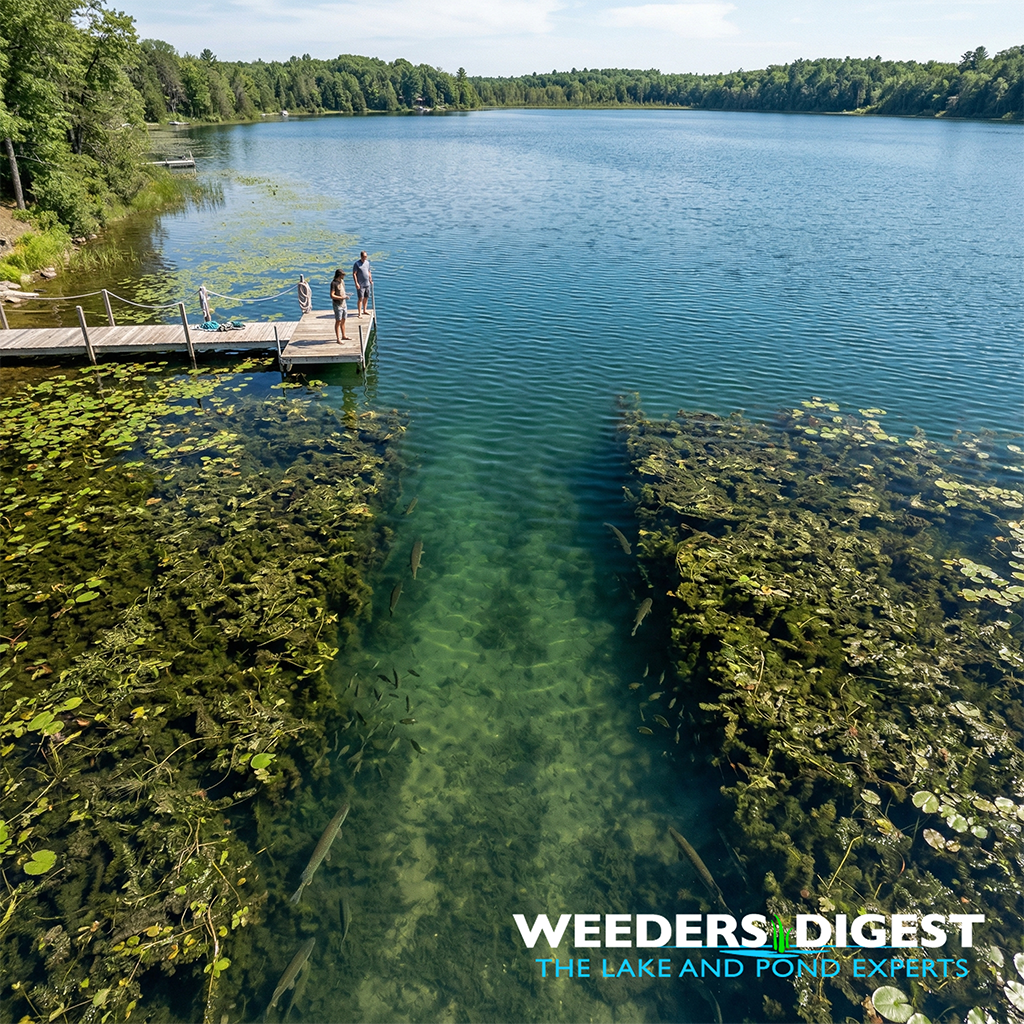
If you have ever looked at a weed-choked shoreline and wondered if clearing a swimming path would ruin the fishing, you are not alone. It is a common concern for many of my fellow lakefront homeowners. The reality is that while thick vegetation provides a home for many small critters, it can actually become "too much of a good thing." When weeds get so dense that they bridge the entire water column, they often create a stagnant environment where big fish can’t hunt and small fish become stunted because they are too well-protected.
By clearing a strategic path through those dense mats, you are essentially opening up a "highway" for aquatic life. I have found that this doesn't just make the water more accessible for your family; it actually creates an "edge effect" that fish love. You are providing a corridor where predator fish like bass can patrol the perimeter, and smaller panfish can move more freely to find better food sources. Instead of a solid wall of green, you are creating a diverse habitat that mimics a more natural, healthy lake structure.
In my experience, the initial disturbance might cause fish to scatter for a few hours, but they usually return quickly to investigate the new open space. Think of it like opening a door in a crowded room—suddenly, there is room to breathe and move. As long as you aren't stripping the entire lake bottom bare, a well-placed path can actually improve the local fishing and the overall health of the fish population right off your dock.
The Science Behind It:
The structural complexity of aquatic macrophytes plays a critical role in the community dynamics of freshwater ecosystems. When submerged vegetation reaches excessive densities, it often leads to a phenomenon known as "trophic decoupling." In these hyper-dense environments, the efficiency of apex predators, such as Largemouth Bass (Micropterus salmoides), significantly decreases because the physical barrier of the stems prevents successful foraging maneuvers. Research indicates that when weed cover exceeds 40-60% of a given area, the growth rates of both predators and prey can decline due to restricted energy flow.
Clearing a localized channel through dense monocultures creates what ecologists term an "ecotone" or "edge habitat." This interface between the open water and the remaining vegetation increases the availability of foraging opportunities. According to studies published in the Journal of Aquatic Plant Management, removing portions of dense vegetation can actually increase the growth rates of bluegill and other sunfish by reducing over-competition for limited resources within the weed beds. The creation of these lanes allows for better water circulation and dissolved oxygen exchange, mitigating the localized hypoxia that often occurs in the center of stagnant, decaying weed mats.
The immediate behavioral response of the fish population is governed by "optimal foraging theory." Predators are naturally drawn to edge environments because they provide the perfect vantage point to ambush prey emerging from the safety of the weeds. Consequently, clearing a path does not typically result in a net loss of fish biomass; rather, it redistributes the biomass more effectively across the littoral zone. This "intermediate disturbance" can bolster biodiversity by preventing a single invasive weed species from dominating the entire shoreline.
Furthermore, the long-term impact of selective harvesting rather than total eradication preserves the essential functions of the ecosystem. The remaining vegetation continues to provide substrate for epiphytic algae and macroinvertebrates, which form the base of the food web. By maintaining a mosaic of open water and vegetated cover, lake managers can optimize the "catchability" of fish while ensuring the lake maintains its nutrient-cycling capabilities and sediment stability.
Sources / References:
- https://www.apms.org/japm/vol36/v36p33.pdf (Journal of Aquatic Plant Management: Influence of Fish on Aquatic Weeds)
- https://extension.msstate.edu/publications/information-sheets/aquatic-plant-management-fish-ponds (Mississippi State University Extension: Aquatic Plant Management)