

From My Collection to the Abyss: What Really Happens to Your Lost Lake Sunglasses?

Summary:
It happens in a split second—a leaned-over boat rail, a sudden splash, or a missed dive, and your favorite pair of sunglasses is gone forever. While it feels like a personal loss of a fashion accessory, for the lake, it is the beginning of a very long, very quiet transformation. Once those glasses hit the muddy floor, they transition from a human tool into a permanent fixture of the underwater landscape.
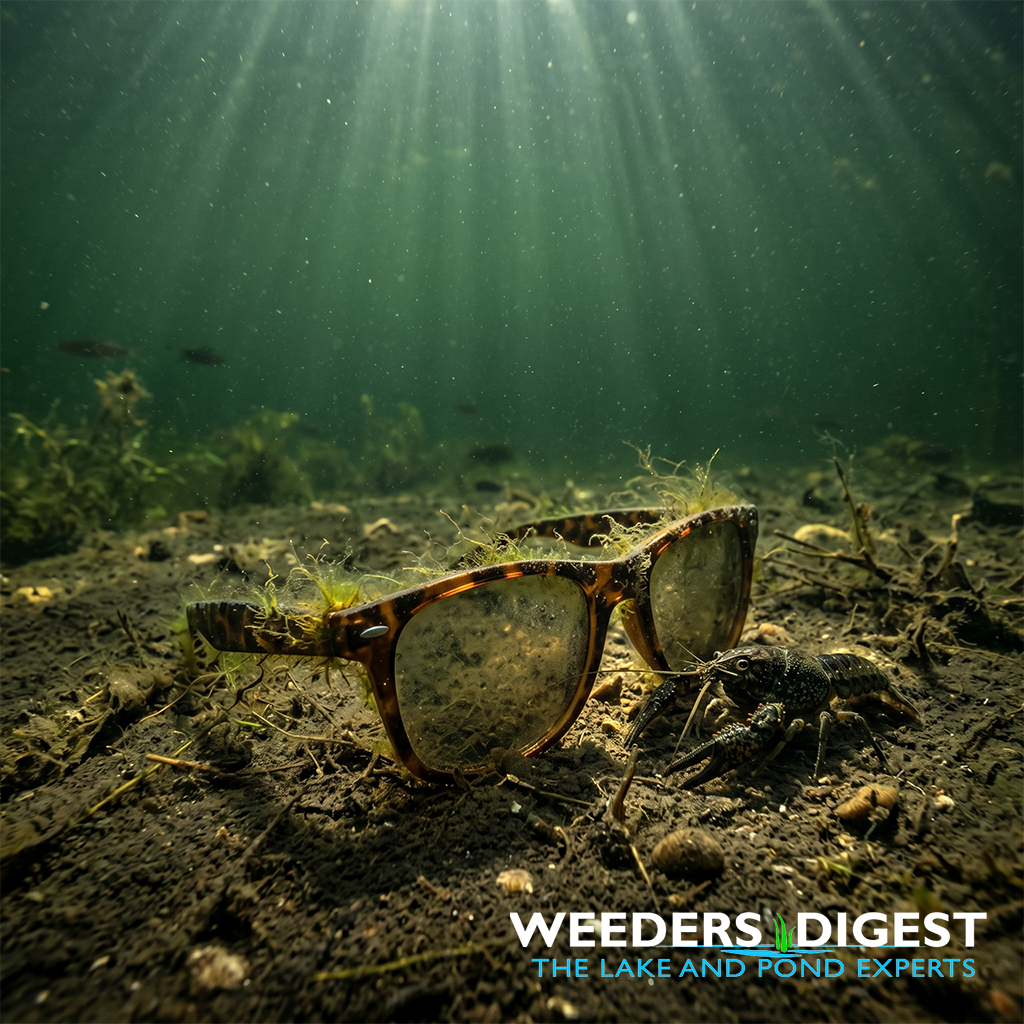
Because most modern sunglasses are made of complex plastics and treated metals, they don't simply "go away." Instead, they become tiny artificial reefs. In the short term, they might offer a hiding spot for a small crayfish or a surface for algae to grow. Over years and decades, they aren't dissolving; they are simply being buried by layers of falling sediment and organic debris, effectively becoming part of the lake’s geological record.
However, "out of sight" does not mean "out of the ecosystem." While you might mourn the cost of the replacement, the lake has to deal with the slow breakdown of the materials. From the peeling of UV-protective coatings to the eventual weakening of the plastic frames, your lost shades are undergoing a slow-motion chemical breakdown that can span centuries.
The Science Behind It:
The fate of eyewear in lentic ecosystems is governed by the principles of polymer degradation and sedimentation rates. Most contemporary sunglasses are composed of cellulose acetate, polycarbonate, or nylon-based polymers, which are engineered for high durability and resistance to environmental stressors. According to research on microplastic persistence in freshwater systems, these synthetic polymers do not biodegrade in the traditional sense; rather, they undergo photo-degradation and mechanical weathering. In the aphotic zone of a deep lake, where UV radiation is absent and temperatures remain stable and low, the rate of chemical breakdown is significantly retarded.
As the eyewear rests on the benthic surface, it undergoes a process known as biofouling. Periphyton—a complex mixture of algae, cyanobacteria, and heterotrophic microbes—colonizes the frames and lenses. This biological film creates a localized microenvironment that can either shield the plastic from further degradation or, in some cases, facilitate the slow leaching of chemical additives. Studies published in journals such as Environmental Science & Technology indicate that plasticizers like phthalates and UV stabilizers used in manufacturing can slowly desorb from the polymer matrix into the surrounding pore water of the sediment.
Over longer temporal scales, the physical burial of the object becomes the primary driver of its "disappearance." Sedimentation rates in inland lakes vary significantly based on trophic status and watershed activity, but generally, a steady accumulation of autochthonous and allochthonous organic matter encapsulates the sunglasses. Once buried in the anaerobic (oxygen-poor) layers of the substrate, the lack of microbial activity and light effectively "mummifies" the object. This ensures that the plastic components remain structurally intact for hundreds of years, contributing to the "plasticene" layer of the global stratigraphic record.
Furthermore, the metallic components, such as hinges and screws—often made of stainless steel or nickel alloys—undergo slow oxidation. In freshwater environments, this corrosion is relatively sluggish compared to marine settings, but it eventually leads to the structural failure of the frame. The lenses, particularly if made of CR-39 or polycarbonate, may eventually succumb to "crazing," where internal stresses cause a network of fine cracks. However, even as the object loses its macro-form, the persistent polymer fragments remain within the sediment, posing long-term risks as secondary microplastics that can be ingested by benthic macroinvertebrates.