

Hidden Springs: How My Lake Stays Full Without a Single Stream
 |

Summary:
Have you ever looked at a pristine lake tucked away in the woods or sitting in your own backyard and wondered how it stays so full despite having no visible rivers or streams feeding into it? It can feel a bit like magic, watching water levels remain steady even during a dry spell. While we often think of lakes as basins filled by rain or runoff, many of them are actually windows into a massive, hidden world of water moving beneath our feet.
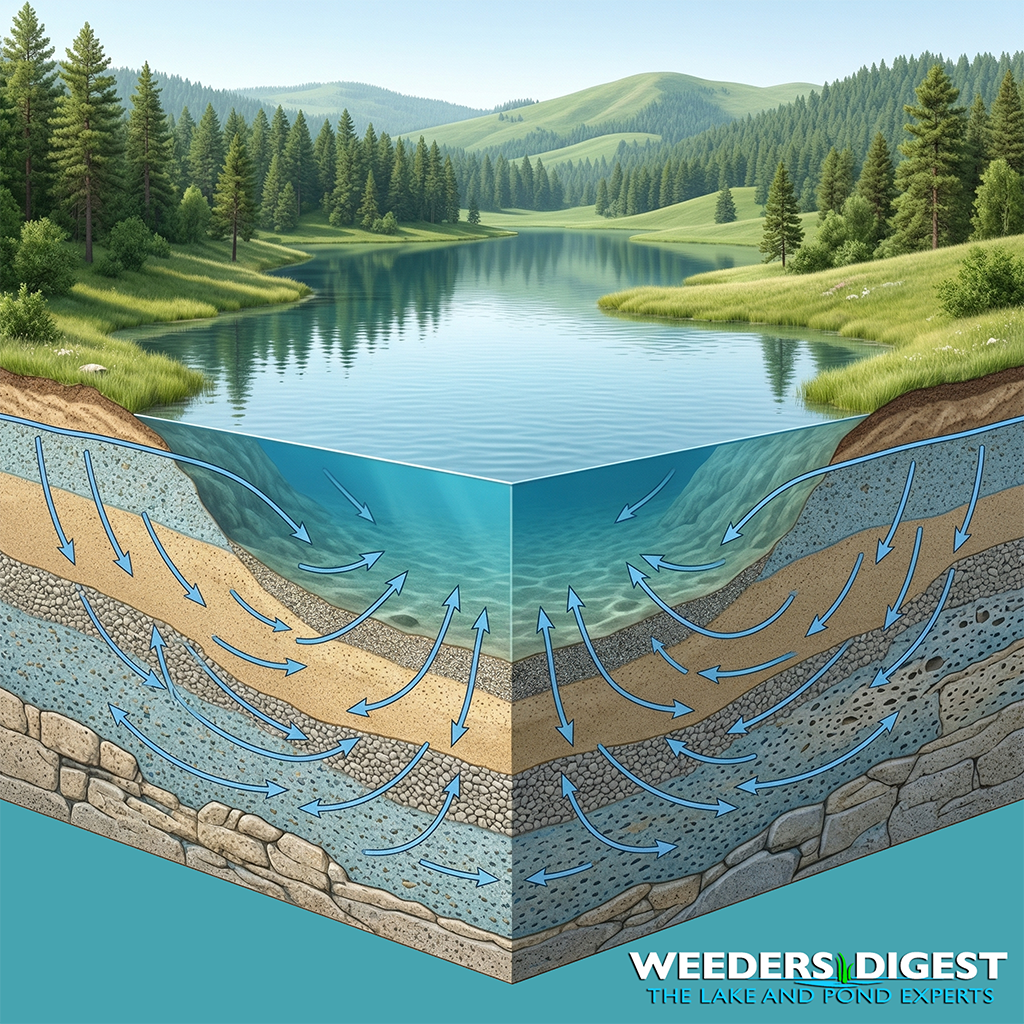
In these cases, your lake is likely connected to an underground aquifer. Think of an aquifer not as an underground cavern of water, but more like a giant, water-soaked sponge made of sand, gravel, or porous rock. When the water table—the upper level of this underground saturation—is higher than the bottom of your lake basin, the water naturally pushes upward and inward through the lake bed. This process is often so subtle and distributed across the bottom that you’ll never see a bubbling spring or a rushing current.
These "seepage lakes" are incredible natural filters. Because the water has traveled through layers of earth before reaching the surface, it is often clearer and cooler than water found in drainage lakes. However, this also means the lake is deeply "married" to the groundwater around it; if the local water table drops due to drought or excessive well pumping, the lake level will mirror that drop almost immediately.
Understanding this connection helps us appreciate that a lake isn't just a surface feature—it’s the visible tip of a much larger hydrological iceberg. By protecting the land and groundwater for miles around a lake, we are directly protecting the health and volume of the water we see and enjoy every day.
The Science Behind It:
The phenomenon of a lake being replenished by an aquifer without surface inflows is classified in limnology as a "seepage lake" or a "groundwater-dominated system." According to the United States Geological Survey (USGS), the interaction between groundwater and surface water is governed by the hydraulic gradient and the hydraulic conductivity of the geological medium. In these systems, the lake basin intersects the local or regional water table. When the hydraulic head of the surrounding aquifer is higher than the stage (elevation) of the lake surface, groundwater discharges through the benthic zone into the water column.
The physical movement of this water follows Darcy's Law, which states that the flow rate through a porous medium is proportional to the hydraulic gradient. Mathematically, this is expressed as:
Q = -KA (dh/dl)
Where Q is the flow rate, K is the hydraulic conductivity, A is the cross-sectional area, and dh/dl represents the hydraulic gradient. In many glacial kettle lakes, the substrate consists of high-permeability materials like glaciofluvial sand and gravel, which allow for significant volumetric exchange between the aquifer and the lake. Research published by the University of Wisconsin-Extension notes that seepage lakes typically have long hydraulic residence times because they lack the rapid flushing provided by surface inlets and outlets, making their chemistry highly dependent on the mineralogy of the aquifer.
Furthermore, the spatial distribution of groundwater inflow is rarely uniform. Most seepage occurs near the shoreline in the littoral zone, where the pressure differential between the aquifer and the lake is most pronounced. As depth increases, the rate of inflow typically decreases exponentially. This subsurface influx provides a stable thermal regime, as groundwater remains at a relatively constant temperature year-round, often creating "cold-water refugia" for stenothermic fish species during peak summer temperatures.
Chemical signatures also differentiate these lakes from drainage systems. Because the water undergoes extensive subsurface filtration and ion exchange with soil particles, it often carries higher concentrations of dissolved minerals such as calcium and magnesium, depending on the lithology of the aquifer. Conversely, they may have lower concentrations of phosphorus and suspended solids compared to lakes fed by agricultural runoff. The delicate balance of a seepage lake is maintained by the equilibrium between groundwater inflow, direct precipitation, and losses through evaporation and down-gradient groundwater recharge.