

How Long Will My Galvanized Steel Boat Lift Actually Last Underwater?
 |

Summary:
When you invest in a boat lift, you are essentially buying peace of mind for your watercraft, but the clock starts ticking the moment that galvanized steel hits the water. I often get asked by concerned lakefront owners if their lift is a "lifetime" purchase. The short answer is that while galvanized steel is incredibly rugged, it isn't immortal. Depending on your specific lake environment, you can generally expect a high-quality galvanized lift to remain structural for 15 to 25 years, though its aesthetic "silver" finish will vanish much sooner.
The longevity of your lift depends almost entirely on the water chemistry of your specific shoreline. In many freshwater lakes, the protective zinc coating wears down slowly, giving you decades of use. However, if your lake has high mineral content, fluctuating pH levels, or significant runoff, that lifespan can be cut short. It is a slow-motion chemical battle happening right under your dock, and understanding that process is the best way to protect your investment.
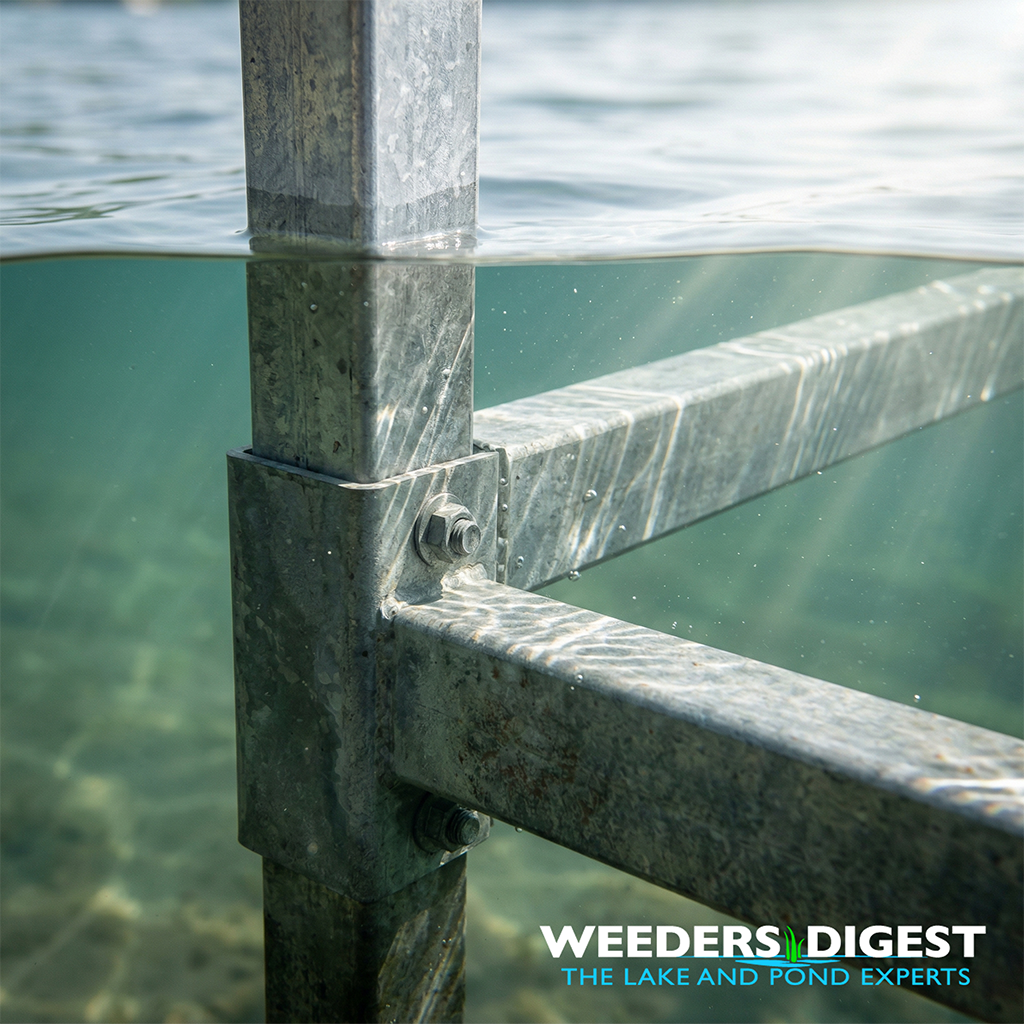
If you start seeing "white rust" or small flecks of orange-brown on the frame, your lift is telling you a story about its remaining years. While it won't collapse overnight, these are the signs that the sacrificial protection is exhausted. Keeping a close eye on the waterline and the submerged bracing is the difference between a simple maintenance fix and a total structural failure a decade down the line.
The Science Behind It:
The durability of submerged galvanized steel is dictated by the principles of galvanic protection and the formation of a passive film known as the zinc carbonate patina. Hot-dip galvanizing involves immersing steel in molten zinc, creating a series of zinc-iron alloy layers topped with pure zinc. According to research from the American Galvanizers Association, the corrosion rate of zinc in still freshwater is significantly lower than in moving or aerated water, primarily because the zinc reacts with dissolved oxygen and water to form zinc hydroxide, which further reacts with carbon dioxide to create a stable, insoluble layer of zinc carbonate.
The primary mechanism of failure in submerged environments is the depletion of this sacrificial anode layer. In the electrochemical hierarchy, zinc is more electronegative than steel. Consequently, when the coating is scratched or naturally thins, the zinc corrodes preferentially to protect the underlying iron (Fe). Data from university studies on aquatic infrastructure indicate that in "soft" freshwater—which lacks protective scale-forming minerals like calcium—the zinc layer can erode at a rate of 2 to 5 micrometers per year. Conversely, in "hard" water, the deposition of calcium carbonate scales can actually supplement the zinc patina, potentially extending the lifespan of the submerged members.
Water chemistry parameters such as pH and dissolved oxygen (DO) levels are the critical variables in this equation. Most galvanized coatings are stable within a pH range of 6 to 12. If a lake environment experiences seasonal acidification or is naturally boggy with high tannin concentrations (low pH), the zinc carbonate patina becomes soluble and dissolves, exposing the raw steel to rapid oxidation. Furthermore, the "splash zone"—the area at the waterline where the steel is frequently wet and dry—experiences the highest rate of corrosion due to the constant availability of atmospheric oxygen to fuel the oxidation-reduction reaction.
Structural integrity is generally maintained until the zinc coating is entirely consumed, at which point the base steel begins to form hydrated iron oxide, commonly known as red rust. Unlike the compact zinc patina, iron oxide is porous and expansive, leading to "pitting" and a reduction in the cross-sectional area of the boat lift's structural tubing or C-channels. Research published in the Journal of Marine Science and Engineering emphasizes that once pitting corrosion initiates in submerged steel, the rate of structural degradation increases exponentially, eventually compromising the load-bearing capacity required to safely hoist a watercraft.