

How Your Lake’s Hidden Currents Are Moving My Weed Problem Around
 |

Summary:
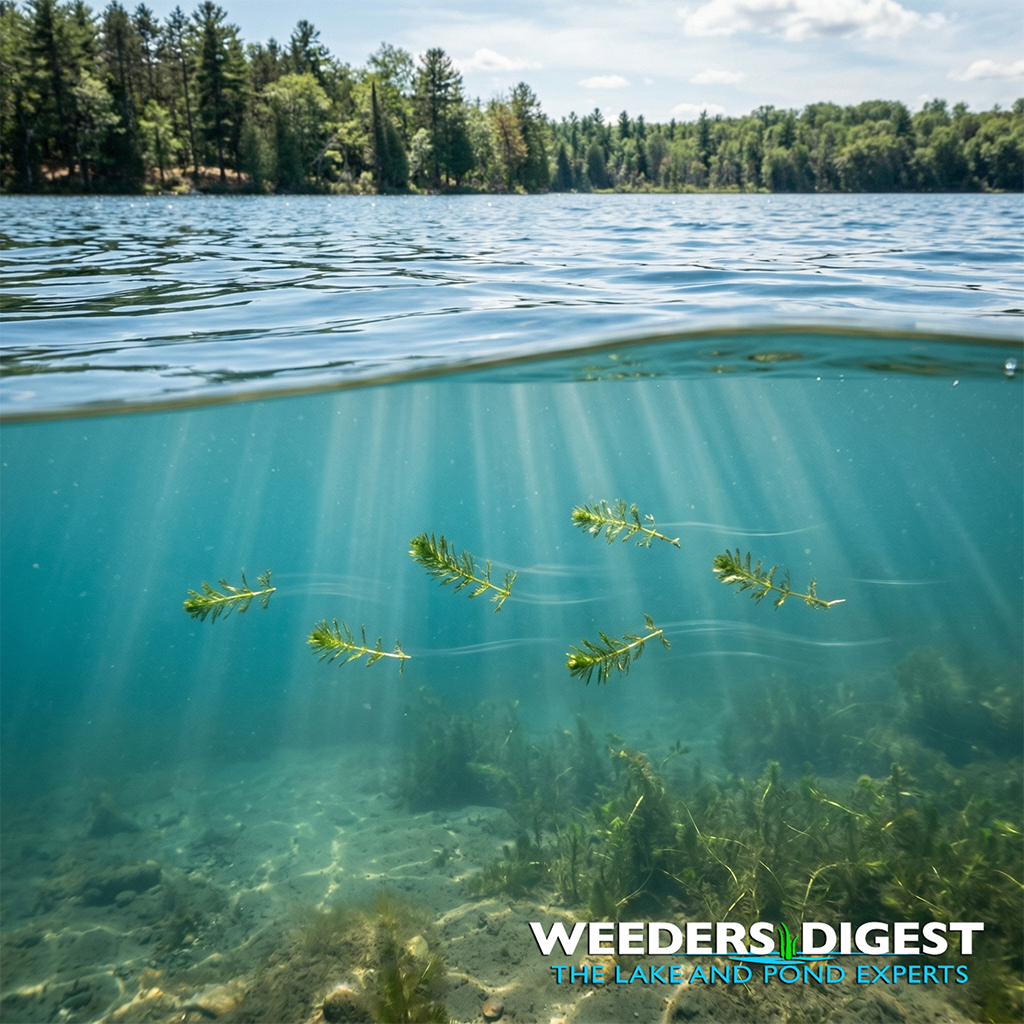
If you have ever cleared a patch of weeds from your dock only to find a new cluster appearing across the bay a few days later, you are witnessing the power of underwater lake currents. Most people think of lakes as still bodies of water, but they are actually dynamic systems with internal "rivers" that never stop moving. When aquatic plants like Eurasian Watermilfoil are broken apart by boat propellers, waves, or even hungry waterfowl, those tiny fragments don't just sink; they become passengers on these invisible underwater highways.
These fragments are remarkably buoyant and can travel surprising distances. Because many invasive species are designed to grow from just a single small piece—a process called vegetative fragmentation—these currents act as a delivery service for new infestations. A single afternoon of high wind or heavy boat traffic can scatter fragments throughout an entire basin, allowing weeds to "leapfrog" from one shoreline to another without any human help.
Understanding how these currents work is the first step in realizing why lake management is such a community-wide effort. You might be meticulously cleaning your own shoreline, but if the wind and water are moving toward your property, you are at the mercy of the fragments drifting in from elsewhere. It is a constant cycle of movement driven by temperature, wind, and the very shape of the lake bottom.
The Science Behind It:
The transport of aquatic macrophyte fragments is primarily dictated by three-dimensional hydrodynamic patterns, specifically wind-induced surface drift and the resulting return currents. When wind blows across the surface of a lake, it initiates a shear stress that moves the upper layer of the water column. According to research published in Freshwater Biology, these surface currents typically move at approximately 2-3% of the wind speed. This movement creates a "conveyor belt" effect where buoyant vegetative fragments are pushed toward the leeward shore, often accumulating in "dead zones" or sheltered embayments.
Beneath the surface, the mechanics become more complex due to thermal stratification and the metalimnetic gradient. As surface water is pushed toward one shore, it piles up, creating a pressure gradient that forces water downward and back across the lake bottom or along the thermocline. This is known as a return current or "undercurrent." Fragments that lose buoyancy or become entrained in turbulent eddies can be transported in the opposite direction of the surface wind. Research by Kim et al. (2022) indicates that the settling velocity of fragments, such as those from Myriophyllum spicatum, is low enough that they can remain suspended in the water column for several days, traveling kilometers from their point of origin.
The morphology of the lake basin also plays a critical role in fragment dispersal through the creation of gyres and longshore currents. In large lakes, the Coriolis effect and the shape of the shoreline can cause water to circulate in large, circular patterns. These gyres act as centrifugal traps, concentrating floating biomass and fragments in specific areas of the lake while keeping other areas relatively clear. This explains why certain shorelines consistently experience "weed drift" regardless of local growth patterns. The physical interaction between the moving water and the lake's bathymetry creates localized velocity increases, ensuring that fragments are not just drifting, but are actively being funneled into new habitats.
Furthermore, the survival and successful colonization of these transported fragments are supported by the physiological resilience of invasive macrophytes. Studies in the Journal of Aquatic Plant Management have shown that fragments can survive for extended periods while in transport, often developing adventitious roots mid-drift. By the time a current deposits a fragment into a shallow, nutrient-rich littoral zone, the plant is already prepared to anchor itself. This synergy between lake hydrodynamics and plant biology facilitates the rapid expansion of invasive populations across fragmented habitats.
Sources / References:
- Journal of Aquatic Plant Management: https://www.apms.org/japm/
- University of Minnesota Extension - Aquatic Invasive Species: https://extension.umn.edu/identify-invasive-species/aquatic-invasive-species