

How Your Watershed Holds the Key to My Shoreline’s Secret Health
 |

Summary:
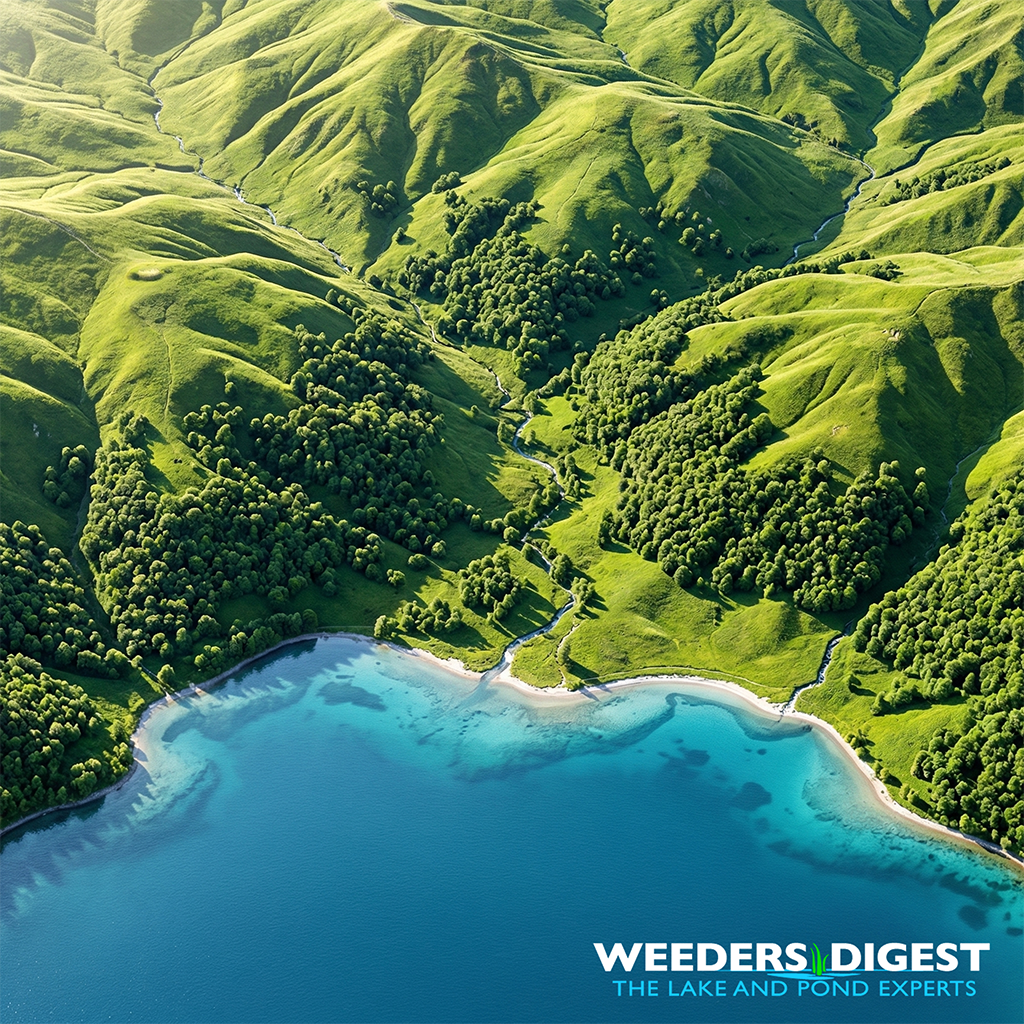
Imagine your property as a small piece of a giant funnel. Whenever it rains or snows, that water doesn't just sit there; it follows the tilts and curves of the land, eventually draining into a common body of water like your local lake or pond. This entire area of land that catches the water and directs it toward a single exit point is what we call a watershed. Everything that happens within this "funnel"—from the fertilizer you put on your lawn to the way your neighbor’s driveway is paved—directly influences the water quality at your shoreline.
Because water is the ultimate traveler, it picks up a little bit of everything it touches along the way. If the land in your watershed is covered in lush, natural vegetation, the plants act like a filter, cleaning the water before it reaches the lake. However, if the watershed is filled with hard surfaces like rooftops and roads, the water moves much faster and carries more pollutants. This means your shoreline health isn't just about what you do on your own beach; it’s a reflection of the entire landscape surrounding you.
Understanding your watershed helps you realize why certain issues, like sudden algae blooms or murky water, might be happening. It’s not always a local problem; often, it’s the result of "upstream" activities accumulating at your water's edge. By looking at the bigger picture, you can better manage your own property to help protect the clarity and biology of the water you love. It turns the management of a single shoreline into a community-wide effort to keep the ecosystem thriving.
The Science Behind It:
A watershed, or drainage basin, is a topographically defined area where all surface water and groundwater flow to a common outlet. This hydrological unit is governed by the laws of gravity and the geological composition of the basin. According to research from the University of Minnesota Extension, the relationship between a watershed and its receiving water body is foundational to limnology. The "watershed-to-lake ratio" is a critical metric; lakes with larger watersheds typically receive a higher volume of nutrient loading and sediment than those with smaller drainage areas. This ratio dictates the baseline trophic state of the water body, influencing whether a lake remains oligotrophic or trends toward eutrophy.
The health of a shoreline is primarily dictated by the "loading" of non-point source pollutants, which include nitrogen, phosphorus, and suspended solids. As water traverses the watershed, it interacts with various land-use types. In undisturbed ecosystems, the soil and rhizosphere of native plants facilitate infiltration and bioremediation. However, anthropogenic modifications increase "impermeable surface cover." High levels of such cover lead to increased peak flow rates during storm events, resulting in shoreline erosion and the transport of dissolved nutrients. These nutrients, particularly phosphorus, are the primary limiting factors for primary production in freshwater systems.
When an excess of nutrients reaches the littoral zone—the shallow area near the shoreline—it triggers accelerated primary productivity. This often manifests as harmful algal blooms (HABs) or the overgrowth of invasive macrophytes. Scientific data from the Environmental Protection Agency (EPA) emphasizes that the "riparian buffer," or the strip of land immediately adjacent to the water, acts as the last line of defense. A degraded watershed diminishes the capacity of this buffer to process pollutants, leading to a decline in dissolved oxygen levels as organic matter decomposes on the lake bottom.
Furthermore, the chemical signature of a shoreline’s water is a direct reflection of the watershed's mineralogy and land management practices. For instance, watersheds with heavy agricultural or urban development often show higher conductivity and altered pH levels. These chemical shifts can disrupt the life cycles of macroinvertebrates and fish species that rely on specific water quality parameters for spawning. Therefore, the management of a shoreline cannot be performed in isolation; it requires a comprehensive understanding of the hydrological and chemical inputs derived from the entire basin.
Sources / References:
- University of Minnesota Extension: https://extension.umn.edu/shoreland-owners/watersheds
- Environmental Protection Agency (EPA): https://www.epa.gov/hwp/basic-information-and-answers-to-frequent-questions