


Is My Lake Getting a Clean Slate? The Truth About Heavy Rain and Water Quality
 |

Summary:
When you see a massive rainstorm drenching your property, it is natural to think of it as a giant bathtub faucet being left on. You might imagine that all that fresh rainwater is pushing out the old, stagnant water and "flushing" your pond or lake clean. In your mind’s eye, the murky water is being replaced by pristine, clear runoff, essentially hitting the reset button on your ecosystem’s health.
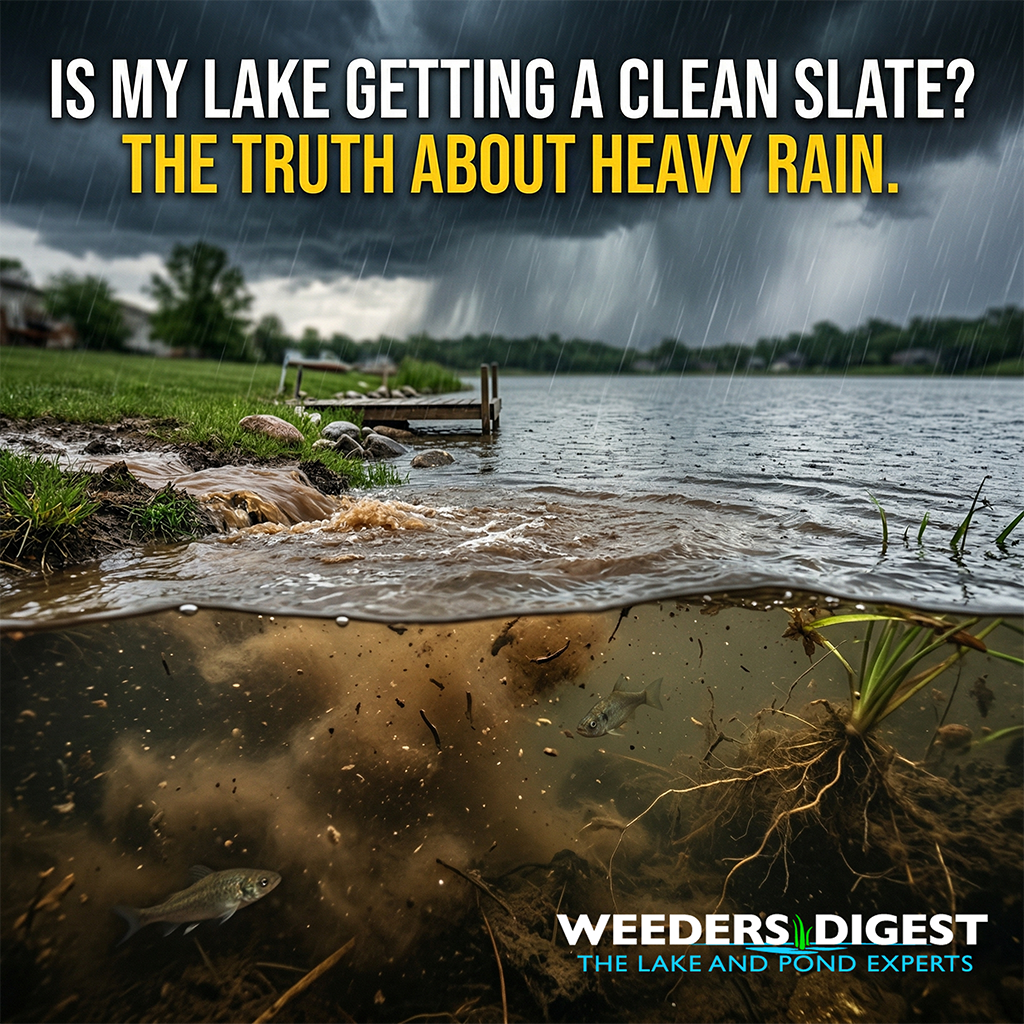
However, the reality of what happens beneath the surface is often the exact opposite of a spring cleaning. While a significant volume of water does move through the system, it rarely leaves the lake "cleaner" than it found it. Instead of just moving water out, heavy rain acts like a giant vacuum for the surrounding landscape, sucking up everything from loose soil and lawn fertilizers to organic debris and pet waste, then depositing it all directly into your basin.
Instead of a refreshing rinse, your lake is often dealing with a massive "nutrient dump." This influx of nitrogen and phosphorus can actually trigger the very problems you were hoping the rain would wash away, such as sudden algae blooms or murky, turbid water. While the water level might be higher, the chemistry of the lake is often under more stress than it was during a dry spell.
Understanding this process helps you manage your expectations after a storm. Rather than a "flush," it is better to think of heavy rain as a "refill" that comes with a heavy price tag of external pollutants. Managing the land around your water—your watershed—is the only real way to ensure that when the clouds open up, your lake stays as healthy as possible.
The Science Behind It:
The phenomenon of "flushing" is technically referred to in limnology as the hydraulic residence time (HRT), which is the calculated amount of time required for a total volume of water to flow through a lake basin. While a shortened HRT during high-flow events can physically displace a portion of the existing water column, the qualitative impact on the ecosystem is governed by the loading of Total Suspended Solids (TSS) and dissolved nutrients. Research published in Water Resources Research indicates that extreme precipitation events often lead to "pulse loading," where a disproportionate percentage of a lake's annual phosphorus budget is delivered in a single 24-to-48-hour window.
This process is exacerbated by the "first flush" effect, a concept frequently cited in urban and agricultural hydrology. During the initial period of a rain event, the concentration of pollutants in the runoff is significantly higher as the water scours the terrestrial environment. According to studies from the Journal of Environmental Quality, this runoff carries high concentrations of bioavailable orthophosphates and nitrates. Rather than improving clarity, these nutrients stimulate the rapid growth of phytoplankton and cyanobacteria, potentially leading to harmful algal blooms (HABs) shortly after the "flushing" event has concluded.
Furthermore, heavy rainfall disrupts the thermal stratification of a lake. In many small lakes, the water is separated into layers based on temperature and density. A massive influx of cooler, oxygen-rich rainwater can cause "entrainment," where the layers mix violently. While this can temporarily introduce oxygen to the bottom (the hypolimnion), it also kicks up legacy phosphorus stored in the bottom sediments—a process known as internal loading. A study by the University of Wisconsin-Madison suggests that this internal recycling, triggered by storm-induced turbulence, can be just as damaging to water quality as external runoff.
Finally, the physical displacement of water does not equate to the removal of microscopic stressors. While some free-floating algae might be pushed over a spillway, the influx of sediment increases turbidity, which limits light penetration and can stress submerged aquatic vegetation (SAV). The loss of these beneficial plants, which act as natural filters, further destabilizes the ecosystem. Therefore, the scientific consensus is that unless the incoming water source is significantly more oligotrophic (nutrient-poor) than the receiving body, heavy rainfall acts as a vector for degradation rather than a mechanism for purification.
Sources / References:
- https://agupubs.onlinelibrary.wiley.com/journal/19447973 (Water Resources Research)
- https://dl.sciencesocieties.org/publications/jeq (Journal of Environmental Quality)