

Is My Lake Water Safe? How to Tell Harmless Green Algae from Toxic Blue-Green Algae
 |

Summary:
If you own a pond or spend time by a lake, seeing a sudden burst of green growth on the water can be alarming. It is easy to assume that any green "scum" is a sign of a dying ecosystem, but not all green growth is created equal. Most of the time, what you are seeing is common green algae. This is a natural part of the food chain that provides oxygen and food for fish and other aquatic life. While it might look messy or feel slimy when you're swimming, it is generally harmless to humans and pets.
On the other hand, there is a much more serious visitor known as blue-green algae. Despite the name, these are actually bacteria called Cyanobacteria. Unlike true algae, these organisms can produce potent toxins that are dangerous if swallowed or even touched. Identifying the difference is crucial because while green algae might just be a nuisance that ruins your view, blue-green algae can be a significant health risk to your family and your dogs.
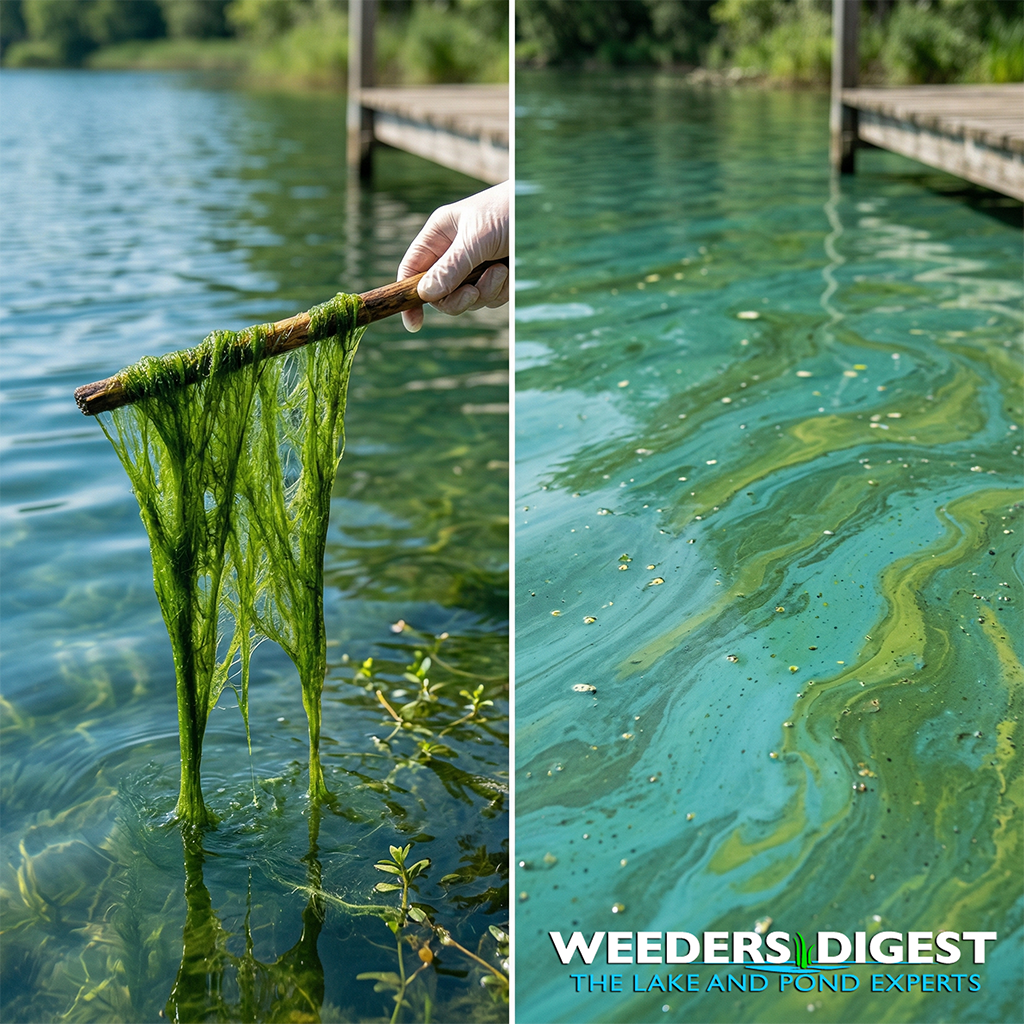
Learning to distinguish between the two involves looking at the texture and behavior of the growth. True green algae often look like floating mats of hair, wet silk, or submerged moss. It has a physical structure you can often pick up with a stick. Blue-green algae, however, usually looks like spilled paint, pea soup, or tiny floating specks. It doesn't have a "stringy" feel and often looks like it has been stirred directly into the water column.
Understanding these differences is the first step in responsible lake management. By knowing what is living in your water, you can make informed decisions about when it is safe to dive in and when it is time to keep the kids and pets on the shore.
The Science Behind It:
The fundamental distinction between these organisms lies in their evolutionary biology and cellular structure. Green algae belong to the kingdom Plantae or Protista and are eukaryotic organisms, meaning they possess a membrane-bound nucleus and chloroplasts. They utilize chlorophyll $a$ and $b$ for photosynthesis, which typically results in a grass-green or lime-green pigmentation. According to research from the University of Florida's IFAS Extension, green algae are primary producers that form the base of the aquatic food web, converting solar energy into organic compounds that support zooplankton and fish populations.
In contrast, blue-green algae are actually Cyanobacteria, a phylum of photosynthetic bacteria. As prokaryotes, they lack a nucleus and utilize specialized pigments called phycobiliproteins, specifically phycocyanin, to capture light energy. This pigment gives them their characteristic blue-green or "cyan" hue. A defining characteristic of many Cyanobacteria species, such as Microcystis or Anabaena, is the presence of gas vesicles. These internal structures allow the bacteria to regulate their buoyancy, moving up and down the water column to find optimal light and nutrient levels. This mechanism often leads to the formation of surface scums when the bacteria aggregate at the interface of the water and atmosphere.
The primary concern regarding Cyanobacteria is their ability to produce cyanotoxins, including microcystins, cylindrospermopsins, and anatoxins. These secondary metabolites are categorized as hepatotoxins (affecting the liver), neurotoxins (affecting the nervous system), or dermatotoxins (affecting the skin). Research published in Harmful Algae indicates that these toxins are often released into the water column during cell lysis—the breaking down of the bacterial cell wall—which can occur naturally as the bloom dies off or following the application of certain algaecides. Green algae do not produce these types of toxins, though excessive growth can still lead to secondary issues like dissolved oxygen depletion during decomposition.
Diagnostic physical tests are often employed by limnologists to differentiate the two in the field. The "stick test" is a common qualitative measure; filamentous green algae will typically drape over a stick like wet hair or fabric due to their cellular wall structure. Cyanobacteria, lacking this structural connectivity, will simply break apart or appear as a "slick" on the stick, much like wet paint. Furthermore, the "jar test" can reveal buoyancy differences; Cyanobacteria will often float to the surface over several hours due to their gas vesicles, while true green algae are more likely to settle at the bottom of the container.