

Can You Burn Gathered Shoreline Weeds and Brush Without Polluting Your Water?
 |

Summary:
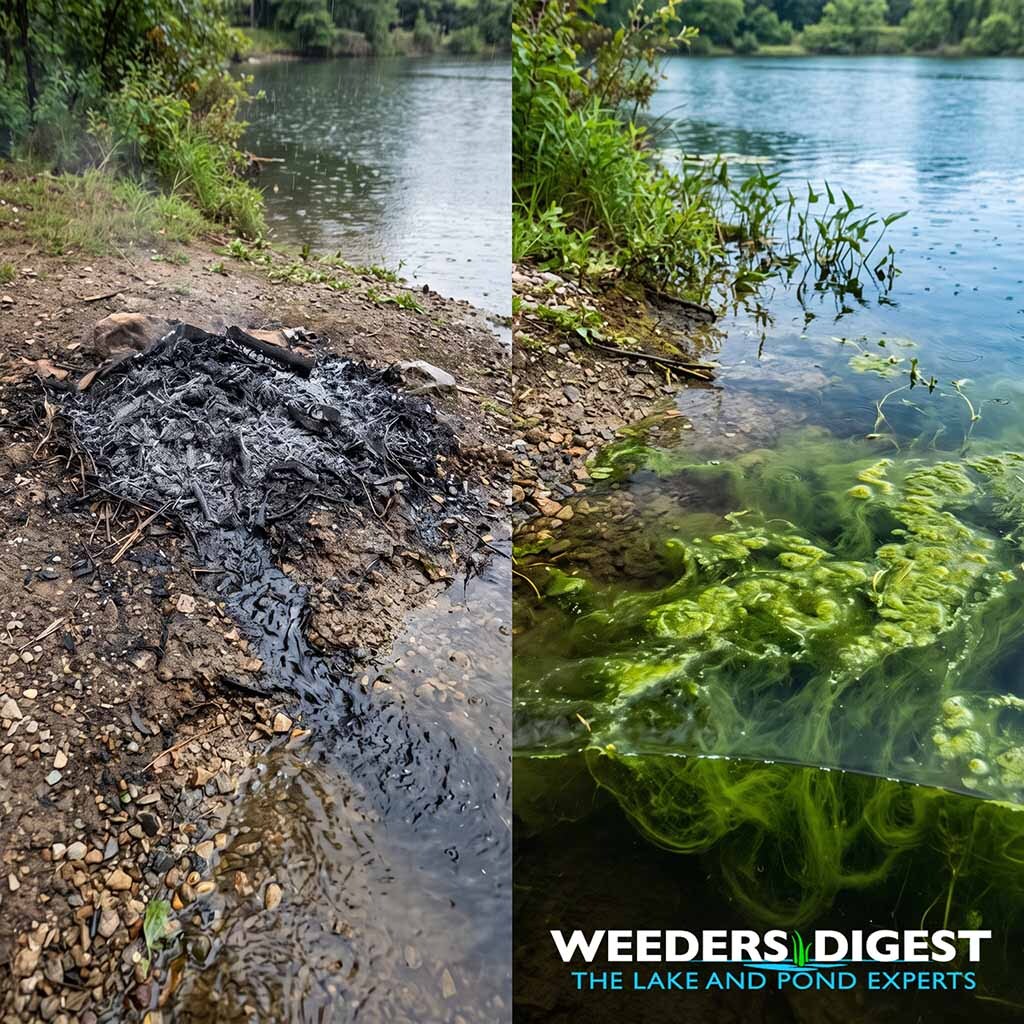
No, you cannot burn gathered shoreline weeds and brush near your pond without causing localized water pollution and rapid nutrient enrichment. While combustion quickly disposes of wet, bulky vegetation, it concentrates massive quantities of bioavailable phosphorus, potassium, and carbonates into fine, water-soluble ash. Wind gusts, precipitation, and shoreline sheet runoff routinely transport this loose residual material directly into the water column. When residual ash enters a pond, it bypasses the slow breakdown cycle of plant matter, delivering an immediate bioavailable fertilizer shock that feeds nuisance filamentous algae and triggers sudden, severe water quality shifts.
Our pond experts routinely walk properties where well-meaning owners raked bushels of milfoil, coontail, or shoreline cattails into a neat pile right at the water’s edge, set it ablaze, and wondered why a neon-green pea-soup bloom exploded directly off their beach two weeks later. When examining the nearshore substrate at these sites, we frequently observe dark, alkaline carbon residues settled into the sand, actively leaching pure elemental nutrients into the shallow littoral zone. Eliminating weeds by fire on your bank does not eliminate their nutrients; it simply converts them into an instant-release fertilizer that runs straight back into your pond.
The Science Behind It:
Aquatic macrophytes and riparian brush act as immense biological sponges that assimilate nitrogen, orthophosphate, and essential minerals directly from the water and bottom sediment. When plant matter dries and undergoes combustion, volatile elements like nitrogen gasify and disperse into the atmosphere, but non-volatile minerals remain behind in an intensely concentrated state. Research compiled by the University of Minnesota Sea Grant program highlights that phosphorus becomes heavily concentrated in combustion ash at approximately 1.2% of its total weight. Burning an equivalent volume of vegetative biomass can deposit significant pounds of elemental phosphorus into the ash bed—an element so biologically potent in freshwater that a single pound of phosphorus can fuel up to 500 pounds of wet algae growth.
Beyond total nutrient loading, the speed of nutrient delivery is fundamentally accelerated. Under normal ecological scenarios, dead organic plant material undergoes microbial decomposition, releasing minerals across months or years. However, empirical findings published in Agronomy on ash nutrient dynamics demonstrate that plant and bio-waste ashes release more than 50% of their total phosphorus within the first 5 to 10 days of moisture exposure. The moment rainwater strikes an unmanaged shoreline fire ring, high-potency orthophosphates rapidly leach across the surface and sub-surface soil directly into the littoral zone.
The introduction of ash also triggers severe hydrochemical alterations in pond chemistry. Wood and vegetation ash contains high concentrations of potassium carbonate, sodium oxide, and calcium oxide, which create caustic potassium hydroxide and lye compounds when introduced to moisture. According to limnological analyses by aquatic scientists, raw ash entering freshwater can spike localized water pH up to 12.0, starkly contrasting against the neutral 7.0 to 8.0 baseline typical of healthy freshwater lakes. This severe chemical swing strips the protective slime coat off juvenile sportfish, scorches delicate gill tissue, and causes zooplankton mortality, simultaneously eliminating the microscopic filter feeders that hold suspended algae in check.
Additionally, fine residual ash consists of particulate carbon and trace heavy metals that degrade physical habitat. Once washed offshore, suspended ash settles over native gravel and sand spawning beds, smothering benthic macroinvertebrates and suffocating fish eggs. Because ash is exceptionally light and fine, it easily stays suspended in the epilimnion (upper water layer), drastically diminishing water clarity and lowering the Secchi disk depth. This prolonged turbidity and alkaline nutrient bath establish the perfect ecological conditions for cyanobacteria (blue-green algae) to outcompete beneficial submerged native flora.
Our Recommendation for Managing Shoreline Weeds and Sediment:
Breaking the vegetative growth and nutrient cycle requires total physical removal from the riparian zone—never in-situ burning. Once cut or harvested from the pond, aquatic weeds must be hauled well past your watershed’s runoff gradient and integrated into upland compost piles away from storm drains and slopes.
However, harvesting weeds only treats the top of the problem; managing the nutrient-dense silt beneath them prevents future growth cycles. To eliminate the stagnant conditions that collect dead organic debris, shorelines benefit scientifically from continuous, directional water movement. Implementing targeted underwater flow via our AquaThruster Muck & Weed Blower collection creates continuous laminar velocity across the pond floor. By replicating natural river currents, these systems mechanically dislodge decomposing sediment, oxygenate the lower benthic boundary layer, and prevent loose debris and settling organic particulates from decaying into thick muck. For physical extraction of floating masses before they reach shore, pairing directional current with manual equipment from our shoreline tools catalog ensures that nutrients leave the aquatic ecosystem permanently.
Sources / References:
- University of Minnesota Sea Grant: https://seagrant.umn.edu/news-info/directors-column/fire-water-ash-are-wood-fires-harmful-lakes
- MDPI Agronomy (Phosphorus Release Dynamics from Ashes): https://www.mdpi.com/2073-4395/14/5/935
- University of Wyoming Extension (Wildfire Effects on Water Quality): https://www.uwyo.edu/barnbackyard/_files/documents/resources/wildfire2013/waterqualityerosion2013wywildfire.pdf