

How Agentic Automation Will Revolutionize Your Lake Management Action Plans
 |

Summary:
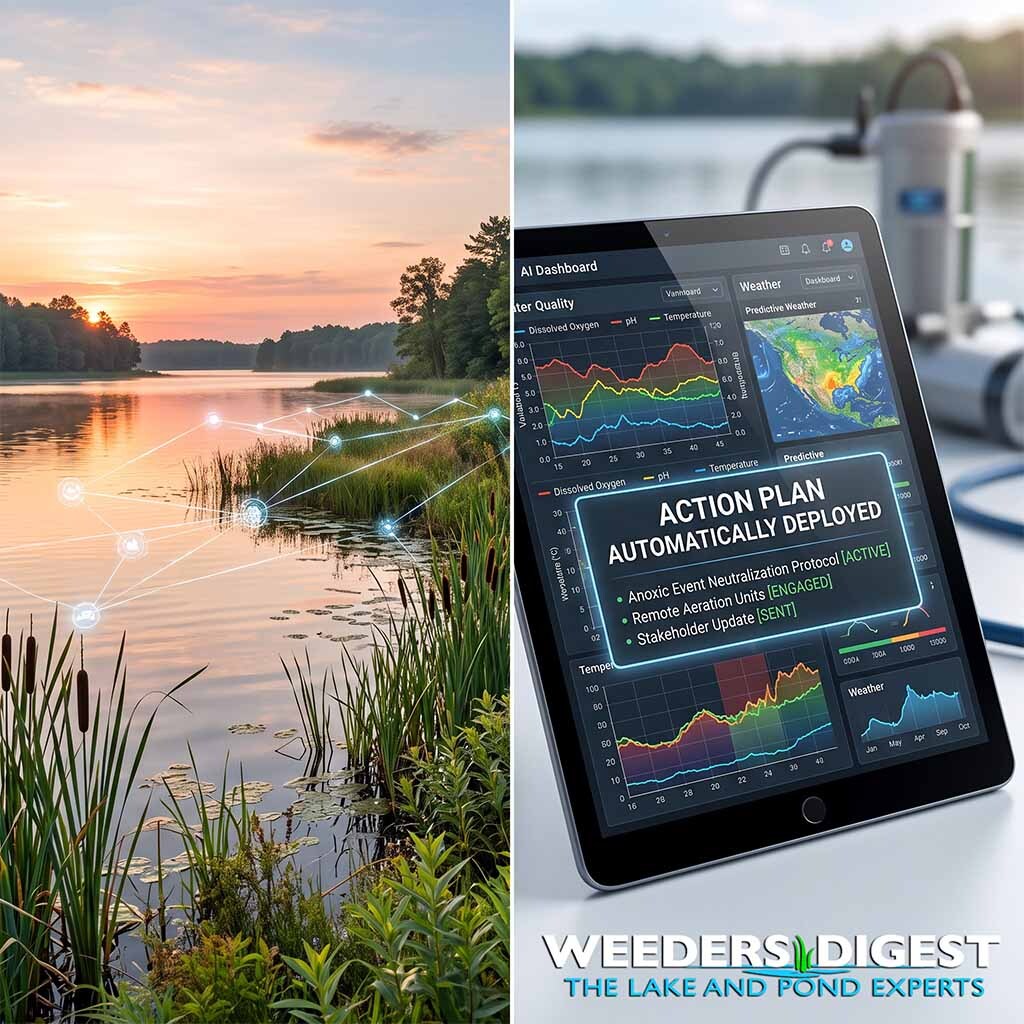
Agentic automation is the use of artificial intelligence to autonomously execute decisions, generate proactive treatment plans, and communicate alerts without human intervention, moving far beyond mere data analysis. In lake management, this shifts the paradigm from reacting to poor water conditions—like sudden algae blooms or sudden anoxic events—to predicting and neutralizing them weeks in advance. By constantly monitoring inputs from IoT (Internet of Things) water sensors and local weather patterns, these AI agents instantly draft work orders, adjust remote aeration schedules, and notify stakeholders the moment a watershed's baseline shifts.
In my experience as a Certified Lake Manager, discovering a dissolved oxygen crash at 6:00 AM usually means losing an entire morning to emergency triage, frantic field deployments, and urgent phone calls to community boards. Agentic systems eliminate this chaos by cross-referencing overnight sensor drops with historical models, automatically sending out a localized treatment mandate and community update while we are still sleeping. This technology bridges the gap between raw data collection and actionable, on-the-ground mitigation, ensuring your shorelines remain healthy with unprecedented efficiency.
The Science Behind It:
Agentic automation in aquatic ecosystems relies on integrating high-frequency telemetric sensor data with ensemble machine learning (ML) models, allowing for real-time synthesis and predictive forecasting of limnological variables. The fundamental mechanism involves deploying in-situ telemetric sensors to continuously measure physicochemical parameters such as dissolved oxygen, pH, temperature, and specific conductance. These data streams feed directly into algorithmic frameworks capable of recognizing complex, nonlinear relationships within the water column. Rather than relying on simple static thresholds, the artificial intelligence continuously trains on historical and real-time inputs to model the Lake Water Quality Index (WQI) and predict ecological shifts before biological thresholds are breached.
The predictive power of these systems is rooted in advanced ensemble learning techniques, which combine multiple decision trees to reduce model variance and improve accuracy. A 2025 study published in Water Research demonstrated the efficacy of Extreme Gradient Boosting (XGBoost) algorithms in evaluating global lake water quality. Researchers found that simplifying the ML model to rely on just three dominant predictors—dissolved oxygen, total nitrogen, and total phosphorus—preserved exceptionally high predictive accuracy with an R² value of 0.98. By streamlining the required environmental parameters, agentic AI can generate highly accurate water quality assessments at a fraction of traditional data collection costs, enabling automated, adaptive monitoring on a massive scale.
Furthermore, explainable artificial intelligence (XAI) frameworks are transforming how limnologists model and preempt Harmful Algal Blooms (HABs), which are severe proliferations of toxic cyanobacteria. A recent comparative study utilized ensemble ML models to predict chlorophyll-a concentrations, a primary proxy for algal biomass, in the Great Lakes system. The research showed that XGBoost and Deep Forest algorithms achieved superior predictive accuracy over traditional linear methods, producing R² values of 0.8517 and 0.8544, respectively. Agentic systems utilize these predictive models to autonomously trigger intervention workflows the moment the algorithm detects a high probability of bloom formation.
Crucially, the "agentic" component goes beyond mere prediction; it employs SHapley Additive exPlanations (SHAP) analysis to mathematically interpret model outputs and initiate appropriate, specific environmental responses. In the HAB study, SHAP analysis identified Particulate Organic Nitrogen, Particulate Organic Carbon, and Total Phosphorus as the critical drivers influencing imminent blooms. An agentic platform ingests this specific attribution data, identifies the precise nutrient driver of the forecasted bloom, and automatically drafts a targeted remediation protocol. This seamless transition from data ingestion to autonomous workflow generation represents a fundamental shift in how environmental managers mitigate anthropogenic impacts on freshwater ecosystems.