

How Crayfish Survive Buried Under Our Frozen Lake Beds All Winter Long
 |

Summary
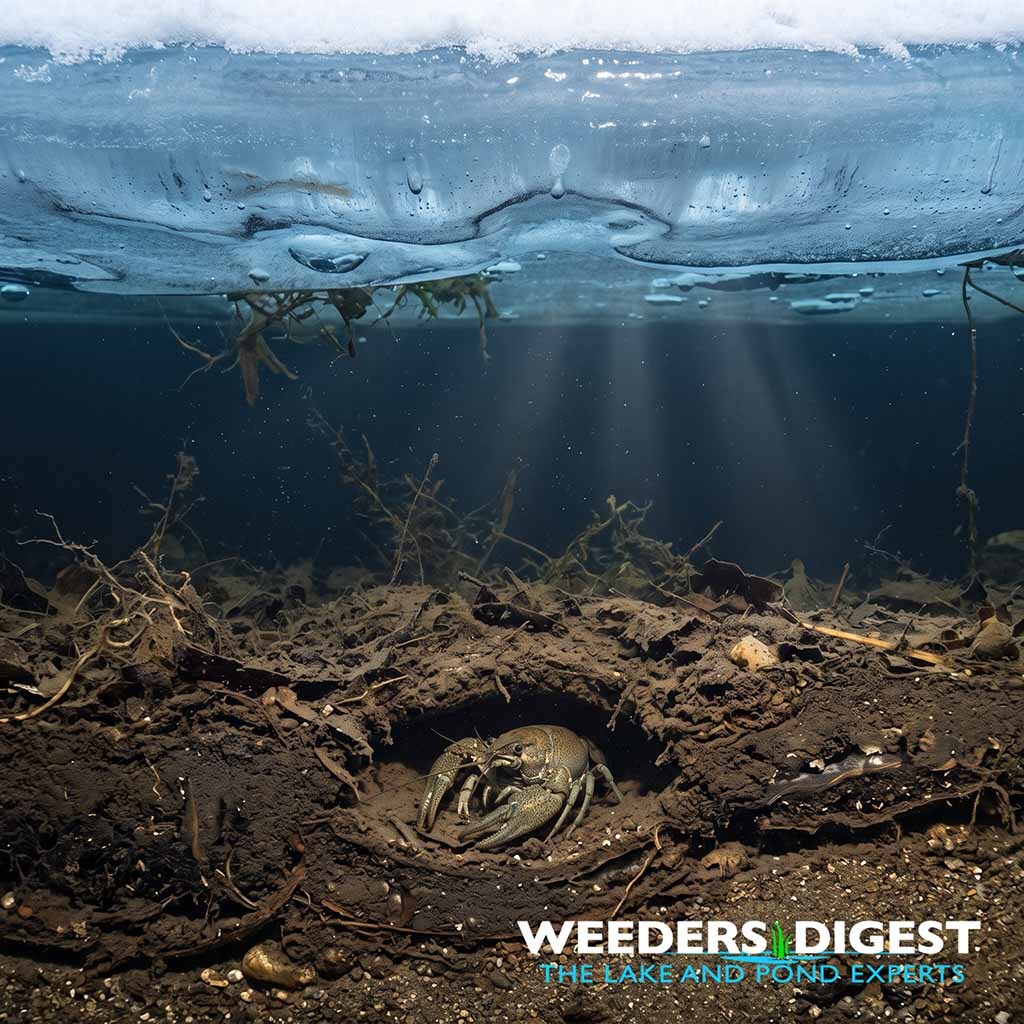
Crayfish survive beneath frozen lake beds by retreating below the frost line into organic benthic sediment or subterranean burrows and entering a metabolic state of dormancy known as torpor or quiescence. While winter turns the surface of our waters into solid sheets of ice, the lake bottom rarely freezes solid thanks to the unique thermal physics of water and the insulating properties of the ice sheet. Rather than freezing in place, crayfish escape cryogenic freezing by taking refuge in the liquid, water-saturated substrate where geothermal heat maintains temperatures slightly above 0°C (32°F).
In our field observations across northern lakes during late-fall and mid-winter dock inspections, our lake and pond experts consistently note how crayfish activity drops to zero as near-shore water temperatures slide below 10°C (50°F). While summer finds them scuttling freely across rocky shorelines and gravel beds, winter sediment core samples and underwater camera surveys reveal them tightly wedged beneath dense silt, packed into mud crevices, or tucked inside deep shoreline excavation tunnels.
Once nestled into these benthic microhabitats, crayfish drastically depress their physiological processes. Their heart rates plunge, their ventilation slows to imperceptible levels, and their cellular energy requirements dwindle to a bare minimum. Because they require so little oxygen in this resting state, they can endure long stretches of low dissolved oxygen within the mud, safely waiting out the brutal cold until the spring thaw restores warm, oxygenated circulation to the littoral zone.
The Science Behind It
The overwintering survival of freshwater decapods like crayfish is governed by a combination of inverse thermal stratification, behavioral excavation, and extreme metabolic depression. Fresh water reaches its maximum density at approximately 3.98°C (39.2°F). As surface temperatures plunge, the densest water sinks, establishing an inverted thermal gradient beneath the ice where deeper benthic zones and interstitial mud spaces remain stable between 1°C and 4°C. This thermal sanctuary prevents the mechanical and cellular destruction that would occur if intracellular water were allowed to crystallize.
To exploit this zone, crayfish rely on behavioral digging using their chelipeds and pleopods to burrow into bottom muck or littoral banks. According to research published in PLOS ONE analyzing the microhabitat ecology of crayfish shelters, flooded burrows naturally transition toward extreme hypoxia, often becoming completely anoxic within an average of 8 hours. The study established that primary and secondary burrowing crayfish species exhibit remarkable physiological adaptations to self-created anoxia, demonstrating anoxic survival rates ranging from 64% to 91% across prolonged exposures.
This capacity to endure severe oxygen depletion is driven by the Q10 temperature coefficient, which dictates that biological reaction rates fall sharply as ambient temperatures decline. Research documented in Physiological Zoology and Freshwater Crayfish indicates that at temperatures approaching 0°C to 4°C, crayfish exhibit profound metabolic depression, reducing standard oxygen consumption (MO2) by more than 70% to 80% compared to summer baselines. Concurrently, crayfish adjust the affinity of their copper-based respiratory pigment, hemocyanin, allowing efficient oxygen transport even under severely depressed partial pressures (PO2).
When dissolved oxygen in the mud drops past critical regulatory limits, crayfish switch smoothly to anaerobic glycolysis to generate ATP. Rather than accumulating unsustainable levels of toxic byproducts, their depressed winter metabolic rate produces minimal metabolic end-products, preventing metabolic acidosis. By coordinating thermal avoidance, severe respiratory bradycardia, and high anoxia tolerance, crayfish turn hostile, frozen substrates into a survivable winter refuge.
Our Recommendation for Managing Lake Bottom Silt & Muck
While burrowing into organic silt serves as a critical winter survival mechanism for native crustaceans, excessive, uncontrolled muck accumulation around docks and swimming areas creates severe ecological problems for waterfront owners. Decomposing biological debris and thick, anaerobic muck layers consume massive amounts of dissolved oxygen under the ice—a biological oxygen demand that leads to winter fish kills, toxic hydrogen sulfide off-gassing, and soft, foul-smelling lake beds each spring.
To break this cycle, shoreline ecosystems require consistent kinetic water circulation. Stationary, stagnant muck deposits thrive because wind and natural wave action cannot penetrate sheltered bays or shallow littoral margins. Scientifically, preventing fine organic sediment from consolidating requires continuous, targeted directional flow. Engineered underwater blowers displace decaying organic matter, scour away soft silt down to a firm, sandy substrate, and circulate oxygenated water throughout the water column. By introducing directional current via our AquaThruster Muck & Weed Blower collection, property owners can eliminate stagnant muck deposits and prevent benthic anoxia, restoring a healthy, clean waterfront without disrupting the broader ecological balance.
Sources / References
- Kouba, A., et al. (2024). Living on the edge: Crayfish as drivers to anoxification of their own burrows. PLOS ONE. https://pmc.ncbi.nlm.nih.gov/articles/PMC10760702/
- Reiber, C. L. (1995). Physiological Adaptations of Crayfish to the Hypoxic Environment. American Zoologist / Physiological Zoology. https://www.semanticscholar.org/paper/cb705e862ba6b683bf9bf462bc3827ee64cc83ee
- McMahon, B. R. (1986). The adaptable crayfish: Mechanisms of physiological adaptation. Freshwater Crayfish, 6(1), 59-74. https://www.astacology.org/article.asp?uid=Guest&t=&type=1&a=235