

How Cutting Back Dying Aquatic Plants Before Winter Protects Your Waterfront
 |

Summary:
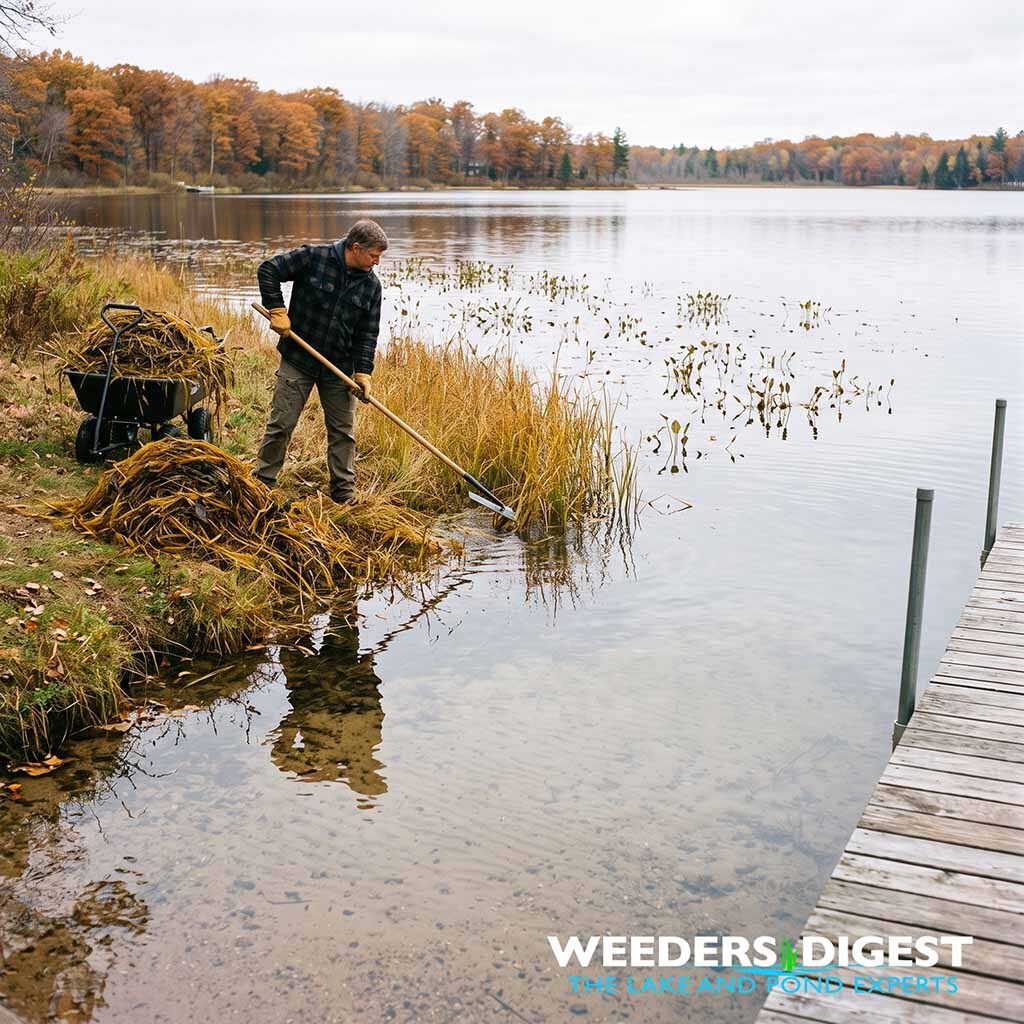
The best way to cut back dying aquatic plants before winter sets in is to physically slice the vegetation as close to the sediment bed as possible using a specialized V-shaped aquatic weed cutter or motorized cutting bar, followed immediately by total manual extraction of all severed plant matter from the water. Leaving cut or dying stems to drift and sink creates an underwater biohazard that decomposes under winter ice, driving down dissolved oxygen levels and accelerating the creation of dense organic black muck. By severing and completely removing this biomass during early to mid-autumn while plant stems maintain structural integrity, waterfront owners halt the seasonal decay cycle that degrades water quality and fuels aggressive weed growth the following spring.
In our late-autumn shoreline assessments across northern waterways, our lake experts routinely observe waterfronts where property owners diligently cut their aquatic weed beds but failed to rake out the plant debris. When our team conducts sub-surface water testing in those same zones beneath mid-winter ice, we find critical dissolved oxygen depletion, sulfurous anaerobic gases bubbling under the freeze, and an accumulated blanket of dark, flocculent silt that blankets native gravel and sand bottoms. Complete physical extraction of cut vegetation is the single most important differentiating step between an overgrown, muck-choked spring shoreline and a clean, healthy waterfront.
The Science Behind It:
The transition from late summer to autumn induces physiological senescence in vascular aquatic macrophytes. As photoperiods contract and water temperatures drop, submerged and emergent plants halt active photosynthetic carbon assimilation and initiate the rapid translocation of mobile carbohydrates and nutrients toward their root crowns, rhizomes, or overwintering vegetative buds like turions. The remaining above-ground vegetative tissues lose structural turgor pressure, collapse under their own weight, and fall to the benthic substrate. This sudden deposition of organic biomass introduces massive quantities of labile carbon, cellulose, and nitrogen into the benthic zone, initiating rapid microbial colonization by heterotrophic aerobic bacteria.
This surge in microbial activity imposes an immense Biological Oxygen Demand (BOD) on the aquatic ecosystem. During the open-water season, atmospheric diffusion and surface turbulence continually reoxygenate the littoral zone, compensating for bacterial respiration. Once winter forms an impenetrable ice sheet across the lake surface, atmospheric reaeration drops to zero. If snowfall accumulates on top of the ice, it blocks photosynthetically active radiation (PAR), shutting down any remnant photosynthetic oxygen production by phytoplankton or cold-tolerant macrophytes. Research published by university extension programs, including Penn State Extension and the University of Illinois Extension, demonstrates that decomposing organic vegetation rapidly forces dissolved oxygen concentrations below the critical 2.0 to 4.0 mg/L hypoxia threshold, triggering lethal winterkill conditions for resident fish populations such as largemouth bass and bluegill.
When dissolved oxygen is completely stripped from the sediment-water interface, the benthic zone shifts from an oxic environment to a chemically reduced, anaerobic state. Under oxygenated conditions, oxidized ferric iron (Fe3+) binds strongly to dissolved orthophosphate, sequestering phosphorus harmlessly within benthic sediments. However, as anaerobic bacteria take over decomposition, the sediment redox potential plummets below critical thresholds, reducing iron to its soluble ferrous state (Fe2+). This chemical reduction severs the bond, releasing sequestered phosphorus directly back into the interstitial pore waters and overlying water column in a limnological process known as internal nutrient loading. Limnological nutrient-budget studies indicate that internal phosphorus recycling driven by winter anoxia can account for 30% to over 50% of the bioavailable phosphorus pool entering the photic zone during spring turnover, directly driving early-season filamentous algae blooms and accelerated weed resurgence.
Beyond chemical disruption, the anaerobic degradation of plant tissue is fundamentally inefficient and incomplete. Lignin and refractory structural celluloses do not fully break down in the absence of dissolved oxygen, transforming instead into a viscous, colloidal organic sediment termed sapropel, commonly recognized by shoreline owners as "black lake muck." In dense, unmanaged littoral zones, unchecked annual macrophyte die-off can contribute between 1 to 3 inches of compacted organic silt annually. This layer of decomposing organic detritus smothers native benthic spawning gravels and creates the ideal, nutrient-saturated foundation for opportunistic, invasive weeds to colonize aggressively as soon as water temperatures warm in early spring.
Our Recommendation for Managing Pre-Winter Aquatic Plant Die-Off:
Safeguarding your lakefront against winterkill and persistent muck accumulation requires a proactive, two-phase management strategy: precision physical extraction paired with automated hydrodynamic clearing. During early to mid-autumn, cut senescing weed beds at the sediment boundary using low-drag aquatic cutters, and systematically remove every fragment above the high-water line using wide-profile collection rakes. Removing the physical biomass prevents the primary biological load from ever decomposing beneath the ice.
However, mechanical cutting alone cannot capture the microscopic plant fragments, loose detritus, and lingering organic silt already settled across the sediment floor. To eliminate these stubborn residues and protect the sediment-water interface from going anoxic, our lake experts recommend pairing mechanical harvesting with continuous horizontal water velocity. Installing a directional sediment-clearing system like our AquaThruster Muck & Weed Blower collection generates the sustained benthic scouring velocity necessary to dislodge loose organic silt, sweep decomposing plant particulates into natural deeper basins, and maintain vital dissolved oxygen circulation over your swimming area before freeze-up. Combining thorough pre-winter mechanical harvesting with continuous hydrodynamic scouring permanently breaks the cycle of annual muck build-up and ensures a firm, weed-free lakebed come spring.
Sources / References:
- Penn State Extension: Winterkill in Ponds and Lakes — https://extension.psu.edu/winterkill-in-ponds
- University of Illinois Extension: Farm Ponds, Fish Kills, and Dissolved Oxygen — https://extension.illinois.edu/news-releases/farm-ponds-fish-kills-and-oxygen
- Water MDPI: Internal Cycling Influences Nutrient Changes Leading to Altered Nutrient Limitation in Eutrophic Lake Systems — https://www.mdpi.com/2073-4441/17/17/2604