

How Falling Water Temperatures Accelerate Wave and Ripple Shoreline Erosion
 |

Summary:
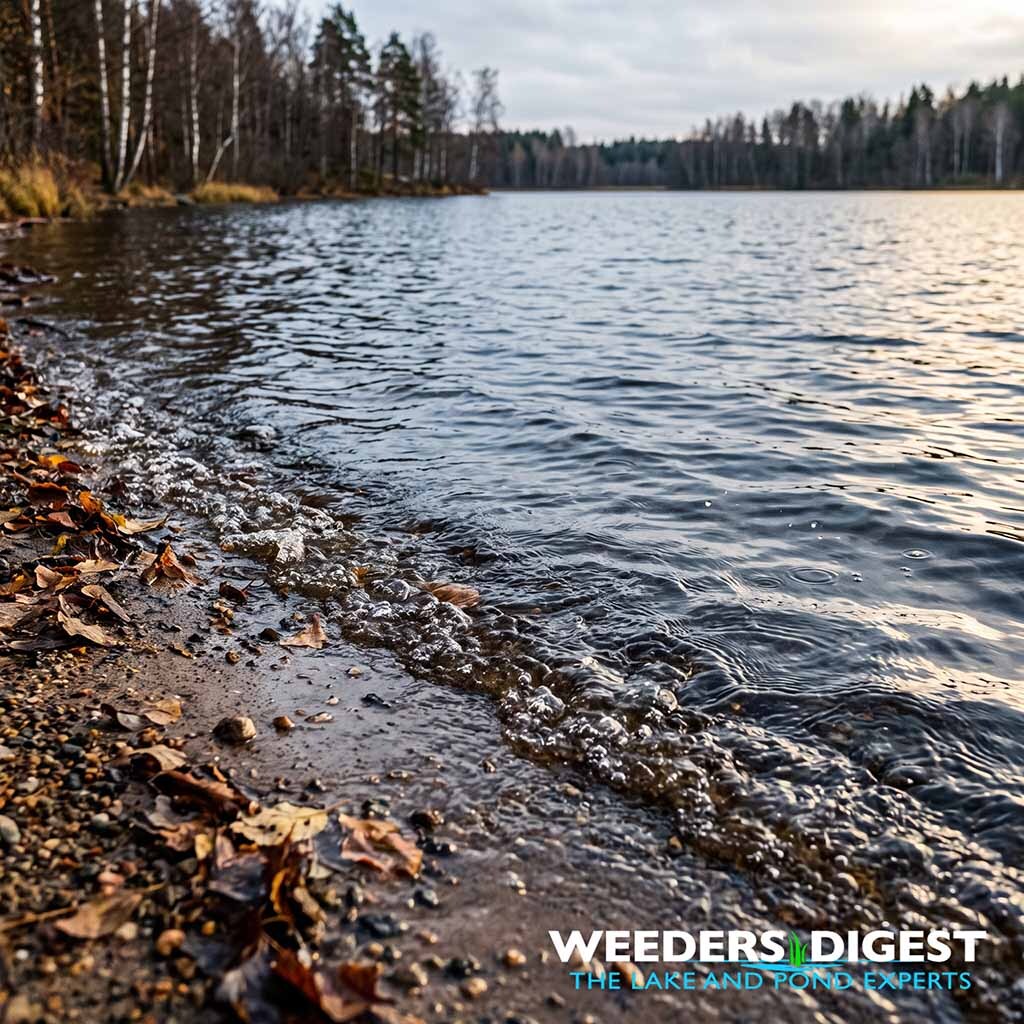
Falling water temperatures accelerate shoreline erosion by increasing the physical density and dynamic viscosity of water, which amplifies the drag force and shear stress applied to bank soils by incoming waves and ripples. When surface water cools during late autumn and early winter, its molecular structure tightens, transforming light ripples into significantly heavier fluid hammers capable of dislodging consolidated littoral sediments. At the same time, cold water reduces the settling velocity of suspended particles, meaning that once soil grains are plucked from the shoreline, they remain adrift longer and wash into deep water rather than settling back onto the littoral shelf. In our fieldwork assessing late-season waterfronts across northern lakes, we consistently observe bank scour and shoreline slumping accelerating rapidly during October and November, even when wind speeds match those of mid-summer. Waterfront owners frequently mistake this cold-water sediment loss for summer boat wake damage, but the true driver is cold-water hydrodynamics stripping unarmored banks.
The Science Behind It:
Water exhibits unique physical behavior as temperatures drop from summer highs down toward freezing, directly governed by thermodynamic fluid mechanics. Dynamic viscosity () measures a fluid’s internal resistance to shear and flow. As water cools from a temperate summer baseline of 20°C (68°F) down to near-freezing at 0°C (32°F), its dynamic viscosity surges by approximately 79%, rising from 1.002 mPa·s to 1.792 mPa·s. Simultaneously, water reaches its maximum density of 1.000 g/cm³ at 3.98°C, making cold water notably denser and heavier than warm summer water.
This shift in fluid viscosity dramatically alters the boundary layer dynamics across the nearshore sediment bed. In coastal and limnological engineering, the threshold for sediment entrainment is governed by the Shields parameter (), which balances fluid shear stress (b) against the submerged weight of sediment grains. Bed shear stress is directly proportional to fluid density and friction factor. Because denser, more viscous water generates a thicker viscous sublayer and exerts higher frictional drag per unit of velocity, autumn ripples and wind waves impart substantially higher hydrodynamic drag on shoreline banks than identical wave heights generated in July.
Once wave action dislodges sediment particles, falling temperatures further inhibit shoreline recovery by slowing particle deposition. According to Stokes’ Law of settling velocity, the terminal fall velocity of a particle in suspension (ws) is inversely proportional to the fluid’s dynamic viscosity (ws1/). Because near-freezing water is roughly 1.8 times more viscous than warm water, the settling rate of silt and fine sand particles drops by over 40%. Dislodged grains that would typically settle back onto the beach face during warm-water backwash are held in suspension and carried into offshore littoral basins, resulting in net negative sediment budgets.
Compounding this physical fluid dynamic is the seasonal dieback of emergent and submergent aquatic vegetation in late autumn. During summer, dense stands of native macrophytes absorb orbital wave energy and anchor fine root zones. When sub-surface temperatures drop, this biological friction disappears, exposing raw sediment banks to high-viscosity waves. Combined with cyclic autumn cold fronts that deliver sustained directional fetch, cold-water hydraulic action and sediment scour reach their annual peak just before winter freeze-up.
Our Recommendation for Managing Shoreline Wave Erosion:
To counteract cold-water bank scour and seasonal sediment displacement, shorelines require engineered hydrodynamics that redirect energy away from vulnerable embankments. When autumn winds push dense, high-viscosity waves toward your beach, passive methods often fail because the ambient fluid itself carries heightened drag force. Breaking this erosive cycle requires active, continuous water displacement that redirects the littoral approach and sweeps destabilized sediment back into safe, stable settling zones. Utilizing directional water movement systems—such as our AquaThruster Muck & Weed Blower collection—allows waterfront owners to establish a counter-current buffer along docks and bulkheads. By maintaining laminar outward flow, you physically deflect cold incoming ripples and prevent dense seasonal sediment loads from scouring out structural shoreline margins before the winter freeze sets in.
Sources / References:
- Engineering ToolBox (2024). Water - Dynamic and Kinematic Viscosity at Various Temperatures. https://www.engineeringtoolbox.com/water-dynamic-kinematic-viscosity-d_596.html
- Madsen, O. S., & Grant, W. D. (1976). Quantitative Description of Sediment Transport by Waves. Coastal Engineering Proceedings. https://scispace.com/pdf/quantitative-description-of-sediment-transport-by-waves-t24fesdtv4.pdf
- Reynolds, C. S. (2006). The Ecology of Phytoplankton (Limnology Fluid Dynamics and Stokes' Settling Principles). Cambridge University Press. https://www.britannica.com/science/lake/Effects-of-wave-and-current-action