

How I Stopped My Lake from Suffocating: The True Science of Eutrophication
 |
Summary:
Eutrophication is the rapid aging and degradation of your lake caused by an overload of nutrients like phosphorus and nitrogen, which triggers explosive toxic algae blooms and strips the water of life-sustaining oxygen. When these massive influxes of nutrients enter a freshwater ecosystem from lawn fertilizers, septic drainage, or stormwater runoff, they act like an artificial fertilizer. This completely disrupts the natural, slow evolutionary timeline of the water body, accelerating its transition from a clear, pristine environment into a stagnant, weed-choked marsh.
Left unchecked, this nutrient enrichment sparks a dangerous biological chain reaction. Microscopic plants called phytoplankton reproduce out of control, creating thick green mats that block sunlight from reaching deeper aquatic vegetation. As this massive volume of organic matter inevitably dies and sinks to the bottom, specialized bacteria consume vast amounts of dissolved oxygen just to decompose the debris. This rapid consumption results in widespread anoxia—a complete lack of oxygen—near the lake bed, which stresses native sport fish and can ultimately lead to devastating fish kills.
My years of managing private water bodies have shown me that a lake suffering from advanced eutrophication feels entirely different underfoot. When walking out onto a failing dock in mid-July, the water often looks like thick pea soup, smells faintly of sulfur, and the lake bed transitions from solid sand to a heavy, black, bubbling organic muck. This intense accumulation of decomposing organic matter is a physical sign that the lake's natural self-purification systems are completely overwhelmed by the sheer volume of incoming nutrients.
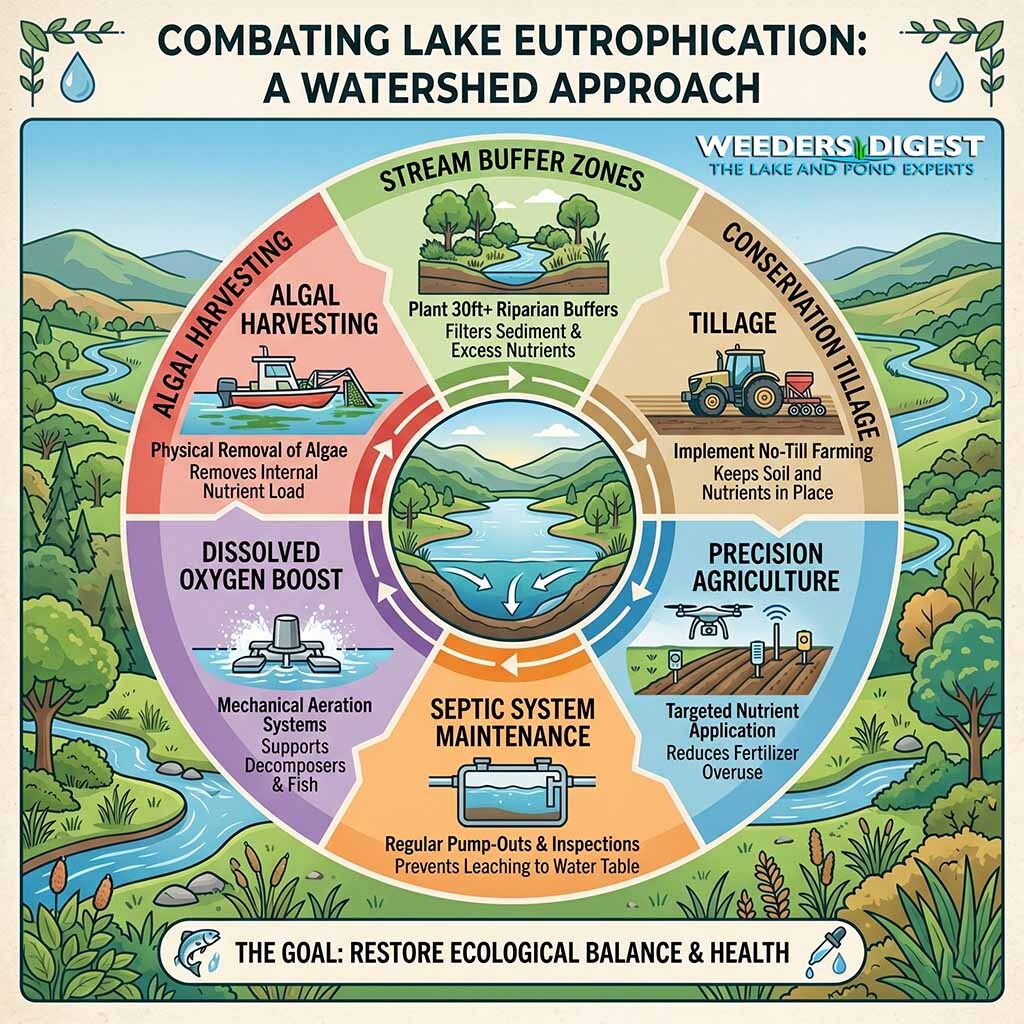
Reversing this process requires a dual-focus strategy that simultaneously halts external nutrient pollution while actively treating the internal cycling already locked within the lake bed. Because phosphorus binds tightly to bottom sediments, it creates a persistent internal battery of pollution that re-fuels toxic algae blooms year after year, even after external runoff is eliminated. Restoring long-term balance means utilizing specialized lake management tools designed to lock up these free-floating nutrients, degrade the deep layers of bottom muck, and continuously infuse oxygen into the lower water layers to interrupt this destructive cycle.
The Science Behind It:
Freshwater eutrophication is fundamentally governed by the principles of limiting nutrients and biogeochemical cycling within a watershed. In most temperate freshwater ecosystems, phosphorus acts as the primary limiting nutrient, meaning its baseline availability directly controls the total volume of biological growth. Research published by the National Institutes of Health indicates that ecological imbalances and severe impairments to algal and macrophyte assemblages begin to manifest when a water body's mean total phosphorus concentration surpasses a critical threshold of just 15 micrograms per liter ($15\ \mu\text{g/L}$). Once concentrations exceed $20\ \mu\text{g/L}$ to $30\ \mu\text{g/L}$, the system transitions from an oligotrophic (nutrient-poor) or mesotrophic (moderate) state into an unstable, highly productive eutrophic classification.
The primary driver behind this acceleration is anthropogenic nutrient loading, which delivers highly reactive dissolved inorganic phosphorus and nitrates directly into surface waters. This influx dramatically alters the nitrogen-to-phosphorus ratio, giving fast-growing cyanobacteria a distinct competitive advantage over beneficial native diatoms and green algae. Cyanobacteria quickly form dense surface scabs that suppress vertical light penetration through the water column, effectively halting the photosynthetic activity of submerged macrophytes. This shading out of deep-water plants drastically reduces the structural complexity of the littoral zone, eliminating vital spawning habitats for apex predatory fish like large-mouth bass and northern pike.
The most complex challenge in limnology involves managing the internal feedback loops that sustain a highly productive state long after external inputs are mitigated. When the massive seasonal biomass of cyanobacteria and aquatic weeds dies, it deposits highly concentrated organic matter onto the lake bed. Heterotrophic bacteria decompose this accumulated detritus, driving up the biochemical oxygen demand and depleting the dissolved oxygen in the hypolimnion—the cold, dense bottom layer of a stratified lake. A comprehensive national modeling study published in PubMed Central revealed that due to this extensive accumulation of phosphorus within benthic sediments, the mean lag time for a 50% decline in water column phosphorus concentrations across more than 70,000 lentic water bodies in the United States is 13.1 years, stretching to 39.0 years for a 75% reduction.
This prolonged lag time is directly caused by internal phosphorus loading under anoxic conditions. In a healthy, well-oxygenated lake, phosphorus binds tightly to oxidized iron compounds, forming insoluble ferric phosphate complexes that safely trap the nutrient within the bottom sediment. However, when bottom-water dissolved oxygen concentrations drop below $2.0\ \text{mg/L}$, the sediment-water interface becomes reducing. This chemical reduction breaks the bond between iron and phosphorus, solubilizing the nutrient and releasing massive amounts of orthophosphate back into the water column. This chemical release creates a continuous internal supply of fertilizer that fuels subsequent algal blooms, creating a self-sustaining loop that cannot be resolved without targeted physical and chemical interventions.
Visualizing Lake Eutrophication
A high-resolution, professional diagram illustrating the complete ecological progression of freshwater eutrophication within a single lake basin. The scene utilizes a split-screen perspective: the left side represents a healthy, balanced oligotrophic lake with high water clarity, abundant sunlight penetration, deep rooted native plants, and active sport fish near a sandy bottom. The right side illustrates an advanced eutrophic state, showing a thick green cyanobacteria bloom blanketing the surface, blocked sunlight, a heavy accumulation of black organic muck on the lake bed, and dead fish floating in an anoxic zone. Detailed, clear scientific annotations are embedded directly into the visual structure, highlighting key phases including 'Nutrient Influx', 'Algal Bloom', 'Decomposition', 'Oxygen Depletion', and 'Internal Phosphorus Release'. The image is styled as a clean, authoritative reference diagram suitable for a high-level academic textbook or environmental extension publication.