

How My Field Experiments with Muck Blowers and Thrusters Transformed My Waterfront and Decoded Lake Hydrodynamics
 |

Summary:
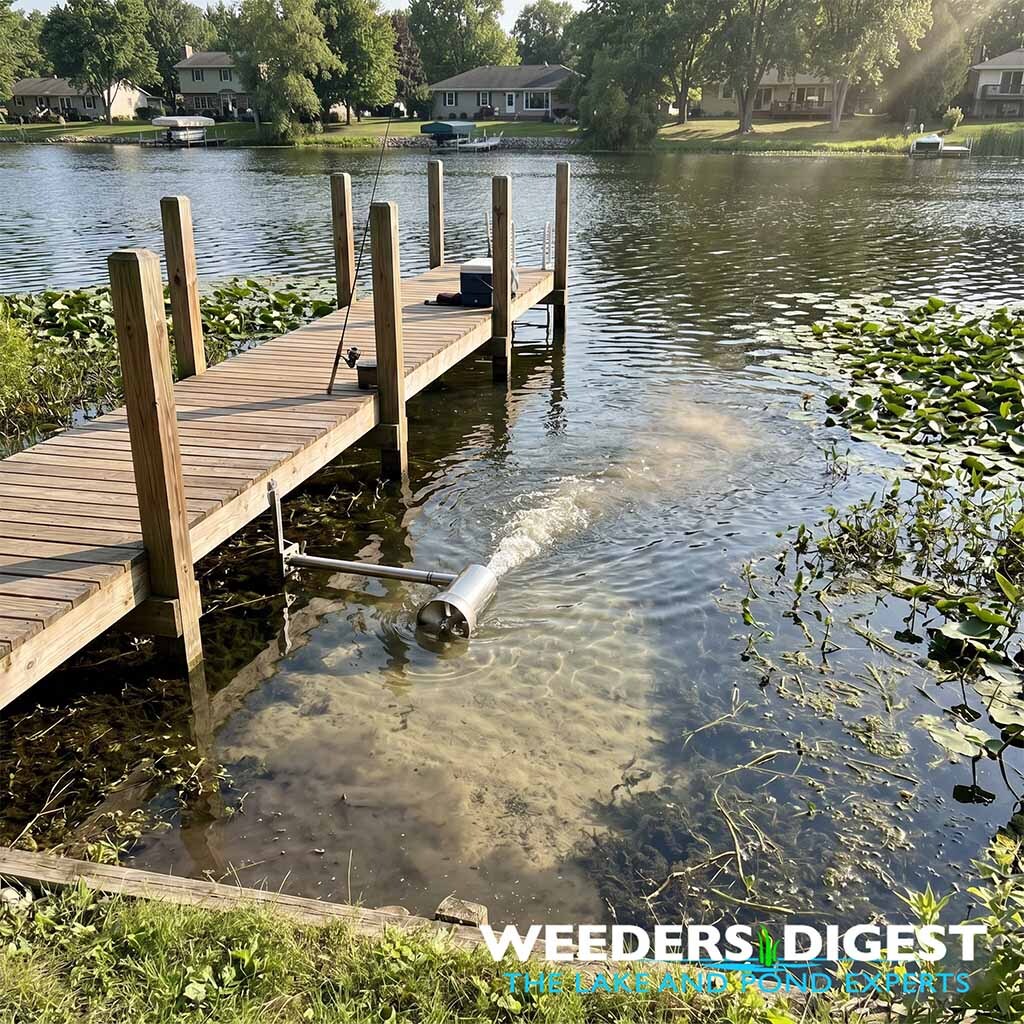
Muck blowers and lake thrusters manage aquatic weeds and muck accumulation by generating a directional, high-velocity stream of water that alters the local hydrodynamics of your shoreline. These devices do not directly cut or kill weeds with blades; instead, they create continuous physical shear stress and artificial currents that prevent organic sediments from settling while physically disrupting the soft rooting zones of opportunistic plants. By driving a concentrated jet of water across the lake bed, these systems establish a localized high-energy zone where muck is displaced and nuisance vegetation struggle to maintain a foothold.
When I first deployed a heavy-duty muck blower at a silt-choked private cove, the transformation was immediate but highly localized. Standing on the dock, I watched the directional thruster turn a stagnant, weed-choked shoreline into a clear, sandy-bottomed swimming area within a matter of days. However, as a Certified Lake Manager, I also observed how the displaced fine muck simply drifted down-current and settled into a deeper, low-energy pocket of the lake. This field experience underscored a vital reality: thrust systems are exceptionally powerful tools for redistributing localized sediment and clearing immediate swim zones, but they must be positioned strategically to avoid simply shifting the ecological challenge to your neighbor's dock.
The Science Behind It:
The mechanical management of submersed aquatic vegetation and benthic organic layers using directional water thrusters relies entirely on fluid dynamics and sediment transport mechanics. When a motorized thruster or muck blower is activated, the rotation of its submerged propeller generates a high-velocity fluid jet. The initial velocity of this jet ($V_0$) is directly governed by the propeller thrust ($T$), the density of the water ($\rho_w$), and the propeller jet contraction area ($D_0$), which can be mathematically formulated as $V_0 = 1.13 \cdot \frac{1}{D_0} \cdot \sqrt{\frac{T}{\rho_w}}$ (Srše et al., 2023). This localized fluid acceleration induces significant shear stress across the benthic boundary layer—the interface where the lake water meets the solid bottom sediment.
As the propeller jet propagates longitudinally from the unit, it transitions through distinct hydrodynamic zones where the velocity profile expands according to Gaussian normal probability functions (Srše et al., 2023). When the bottom shear stress exerted by this expanding fluid jet exceeds the critical shear stress of the bed material, sediment resuspension occurs. Fine organic particulate matter, loose silt, and decaying plant detritus (commonly referred to as muck) possess low critical shear stress thresholds compared to dense sand or gravel. Consequently, the thruster selectively mobilizes and lifts these lighter organic fractions into the water column, leaving behind heavier, compacted substrates.
This resuspension dramatically impacts the growth of nuisance aquatic weeds through multiple physical mechanisms. First, the continuous directional force of the water column exerts ongoing drag forces on the stems and leaves of submersed macrophytes, frequently causing mechanical damage, uprooting, or preventing the settling of vegetative fragments and fragments that rely on stagnant conditions to take root. Second, by stripping away the soft, unconsolidated organic muck layer, the thruster deprives opportunistic weed species of the loose, nutrient-rich rooting medium they require for rapid expansion.
However, the broader ecological implications of operating these devices extend beyond the immediate zone of clearance. Once organic sediments are propelled into suspension, their transport and ultimate fate are dictated by the ambient lake currents and gravitational settling velocities. Hydrodynamic modeling demonstrates that while coarser particles settle rapidly near the edge of the high-energy jet, finer microparticles and organic fractions remain suspended long after the initial thrust force dissipates, traveling significant distances before resedimentation occurs (Srše et al., 2023). This artificial resuspension can temporarily alter local water quality by increasing turbidity and potentially liberating bound nutrients or contaminants back into the water column, highlighting the need for calculated, precise deployment in managed water bodies.
Sources / References:
Srše, J., Perkovič, M., & Grm, A. (2023). Sediment Resuspension Distribution Modelling Using a Ship Handling Simulation along with the MIKE 3 Application. Journal of Marine Science and Engineering, 11(8), 1619.https://doi.org/10.3390/jmse11081619 (Cited by: 7)