

How Real-Time Data from Automated Water Quality Monitoring Buoys Can Save Your Lake
 |

Summary:
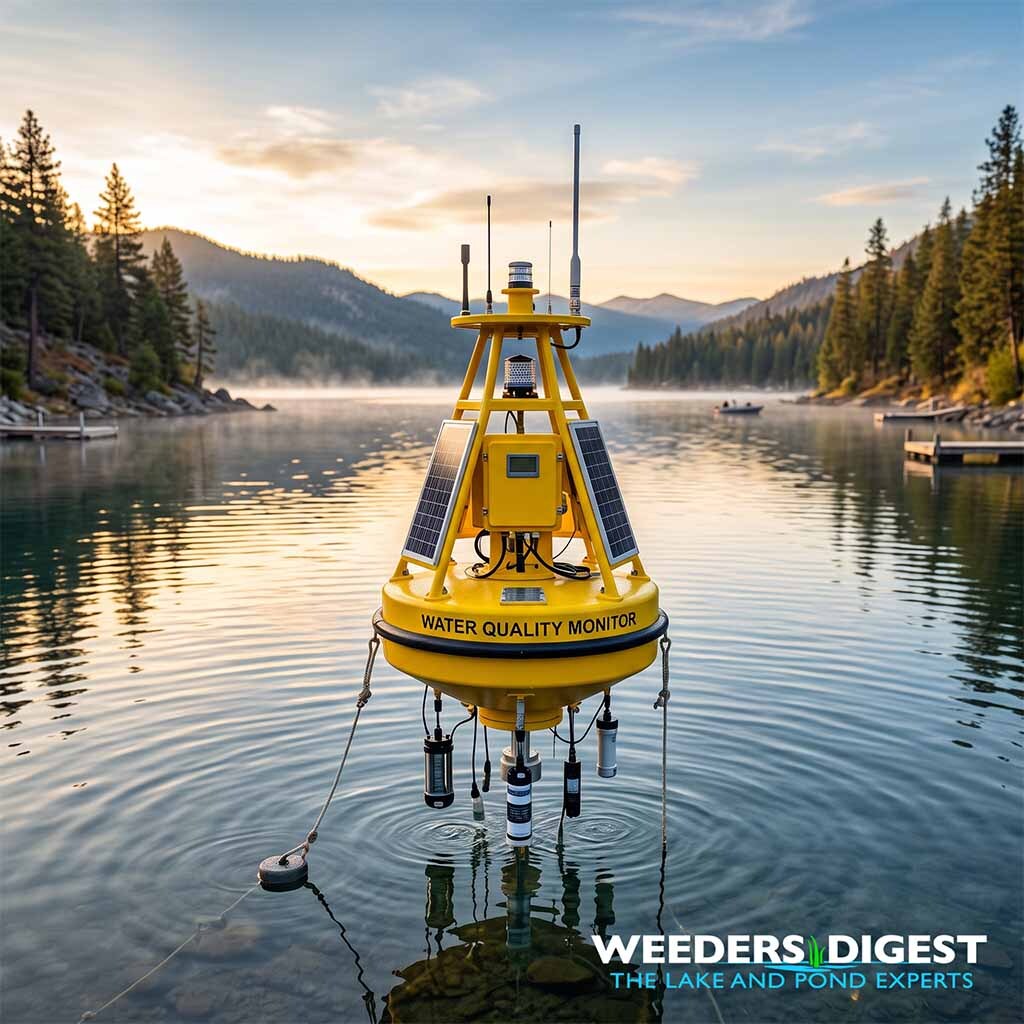
Automated water quality monitoring buoys are floating sensor platforms that continuously measure and transmit real-time data on lake conditions like temperature, dissolved oxygen, and algae levels directly to researchers and lake managers. Traditionally, monitoring a body of water meant physically driving to a site, taking grab samples from a boat, and waiting days or weeks for laboratory results. By the time the data was processed, a severe event like a toxic algae bloom or a massive fish kill could have already occurred. Today, these automated high-frequency monitoring networks serve as an early warning system, allowing us to see exactly what is happening under the surface at any given moment.
As a Certified Lake Manager, I used to rely entirely on manual sampling, which often felt like trying to understand a complex movie by looking at just one or two still frames a month. I remember arriving at a large reservoir on a humid August morning following a massive fish kill, completely blind to the fact that a sudden thermal inversion had wiped out the dissolved oxygen at the bottom of the lake 48 hours prior. Now, by anchoring an automated buoy in the deepest basin of a managed lake, my phone pings me the second dissolved oxygen levels drop below a critical threshold, giving me the crucial window of time needed to activate aeration systems before the ecology crashes.
Having this continuous stream of data fundamentally shifts lake management from a reactive scramble to a proactive science. Instead of guessing how a heavy rainfall event might impact nutrient loading, we can watch the changes in turbidity and conductivity unfold in real time. These buoys empower property owners, municipalities, and environmental scientists alike to make highly informed, immediate decisions to protect the aquatic ecosystems they care about.
The Science Behind It:
High-Frequency Monitoring (HFM) utilizing automated sensor buoys represents a paradigm shift in the field of limnology, the study of inland aquatic ecosystems. These anchored autonomous systems utilize a suite of sophisticated multiparameter sondes to measure critical physicochemical variables—such as water temperature, dissolved oxygen, pH, specific conductance, turbidity, and phycocyanin (a pigment indicative of cyanobacteria)—at rapid intervals. The continuous collection of this limnological data provides an unprecedented, high-resolution temporal scale that reveals diurnal fluctuations and transient ecological events that traditional manual sampling paradigms inherently miss.
The mechanical architecture of these buoys ensures continuous operation even in harsh aquatic environments. Advanced systems integrate self-cleaning wiper mechanisms that prevent biological fouling on the optical sensors, extending the viability of unassisted deployment for several months. Powered by integrated solar panels and battery banks, these buoys utilize cellular telemetry to transmit data uplinks frequently to cloud-based repositories. According to research published on a novel water quality research platform, transmitting multi-parameter data every 15 minutes enables near-real-time visualization and analytics, providing scientists with an immediate indicator of potential contamination pathways and the trajectory of harmful algal blooms.
While the temporal resolution of individual buoys is exceptionally high, contemporary research underscores the complexities of spatial variability within large lacustrine systems. A 2025 study published in PLOS One detailing high-frequency monitoring buoys in large lake ecosystems evaluated the spatial synchrony of limnological data using Pearson correlation across hourly observations. The researchers found that while surface water temperature remained highly synchronous across different monitoring locations, variables governed by biological and chemical processes, such as dissolved oxygen, turbidity, and chlorophyll concentrations, exhibited profound asynchrony. As the spatial distance between the static buoys increased, the correlation of these critical water quality parameters significantly decreased.
This quantitative finding highlights a vital consideration for automated monitoring networks: a single monitoring buoy deployed in a large, complex lake ecosystem has a high probability of missing critical localized events. Limnologists must strategically design HFM networks that account for hydrodynamic isolation, wind-driven circulation, and spatial heterogeneity. By deploying interconnected arrays of automated buoys rather than relying on a singular point of data, researchers can construct a comprehensive, three-dimensional model of lake metabolism, effectively disentangling the effects of nutrient pollution, climate change, and other environmental stressors on freshwater resources.