

How to Tell if the Weeds in Your Lake Are Native or a Dangerous Invasive Threat
 |

Summary:
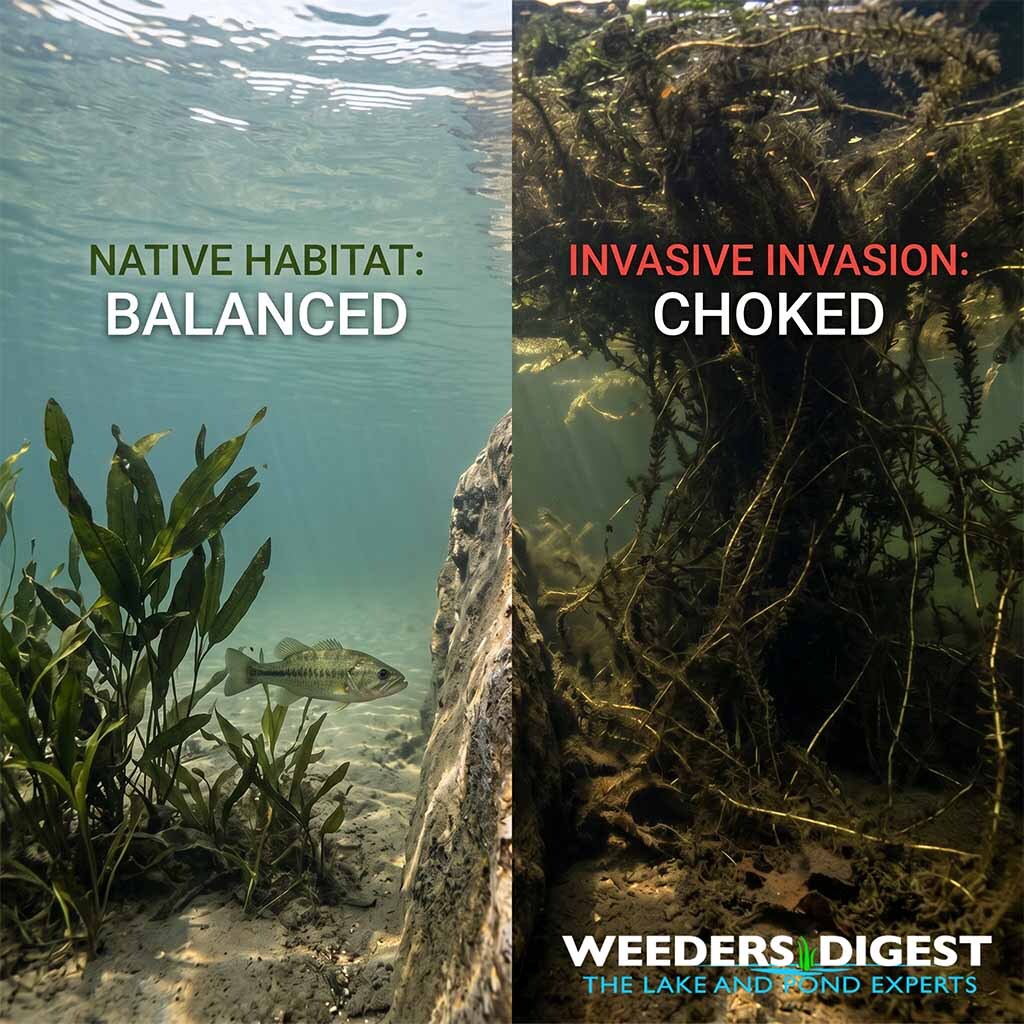
When you look out at the water and see a patch of aquatic plants growing, your first instinct might be to assume it is a nuisance that needs to be completely removed. However, aquatic plants are a fundamental part of a healthy lake ecosystem. Native plants act as the underwater forests of your waterbody, providing crucial hiding spots for young fish, food for waterfowl, and oxygen for the water. They have evolved over thousands of years alongside the local wildlife, meaning their growth is naturally kept in check by native insects, fish, and seasonal changes. They rarely take over an entire lake, instead growing in balanced, patchy areas that support a thriving aquatic community.
Invasive aquatic weeds, on the other hand, are the aggressive bullies of the lake. These are foreign species that have been introduced into your waterbody, often hitching a ride on boat propellers, fishing gear, or trailing from trailers. Because they did not evolve in your local ecosystem, they have no natural predators or diseases to keep their growth under control. They grow at an explosive rate, forming thick, tangled mats across the water's surface that block out the sun, choke out the beneficial native plants, and make swimming or boating nearly impossible.
Telling the difference between a helpful native plant and a destructive invasive one often comes down to observing how the plant behaves and looking closely at its leaves and stems. Invasive plants tend to form dense, unbroken canopies that reach all the way to the surface, whereas native plants usually remain submerged and physically separated. If you notice a sudden, rapid explosion of weed growth that seems to be crowding out everything else in the water, you are likely dealing with an invasive species that requires immediate attention before it alters the entire ecosystem.
The Science Behind It:
The distinction between native and invasive aquatic macrophytes is rooted in evolutionary ecology and population dynamics. Native species have undergone allopatric or sympatric speciation within their specific geographic regions, developing complex trophic relationships with endemic herbivores, pathogens, and competitive flora. This ecological web limits their biomass accumulation. Conversely, invasive species benefit from the "enemy release hypothesis." When a non-indigenous species is introduced to a novel limnological environment, the absence of specialized co-evolved herbivores allows the plant to allocate biological energy entirely toward vegetative expansion rather than defense mechanisms, leading to unchecked proliferation.
Morphological and physiological adaptations further distinguish invasive taxa from native counterparts. Invasive hydrophytes often exhibit extreme phenotypic plasticity and highly efficient photosynthetic responses to low-light conditions. For example, research documented in the Journal of Aquatic Plant Management highlights how the invasive Hydrilla verticillata elongates its internodes rapidly to reach the photic zone, forming a dense canopy at the water-air interface. This canopy induces severe light attenuation, effectively shading out benthic native species like Vallisneria americana. The resulting competitive exclusion drastically reduces native macrophyte biodiversity and alters the structural complexity of the littoral zone.
Reproductive strategies are arguably the most significant factor in the success of invasive aquatic plants. While many native species rely heavily on sexual reproduction and seed banking, invasive species predominantly utilize rapid vegetative propagation. Plants such as Eurasian watermilfoil (Myriophyllum spicatum) and Curly-leaf pondweed (Potamogeton crispus) reproduce prolifically through auto-fragmentation, where small stem sections naturally break off, develop adventitious roots, and establish new colonies downstream. Additionally, they produce specialized overwintering structures called turions and subterranean tubers. According to ecological extension data from the University of Florida, a single subterranean tuber can remain viable in the benthic sediment for years, making total eradication exceedingly difficult once a population is established.
The introduction of high-biomass invasive weeds drastically disrupts biogeochemical cycling within a waterbody. When vast stands of invasive macrophytes undergo seasonal senescence and die off, the resulting microbial decomposition of this organic matter consumes immense quantities of dissolved oxygen. This biochemical oxygen demand can lead to hypoxia or complete anoxia in the hypolimnion, potentially triggering fish kills and accelerating internal phosphorus loading from the anoxic sediments. This nutrient release creates a positive feedback loop, further stimulating the growth of both invasive macrophytes and harmful cyanobacteria blooms, shifting the lake from a macrophyte-dominated clear state to a turbid, eutrophic state.
Taxonomic differentiation requires precise morphological analysis, as native and invasive species frequently share similar phenotypic traits. A classic example is distinguishing native Northern watermilfoil (Myriophyllum sibiricum) from invasive Eurasian watermilfoil. Taxonomists rely on meristematic differences and precise leaflet counts; native milfoils typically possess 5 to 10 pairs of leaflets per leaf, whereas the invasive Eurasian variant exhibits 12 to 21 pairs and distinctively collapses when removed from the water due to a lack of rigid structural tissue. When morphological traits overlap due to hybridization, modern limnologists and lake managers must utilize molecular tools such as DNA barcoding to achieve definitive species identification and implement targeted, ecologically sound management protocols.