

How Your Local Lake Powers Your Home: The Magic of Hydroelectric Dams
 |

Summary:
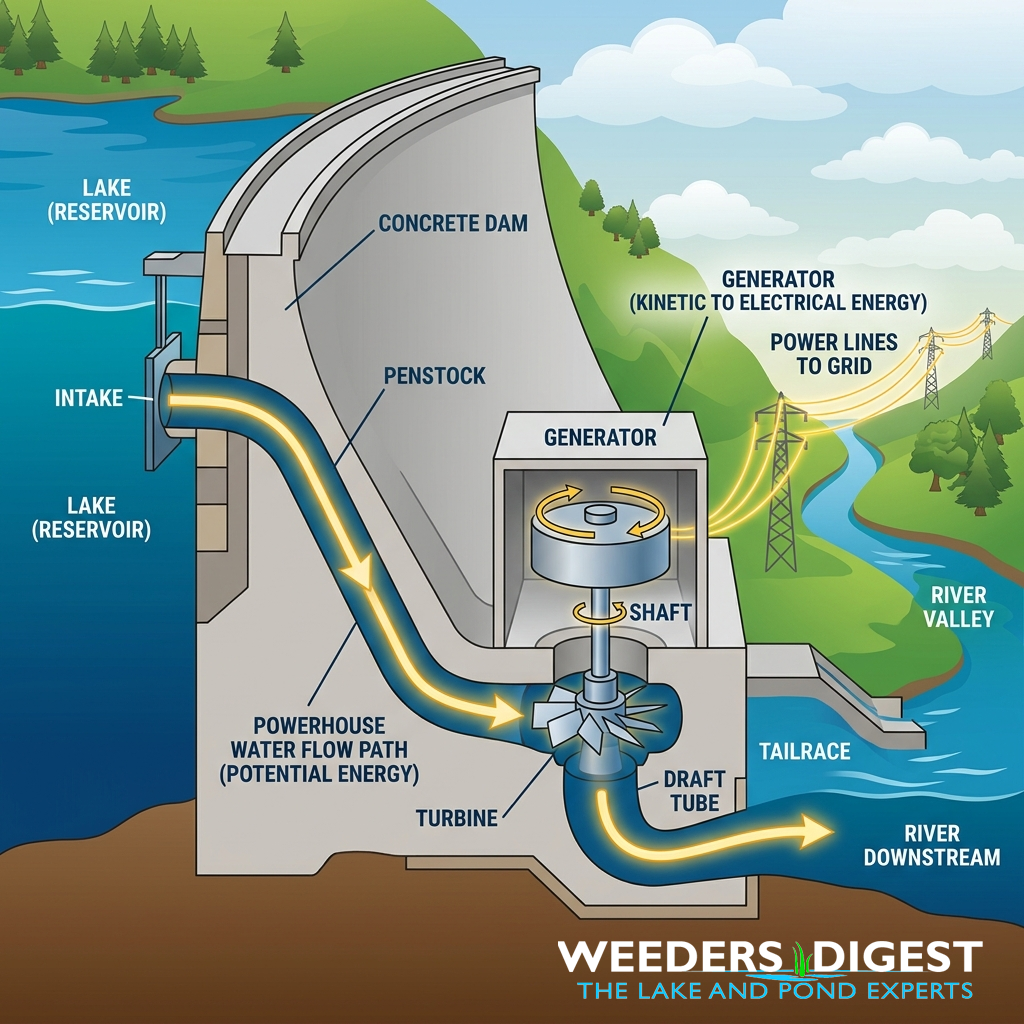
When you see a massive dam holding back the waters of a large lake or reservoir, you are looking at a giant battery waiting to be used. The process of turning that quiet, still water into the electricity that charges your phone or lights your living room is actually quite straightforward. It all starts with gravity. Because the water in the lake is held at a higher level than the river below the dam, it possesses a huge amount of stored energy.
When engineers are ready to create power, they open gates that allow the water to fall through large pipes inside the dam. As this water rushes down, it hits the blades of a massive fan called a turbine, making it spin at high speeds. This spinning turbine is connected to a generator, which uses magnets and wire coils to convert that physical motion into electrical energy. It is one of the cleanest ways to create power because it doesn't "use up" the water; it simply borrows its momentum before sending it back into the river downstream.
The Science Behind It:
The conversion of lacustrine water into electricity relies on the principles of fluid dynamics and electromagnetic induction. According to research from the U.S. Geological Survey (USGS) and university engineering extensions, the process begins with the exploitation of gravitational potential energy, defined by the formula PE = m × g × h, where m is the mass of the water, g is the gravitational constant, and h is the hydraulic head (the vertical distance between the water surface and the turbine). A higher head allows for greater pressure and velocity as the water enters the penstock, the pressurized conduit leading to the powerhouse.
As water travels through the penstock, its potential energy is converted into kinetic energy. This moving fluid strikes the runner blades of a hydraulic turbine—most commonly a Francis or Kaplan design in modern lake-fed systems. The choice of turbine depends heavily on the flow rate and the specific height of the lake’s water column. The force of the water against the blades creates a rotational torque, which is transferred through a vertical or horizontal shaft directly to a rotor within an electrical generator.
The generation phase is governed by Faraday’s Law of Induction. The rotor, which is essentially a series of large electromagnets, spins inside a stationary component called a stator, which is wound with heavy copper coils. As the magnetic fields sweep past these conductors, they force electrons to flow, creating an alternating current (AC). The efficiency of this energy transfer is remarkably high, often exceeding 90% in modern facilities, making it significantly more efficient than thermal power plants that lose energy through heat dissipation (National Renewable Energy Laboratory).
Following the energy extraction, the water exits the turbine through a draft tube and is discharged into the tailrace. It is important to note that the chemical composition and temperature of the water can be affected by this process, particularly if the intake is located in the hypolimnion (the cold, bottom layer) of a stratified lake. Advanced dam management now utilizes aerating turbines to ensure that the discharged water maintains dissolved oxygen levels sufficient to support downstream aquatic biota and maintain ecological integrity.