

Is Fall Rain Runoff Making Your Lake Water Clearer or Dirtier Than Summer Rain?
 |

Summary:
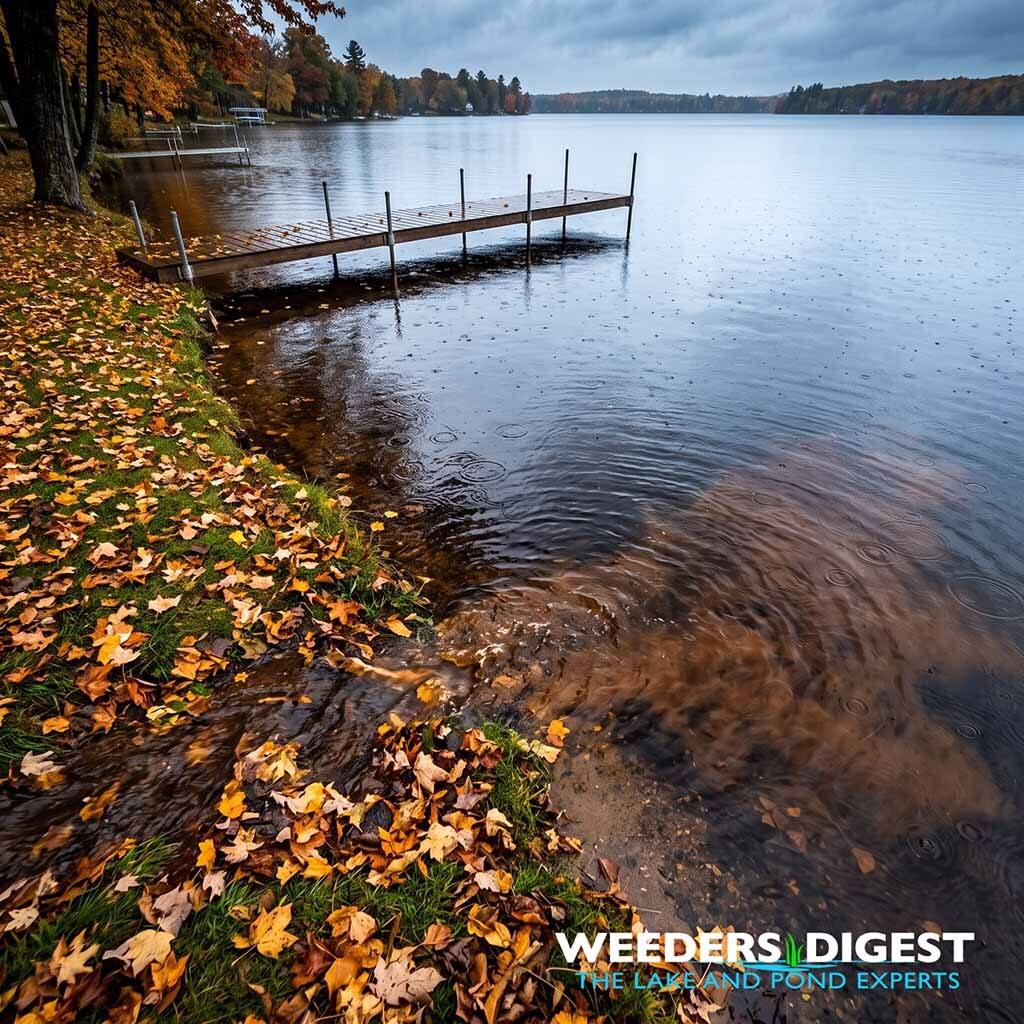
Fall rain runoff typically leaves nearshore lake water looking significantly dirtier and more turbid than summer rain runoff, despite the overall seasonal decline in open-water algal blooms. While summer storms primarily fuel biological turbidity by washing dissolved nutrients into warm, sunlit water that triggers rapid microcystis and green algae blooms, autumn rain introduces a heavy physical sediment and detrital load. As trees drop leaves, shoreline terrestrial vegetation dies back, and exposed littoral soils erode, autumn runoff flushes massive volumes of organic particulate matter, tannins, and suspended minerals directly into shallow bays.
When our lake and pond experts pull Secchi disk readings and sediment core samples along residential docks in late October, the water often presents a false contradiction. Offshore deep basins frequently experience improved baseline clarity due to cooler water temperatures retarding planktonic cell division, yet shoreline swimming zones and dock areas look like murky tea or churned brown silt right after an autumn storm. We frequently observe that the loose, fluffy layer of decaying weeds and newly washed-in leaf detritus sits completely unanchored along the littoral floor, easily kept in suspension by autumn storm surges and sustained wind-driven wave action.
The difference lies in how clarity is compromised across seasons. Summer rain acts as biological fuel, causing water to turn soupy green over several days as heat and sunlight stimulate nutrient uptake. In contrast, fall rain delivers immediate physical discoloration through suspended solids and leaching humic substances, compounded by the natural destabilization of the water column as autumn approaches.
The Science Behind It:
The physical and chemical behavior of stormwater runoff changes substantially between the summer stratified period and the autumn cooling cycle. In summer limnology, lakes in temperate zones exhibit strong thermal stratification, where the warm, less dense epilimnion floats atop the cold, dense hypolimnion separated by a sharp thermocline. Warm summer rainfall enters an epilimnion operating at high metabolic rates. Research examining watershed stormwater pulses demonstrates that particulate phosphorus (PP) and dissolved inorganic phosphorus in agricultural and urban runoff (often carrying average inlet concentrations between 0.082 mg/L and 0.174 mg/L) are rapidly assimilated by phytoplankton under high photosynthetically active radiation (PAR). In this regime, water clarity loss is predominantly biogenic, quantified through Chlorophyll-a concentration spikes rather than inorganic sediment retention.
In contrast, autumn precipitation impacts a lake undergoing seasonal senescence and destratification. As terrestrial vegetation loses canopy cover and shorelines experience frost-induced dieback, catchment soil stability decreases, resulting in higher concentrations of total suspended solids (TSS) per volume of overland flow. Research published in Environmental Monitoring and Assessment demonstrates that stormwater rain events significantly increase TSS, biochemical oxygen demand (BOD), and turbidity compared to baseflow periods, with strong positive correlations between preceding precipitation totals and inorganic sediment loads (p<0.01). In autumn, this particulate delivery is enriched with refractory organic carbon and allochthonous leaf litter rather than purely mineral soil.
Compounding this external runoff is the internal physical dynamics of fall turnover. As surface water cools toward 4°C (the maximum density of freshwater), the thermal density gradient collapses, allowing wind-driven mechanical energy to mix the entire water column. Research on shallow and deep-mixing lakes indicates that this turnover recirculates legacy sediment-bound nutrients, where total phosphorus in bottom interstitial waters can range from 8.45 mg/L to upwards of 21.51 mg/L. When a cold autumn rainstorm hits during or immediately preceding turnover, the kinetic energy of the storm runoff couples with convective mixing, preventing fine inorganic silts (which exhibit settling velocities slower than 1 cm/h in quiescent water) from settling out of the water column.
Furthermore, autumn runoff delivers high concentrations of dissolved organic carbon (DOC) in the form of humic and fulvic acids leached from decomposing leaves. These compounds do not settle out mechanically; instead, they stain the water dark amber or brown, drastically attenuating light penetration independently of algal cell counts. Thus, while a summer rainstorm drives Secchi disk transparency down primarily through rapid photosynthetic biomass blooms (biological turbidity), an autumn rainstorm drives transparency down through a combined assault of high-load total suspended solids, chemical tannin staining, and convective sediment resuspension (physical turbidity).
Our Recommendation for Managing Fall Runoff & Turbidity:
Because fall runoff introduces a dense physical payload of leaf detritus, silt, and decaying biological muck into shallow shorelines, standard chemical treatments like algaecides are virtually useless against autumn murkiness. Resolving this seasonal sediment shock requires physical fluid dynamics: moving water continuously to prevent fine suspended solids from settling into an anaerobic muck layer around your dock and shoreline.
To break the cycle of autumn sediment accumulation before winter freeze-up, we recommend installing directional, continuous-duty water blowers. Utilizing automated sediment displacement equipment like our AquaThruster Muck & Weed Blower collection creates a high-velocity, laminar current along the lake bottom. By sweeping silts and decomposing organic detritus away from your littoral zone and into deeper waters where natural lake turnover can process it, you prevent autumn runoff from compacting into feet of toxic, weed-fueling shoreline muck during the winter months.
Sources / References:
- Water on the Web (WOW) Research Project, University of Minnesota & Minnesota Sea Grant: Understanding Water Quality Parameters — Turbidity and Secchi Disk Transparency. (https://waterontheweb.org/under/waterquality/turbidity.html)
- Reitzel, K., et al. (2009). Phosphorus forms in urban and agricultural runoff and their impact on lake eutrophication and settling velocities. Lake and Reservoir Management / Taylor & Francis. (https://www.tandfonline.com/doi/full/10.1080/07438140903413228)
- Mallin, M. A., et al. (2009). Comparative Impacts of Stormwater Runoff on Water Quality of an Urban, a Suburban, and a Rural Stream. Environmental Monitoring and Assessment. (https://www.researchgate.net/publication/23642551_Comparative_Impacts_of_Stormwater_Runoff_on_Water_Quality_of_an_Urban_a_Suburban_and_a_Rural_Stream)
- Northeast Aquatic Research (NEAR): The Basics of Limnology: Thermal Stratification, Nutrient Loading, and Internal Cycling. (https://northeastaquaticresearch.net/education/the-basics-of-lake-monitoring/)