

Is Your Lake's Weed Overgrowth Quietly Killing Your Fish?
 |

Summary:
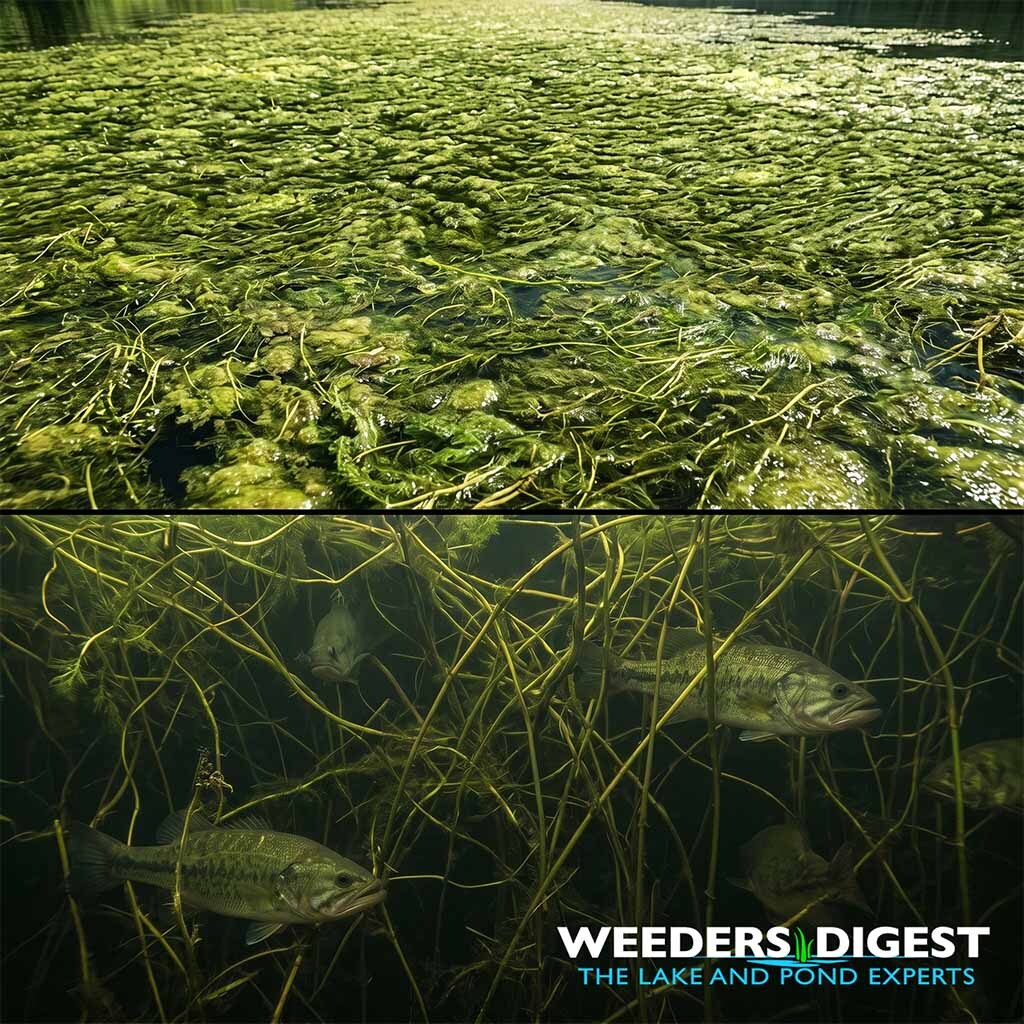
You might look out at your pond or lake and see a lush, thick carpet of green aquatic plants, assuming it is a sign of a thriving, nutrient-rich ecosystem. However, this overabundance of vegetation is often a silent killer for the fish living beneath the surface. While a healthy amount of plant life provides necessary habitat, an unchecked weed explosion throws the entire waterbody out of balance, creating a hostile and dangerous environment for aquatic life.
The most immediate threat your fish face from too many weeds is suffocation. Aquatic plants produce oxygen during the daylight hours, but when the sun goes down, that process reverses. The plants begin to consume oxygen. If your waterbody is choked with vegetation, these plants will suck massive amounts of oxygen out of the water throughout the night. By early morning, oxygen levels can drop so low that fish simply cannot breathe, leading to devastating and sudden fish kills. This risk skyrockets when those massive weed beds naturally die off and rot, as the decay process consumes even more oxygen.
Beyond the threat of suffocation, severe weed overgrowth ruins the natural food chain in your water. Predatory fish, like bass, rely on open swimming lanes to hunt. When weeds become an impenetrable underwater jungle, these larger predators cannot reach the smaller fish to feed. As a result, the smaller fish overpopulate, eat up all the available food resources, and stop growing. You are eventually left with a body of water filled with skinny, stunted panfish and a struggling population of large game fish.
The Science Behind It:
The relationship between dense macrophyte biomass and fish mortality is fundamentally tied to extreme diurnal fluctuations in dissolved oxygen (DO) concentrations. Through the process of photosynthesis, submerged aquatic vegetation (SAV) supersaturates the water column with oxygen during periods of high solar radiation. However, during nocturnal hours, the cessation of photosynthesis coupled with high rates of plant cellular respiration creates a severe oxygen deficit. In eutrophic lentic systems dominated by dense macrophyte canopies, this biological oxygen demand frequently drives early-morning DO concentrations below the 3.0 to 5.0 mg/L threshold required for most teleost survival, inducing acute hypoxia or anoxia.
This dissolved oxygen crisis is severely exacerbated during periods of macrophyte senescence. As vast quantities of plant biomass die—whether due to seasonal temperature shifts, prolonged cloud cover, or natural lifecycle completion—the subsequent bacterial decomposition exerts an immense biochemical oxygen demand (BOD) on the water column. Aerobic bacteria rapidly strip the remaining oxygen from the aquatic environment to metabolize the detritus. According to limnological research published by university extension programs, including guidelines from the University of Florida IFAS, this decomposition phase is the primary catalyst for large-scale, catastrophic summer and winter fish kills in heavily vegetated lakes.
Furthermore, structural habitat complexity directly influences piscivore foraging efficiency and predator-prey dynamics. While a moderate coverage of aquatic vegetation (typically 20 to 40 percent) provides optimal nursery habitats, macrophyte densities exceeding this threshold severely inhibit the visual and physical hunting mechanics of apex predators. Research by Savino and Stein (1982) demonstrated that as the stem density of submerged vegetation increases, the capture success rate of visual predators like Micropterus salmoides (largemouth bass) declines exponentially, effectively providing an absolute refuge for prey species such as Lepomis macrochirus (bluegill).
This disruption in trophic interactions leads to severe population imbalances characterized by density-dependent growth depression. Because the piscivores are unable to effectively crop the planktivorous and insectivorous fish populations, the prey species experience unchecked recruitment. The localized carrying capacity of the ecosystem is quickly exhausted as intra-specific competition for zooplankton and benthic macroinvertebrates intensifies. The resulting demographic shift produces a stunted prey fish assemblage with exceptionally low relative weights, while the isolated predators suffer from caloric deficits and reduced fecundity.
Ultimately, macrophyte overgrowth accelerates the transition of a clear-water, balanced trophic state into a functionally degraded ecosystem. The dense vegetation limits wind-driven mixing, leading to intense thermal and chemical stratification. As organic matter accumulates in the benthic zone and dissolved oxygen remains chronically low in the hypolimnion, toxic byproducts such as hydrogen sulfide and ammonia are released from the sediment. This hostile biochemical environment restricts habitable volume, forcing fish into narrow, highly stressed epilimnetic zones, thereby compromising the overall ecological integrity and secondary productivity of the lake.
Sources / References:
- University of Florida IFAS Extension: "The Role of Aquatic Phanerogams in Eutrophication and Fish Kills" - https://edis.ifas.ufl.edu/publication/FA043
- Penn State Extension: "Pond Ecology: Managing Aquatic Plants and Fish Populations" - https://extension.psu.edu/pond-ecology