

Keeping Your Waterways Clear: My Professional Guide to Mechanical Weed Harvesting and Aquatic Equipment
 |

Summary:
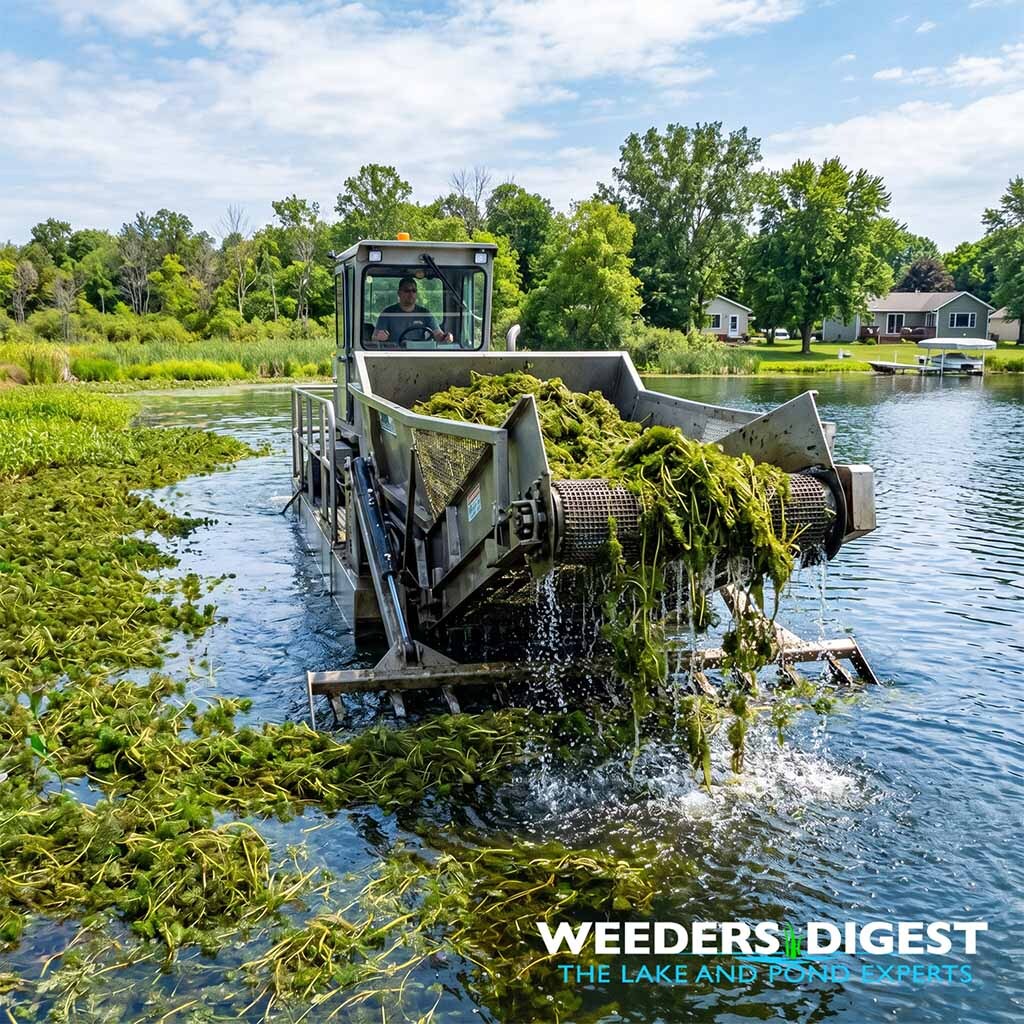
Mechanical control science and the use of specialized aquatic weed equipment is a highly reliable, non-chemical method for instantly restoring usability, clear water, and open channels to heavily infested lakes and ponds. Unlike chemical treatments that leave dead vegetation to rot on the lake bed, mechanical harvesting physically lifts the targeted plant biomass completely out of the water system. This industrial-grade approach cuts the nuisance vegetation below the surface, collects the stalks, and transfers them to the shoreline for proper disposal. This process is highly favored by waterfront property owners who want immediate results without swimming restrictions, chemical withdrawal periods, or the risk of sudden dissolved oxygen depletion caused by massive, in-lake plant decay.
During my years managing freshwater systems as a Certified Lake Manager, I have frequently stepped onto shorelines where well-meaning property owners used improper cutting equipment or cleared areas at the wrong time of year, only to inadvertently trigger an explosive, aggressive resurgence of fragmented weeds across the entire lake. When performed incorrectly or without strategic planning, mechanical harvesting can slice plants into thousands of viable fragments that drift, root, and establish brand new colonies. To achieve true long-term control, mechanical methods must be treated as a rigorous, data-driven science that balances equipment capabilities with the reproductive lifecycles of the target aquatic plant species.
The Science Behind It:
The efficacy and ecological impact of mechanical control are governed by the physiological response of aquatic macrophytes to physical trauma. When an aquatic harvester deploys its specialized sickle bars to sever plant stems, it radically alters the structural dynamics of the submersed or emergent plant community. This management technique can cause a significant shift in the aquatic plant community depending on the timing and execution of the harvest (Madsen, 2000). For example, deep-water harvesting below the surface of the water has been shown to successfully reduce the dominance of aggressive, invasive clones while allowing native, low-growing, submerged species the light and space needed to recolonize the lake floor (Lishawa et al., 2017).
However, the primary technical challenge of mechanical harvesting is the management of vegetative fragments. Many of the most problematic invasive aquatic weeds, such as Egeria densa (Brazilian elodea), Hydrilla verticillata, and Myriophyllum spicatum (Eurasian watermilfoil), propagate primarily through fragmentation. Research demonstrates that while a single mechanical cutting temporarily reduces submersed biomass, the cutting process generates numerous plant fragments that exhibit remarkably high survival and anchoring rates in the sediment (Thiébaut, 2023). To counteract this, modern mechanical control equipment must utilize secondary containment nets and high-efficiency shore conveyors to capture and remove free-floating fragments before they can disperse via wind and water currents to form new beds.
The frequency and timing of mechanical harvesting also play a critical role in determining whether a plant community recovers or collapses. Academic studies indicate that the frequency of cutting has a highly significant effect on controlling final dry plant biomass. In controlled experiments on invasive macrophytes, executing two targeted mechanical removals over a season significantly reduced the final dry plant biomass down to $0.753\text{ g } \pm \text{ } 0.058\text{ g}$, compared to a dense unmanaged control biomass of $2.480\text{ g } \pm \text{ } 0.273\text{ g}$ (Thiébaut, 2023). Furthermore, the timing of the harvest is vital; conducting removals in the late summer can produce fragments with lower overall regeneration and colonization abilities compared to fragments generated during aggressive spring growth phases (Thiébaut, 2023).
Additionally, the intensity of the mechanical harvest directly governs the plant's long-term recovery time and its ability to produce reproductive structures. High-intensity mechanical harvesting severely limits the development of lateral branches and curtails asexual reproduction. Research on Hydrilla verticillata shows that as harvesting intensity increases, the formation of over-wintering subterranean structures, known as winter buds or turions, decreases sharply (Zhu et al., 2022). Specifically, when harvesting intensities were escalated across a gradient of 15%, 30%, 45%, 60%, and 75% biomass removal, the final plant biomasses dropped predictably to 66.61%, 49.13%, 43.95%, 43.77%, and 29.94% of the unharvested control groups, respectively (Zhu et al., 2022). Implementing medium-to-high intensity repeated harvests during peak growth seasons not only suppresses weed height but also successfully inhibits the propagation of phytoplankton, actively improving overall lake water quality (Zhu et al., 2022).
Sources / References:
- Lishawa, S. C., Carson, B. D., Brandt, J. S., Tallant, J. M., Reo, N. J., Albert, D. A., Monks, A. M., Lautenbach, J. M., & Clark, E. (2017). Mechanical harvesting effectively controls young Typha spp. invasion and unmanned aerial vehicle data enhances post-treatment monitoring. Frontiers in Plant Science, 8, Article 00619. https://doi.org/10.3389/fpls.2017.00619
- Madsen, J. D. (2000). Advantages and disadvantages of aquatic plant management techniques. Defense Technical Information Center. https://doi.org/10.21236/ada392169
- Thiébaut, G. (2023). Impact of mechanical removal on the regeneration and colonization abilities of the alien aquatic macrophyte Egeria densa. Life, 13(10), Article 2004. https://doi.org/10.3390/life13102004
- Zhu, S., Wu, X., Zhou, M., Ge, X., Yang, X., Wang, N., Lin, X., & Li, Z. (2022). Effects of harvesting intensity on the growth of Hydrilla verticillata and water quality. Sustainability, 14(22), Article 15390. https://doi.org/10.3390/su142215390