

Mastering Your Pond: How pH Levels Influence the Efficacy of Aquatic Herbicides
 |

Summary:
The pH level of your pond water is one of the most critical factors determining whether an aquatic herbicide treatment successfully clears out nuisance weeds or completely fails. When you mix an aquatic herbicide, the carrier water isn't just a vehicle for delivery; it is a chemically active environment. If the water is too alkaline (high pH) or too acidic (low pH), it can prematurely break down the herbicide's active ingredients or lock them up so that target plants cannot absorb them.
In our years managing diverse water bodies, we have frequently stood on a pond bank testing water with a digital meter, watching a property owner look on in surprise when we explain why a previous DIY application failed. It is incredibly common to see a pond owner apply a high-quality weak-acid herbicide into an alkaline limestone-fed pond, only to get zero results because the water's chemical makeup neutralized the active ingredients before they could even penetrate the plant tissue. Understanding this hidden dynamic is the secret to getting a clear, healthy pond on the first try without wasting time or money.
The impact of pH primarily manifests through two main pathways: alkaline hydrolysis, which rapidly degrades certain chemical bonds in high-pH environments, and altered molecular ionization, which dictates how easily a plant's cuticle can absorb the applied compound. While most homeowners assume a herbicide remains stable once mixed, the wrong chemical environment can reduce a product's lifespan from weeks down to a matter of mere hours. By testing your water and adjusting the tank mix accordingly, you can ensure that your lake management efforts yield maximum results.
The Science Behind It:
The relationship between water pH and herbicide performance is governed by fundamental principles of chemical thermodynamics and plant physiology. When a herbicide active ingredient is introduced to water, it interacts with dissolved hydronium (H_3O^+) and hydroxyl (OH^-) ions. According to data published by the Purdue University Extension Service, a single unit shift on the pH scale represents a tenfold change in hydrogen ion concentration, meaning water at a pH of 9.0 is 100 times more alkaline than neutral water at a pH of 7.0. This dramatic shift fundamentally alters the solubility, stability, and chemical structure of the applied compounds.
One of the primary mechanisms of failure in high-pH water is alkaline hydrolysis, a chemical process where hydroxyl ions attack the ester or amide bonds of a pesticide, splitting the molecule into inactive, non-toxic components. Research compiled by the Mississippi State University Extension Service highlights that weak acid and weak alkaline herbicides exhibit drastically altered half-lives based strictly on the pH of the carrier solution. For instance, certain susceptible pesticides that remain chemically stable for over 100 days in slightly acidic environments can experience a half-life reduction down to less than 24 hours when the pH exceeds 8.5.
Beyond structural degradation, pH directly influences the ionization state of weak acid herbicides, such as glyphosate and triclopyr. Every weak acid herbicide possesses a characteristic acid dissociation constant (pK_a). When the pH of the water carrier is significantly higher than the herbicide's pK_a, the molecules lose a proton and acquire a negative electrical charge. Because the waxy cuticle of an aquatic plant leaf is also negatively charged, these ionized herbicide molecules are electrostatically repelled by the target weed's surface, severely limiting chemical absorption and subsequent translocation throughout the plant's vascular network.
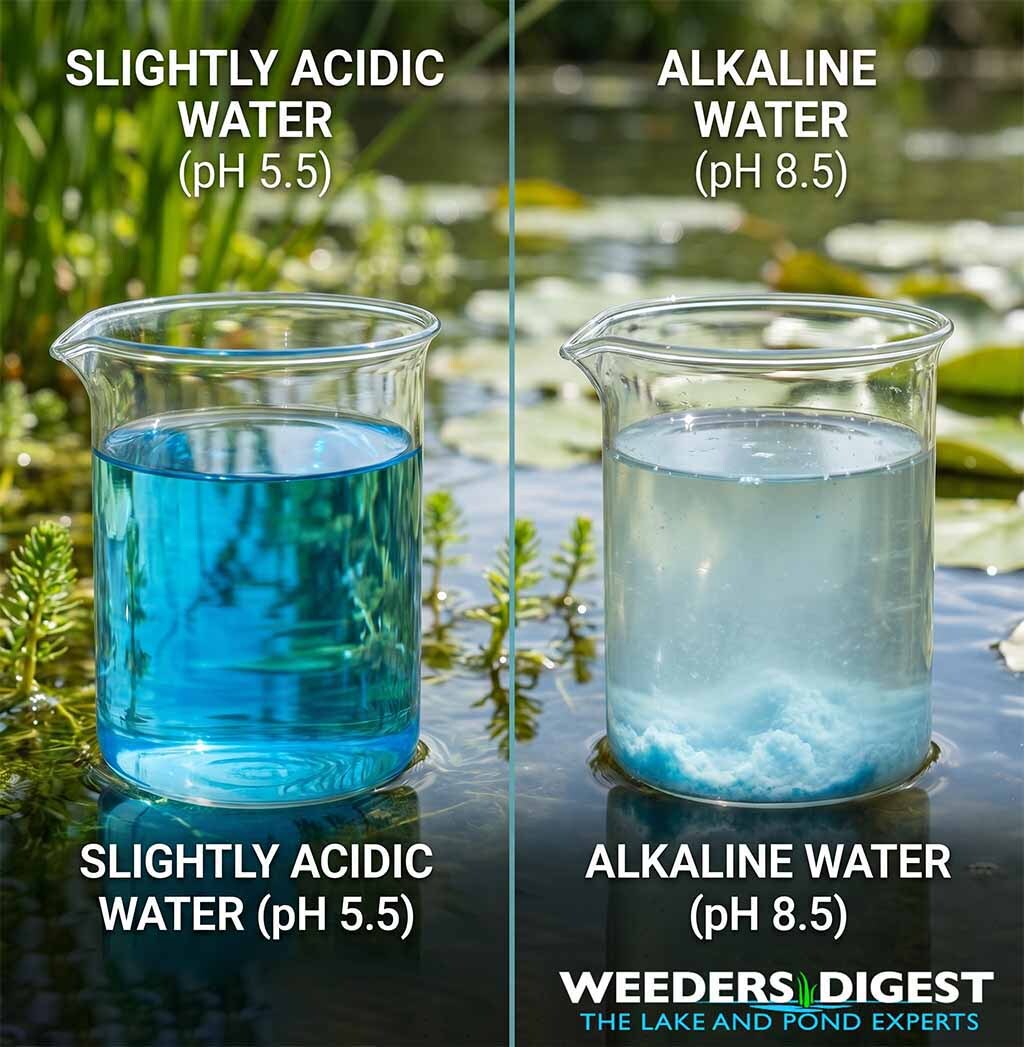
Conversely, excessively low pH levels also introduce specific chemical complications, particularly regarding solubility. Academic research from Purdue University detailing the properties of saflufenacil demonstrated that its solubility was severely compromised by extreme shifts in acidity; the herbicide's solubility plummeted from 3,687 mg L^-1 at a neutral pH of 7.7 down to a mere 10 mg L^-1 when the pH dropped to an acidic 4.0. When an herbicide loses solubility, it precipitates out of the solution as a solid crystal or sludge, rendering it entirely unavailable for plant uptake and frequently clogging application equipment.
Sources / References:
- Purdue University Extension Service (The Impact of Water Quality on Pesticide Performance): https://www.extension.purdue.edu/extmedia/ppp/ppp-86.pdf
- Mississippi State University Extension Service (Water Quality and Herbicide Efficacy): https://extension.msstate.edu/publications/water-quality-and-herbicide-efficacy
- Purdue University Research Repository (The influence of water pH, water hardness, and co-applied herbicides): https://docs.lib.purdue.edu/dissertations/AAI1535139/