

My Complete Guide to Reclaiming Your Lake: The Role of Benthic Barriers in Suppressing Rooted Aquatic Plants
 |

Summary:
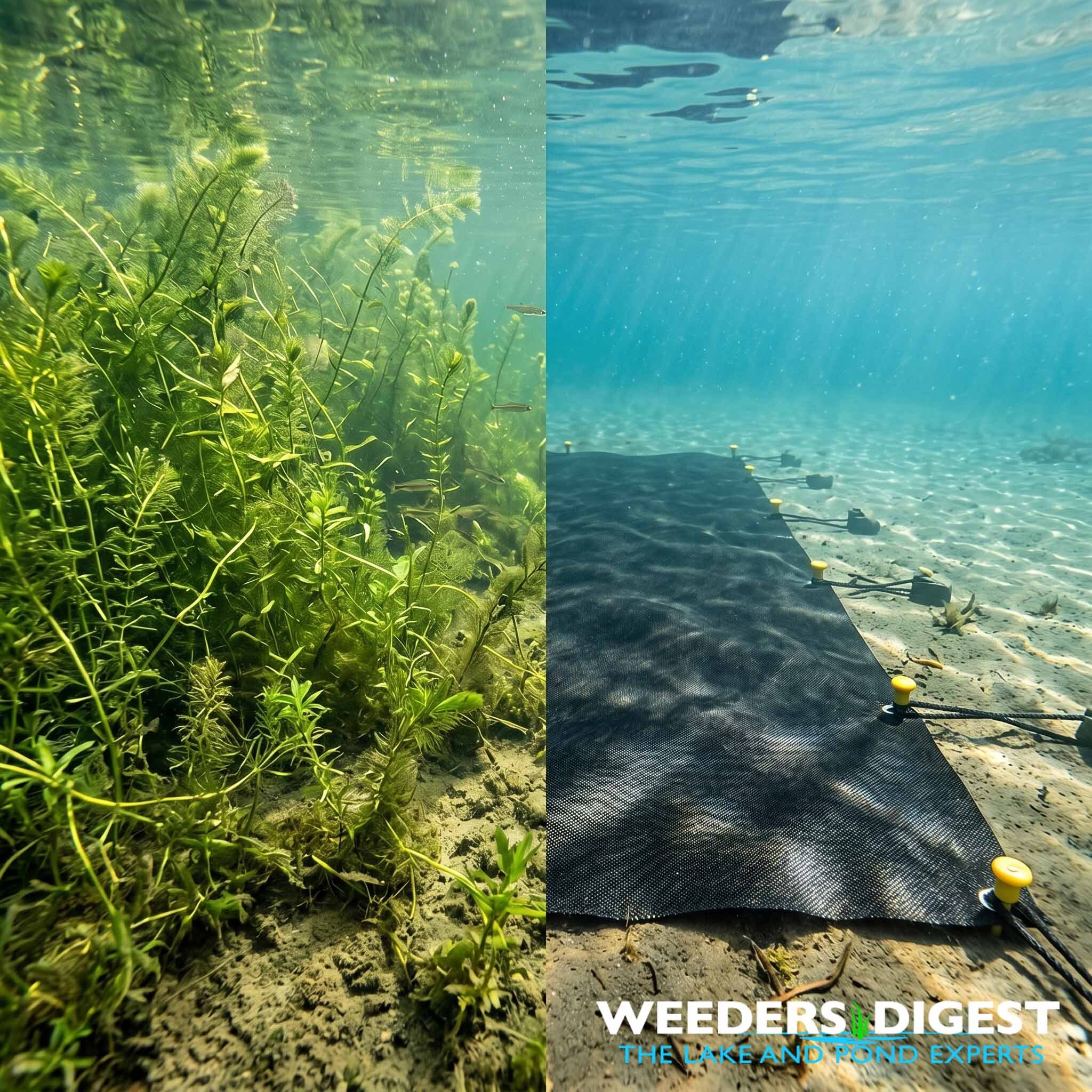
Benthic barriers are essentially underwater weed mats that physically suppress rooted aquatic plants by blocking the sunlight they need to photosynthesize and preventing them from growing upward into the water column. When you place these specialized geotextile mats directly over the lakebed, they smother invasive species and deprive them of the energy required to survive, effectively clearing out dense weed beds without the use of chemical herbicides.
As a Certified Lake Manager, one of my favorite field observations is watching a homeowner's reaction when we pull back a benthic mat after a couple of months in the water. You can visibly see a perfect, rectangular footprint of clean, weed-free sediment surrounded by an aggressive jungle of milfoil or hydrilla, proving just how powerfully a simple physical barrier can reclaim a swimming area or boat slip.
These barriers are particularly useful for targeted management around high-traffic zones like private docks, swimming beaches, and narrow channels where your family wants clear water. Because they are a pesticide-free alternative, they offer an environmentally friendly way to instantly improve the usability of your shoreline while slowly exhausting the root systems of the targeted weeds trapped beneath them.
The Science Behind It:
Benthic barriers control rooted macrophyte populations through two primary mechanisms: light attenuation and physical confinement. Submerged aquatic vegetation relies heavily on photosynthetically active radiation (PAR) penetrating the water column to drive the carbohydrate synthesis necessary for biomass production and root expansion. By deploying opaque or semi-opaque geotextile fabrics directly over the benthic zone, managers effectively sever the photic connection. Deprived of solar radiation, macrophytes are forced to consume their stored carbohydrate reserves located within their rhizomes or root crowns. Once these metabolic reserves are exhausted, cellular necrosis begins, leading to the gradual die-off of the plant structure beneath the barrier.
The physical weight and tensile strength of the barrier also inhibit the vertical elongation of shoots. The materials used, ranging from synthetic woven plastics to biodegradable jute or burlap, prevent vegetative fragments and propagules from establishing themselves in the sediment. Research published in Invasive Plant Science and Management evaluated the efficacy of geotextile barriers on Eurasian watermilfoil (Myriophyllum spicatum). The study demonstrated that a barrier deployment duration of just four weeks reduced Eurasian watermilfoil biomass by 75%, while durations of eight, ten, and twelve weeks achieved a 100% reduction in weed biomass.
However, the efficacy of benthic barriers is highly dependent on continuous maintenance and the prevention of sediment accumulation on top of the fabric. In lake ecosystems, autochthonous materials like decaying algae and allochthonous inputs like terrestrial soil constantly settle out of the water column. If enough sediment accumulates over the barrier, invasive macrophytes can root directly into this newly deposited substrate, entirely bypassing the barrier's suppressive effects. The same study evaluating Eurasian watermilfoil found that when sediment depths on top of the barrier reached 4 centimeters, root and shoot biomass actually increased compared to untreated controls, highlighting that strict maintenance and periodic sweeping of the mats are ecologically necessary to maintain suppression.
Furthermore, benthic barriers temporarily alter the localized biogeochemistry of the sediment-water interface. By capping the sediment, these mats can restrict gas exchange, leading to hypoxic or anoxic conditions directly beneath the fabric. While this localized anoxia accelerates the decay of the targeted macrophyte rhizomes, it also causes the accumulation of gases like methane and hydrogen sulfide resulting from anaerobic bacterial decomposition. To prevent these gases from ballooning the barrier and lifting it into the photic zone, modern installations require synthetic venting or strategic weighting, ensuring the barrier remains flush against the lakebed for optimal physical and biological suppression.
Sources / References:
- https://www.cambridge.org/core/journals/invasive-plant-science-and-management/article/efficacy-of-benthic-barriers-as-a-control-measure-for-eurasian-watermilfoil-myriophyllum-spicatum/A065DEC89EA03F4599DD8E89384A74BD
- https://www.researchgate.net/publication/273673500_Efficacy_of_Benthic_Barriers_as_a_Control_Measure_for_Eurasian_Watermilfoil_Myriophyllum_spicatum