

My Deep Dive Into the Real Biomass Removal Efficiency of Aquatic Harvesters
 |

Summary:
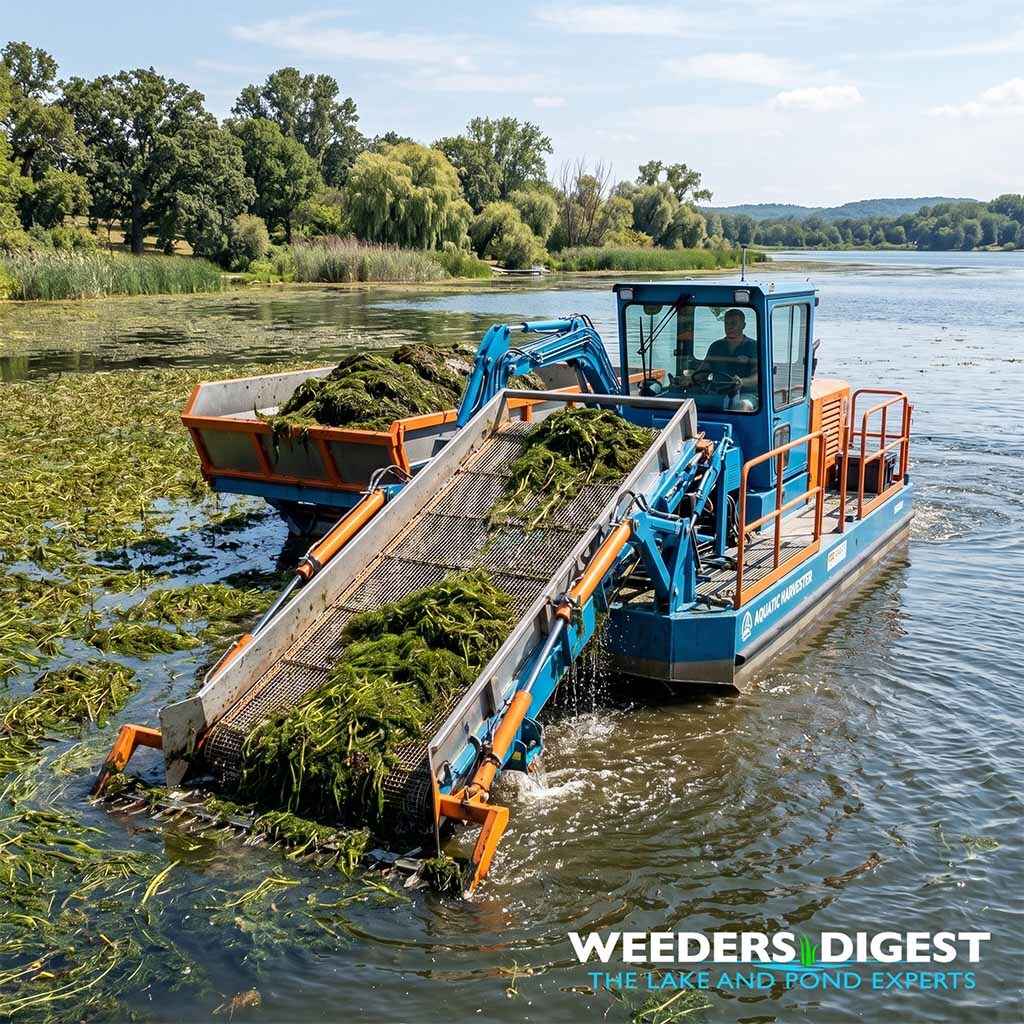
Mechanical aquatic harvesters are highly effective tools that can instantly clear choked waterways, but their true biomass removal efficiency depends heavily on whether you are dealing with free-floating or submersed vegetation. When navigating these large machines across your lake or pond, a harvester acts like an underwater lawnmower, physically cutting and lifting heavy mats of weeds directly out of the ecosystem. While they provide immediate aesthetic relief and an eco-friendly alternative to chemical treatments, their operational efficiency varies wildly based on the structural characteristics and water content of the targeted target plants.
When I am out on the water operating or managing a mechanical harvesting project, the sheer weight of the hauled material is always a logistically humbling reminder of what is happening beneath the surface. I frequently watch the storage bunk fill up in mere minutes when tackling dense, interwoven mats, forcing us to spend a significant portion of our field hours traveling back to the shoreline just to offload thousands of pounds of wet material. This constant cycle of cutting, hauling, and offloading dictates the true pace and economic efficiency of any large-scale mechanical mitigation project.
For free-floating plants like water hyacinth, the harvester faces massive physical loads because these dense populations can easily average an astonishing 150 tons of fresh weight per acre. Compounding this challenge is the fact that free-floating weed mats are structurally volatile; the physical impact and seismic stress applied by the harvesting hull causes the outer perimeter of the mat to fracture. Field research shows that as much as 20% of an intact floating mat can break off and scatter during harvesting operations, which severely hampers the machine’s net collection efficiency and requires extensive secondary skimming.
Conversely, managing submersed weeds that grow entirely underwater—such as Eurasian watermilfoil or curly-leaf pondweed—presents a completely different operational profile. Submersed vegetation yields significantly less physical mass, typically averaging only 10 to 15 tons of fresh weight per acre when the growth reaches the water surface. Because submersed species produce up to 15-fold less biomass per acre compared to free-floating species, an aquatic harvester can cover substantially more acreage before needing to return to the shore to offload its cargo, making the structural management of submersed plants far more logistically streamlined.
The Science Behind It:
To fully comprehend the operational efficiency of mechanical harvesting, it is necessary to evaluate the physiological profile of aquatic macrophytes and the mechanical dynamics of the harvesting vessels. Aquatic plants are characterized by extraordinarily high water content compared to terrestrial plants. In free-floating species such as water hyacinth (Eichhornia crassipes), fresh biomass consists of approximately 95% water (Sperry et al., 2021). Consequently, when a harvester extracts an average load of 150 tons of fresh material per acre, it is moving approximately 32,300 gallons of water trapped within the plant tissue, yielding a true dry weight biomass removal of only 7.5 tons per acre (Sperry et al., 2021). This drastic wet-to-dry weight ratio places immense mechanical strain on hydraulic lifting systems and elevates transport costs, while removing a comparatively small amount of solid organic matter.
Submersed macrophytes, by contrast, are limited by carbon dioxide diffusion and light attenuation in the water column, preventing them from developing the dense, fibrous supporting structures seen in emergent or floating vegetation. This ecological constraint limits their total standing crop. Because submersed species exhibit an average fresh weight of 12 tons per acre at maximum peak biomass, the volumetric demand on the harvester's storage conveyor is dramatically reduced (Sperry et al., 2021). The 15-fold reduction in total weight allows the machine to sustain continuous cutting operations across larger surface areas, optimizing fuel consumption and minimizing non-productive transit time to disposal sites.
Beyond simple volumetric extraction, mechanical harvesting is frequently utilized as a remediation strategy for nutrient renovation. As macrophytes grow, they assimilate dissolved nitrogen and phosphorus from the water column and benthic sediments into their living tissue. Mechanical harvesting acts as a direct export mechanism, permanently removing these assimilated nutrients from the lacustrine system and preventing them from recycling back into the water column during autumn senescence. This stands in stark contrast to herbicide applications, which cause rapid plant die-off, leading to microbial decomposition that depletes dissolved oxygen and releases bound nutrients back into the water, frequently triggering secondary harmful algal blooms.
However, the efficacy of harvesting as a lake-wide nutrient reduction tool depends entirely on the broader nutrient budget of the watershed. Quantitative evaluations indicate that while harvesting large volumes of aquatic vegetation can remove significant absolute masses of nutrients, these figures are often negligible when contrasted against the total internal loading stored within the lake’s active sediment layer. For example, historical modeling in the Rotorua Te Arawa Lakes demonstrated that an annual harvesting operation extracting over 3,200 tonnes of wet weed mass succeeded in removing less than 6 tonnes of nitrogen from the system (Matheson & Clayton, 2002). When compared to the 2,000 tonnes of nitrogen sequestered within just the upper 5 centimeters of the lake's sediment, and the 450 tonnes circulating in the water column, the net renovation efficiency proved insufficient to alter overall water column nutrient concentrations or arrest eutrophication (Matheson & Clayton, 2002).
Furthermore, the mechanical cutting action introduces distinct ecological trade-offs that can alter community structures. Harvesting vessels cutting dense monocultures, such as invasive cattails (Typha spp.), alter light penetration and physical space. Studies tracking mechanical removal have demonstrated that cutting invasive biomass below the water surface effectively drowns the target species by cutting off gas exchange to the rhizomes, leading to a significant reduction in dominant invasive cover and a corresponding expansion of native floating and submersed plant guilds (Lishawa et al., 2017). Conversely, operators must account for mechanical fragmentation; species like Eurasian watermilfoil reproduce primarily via autofragmentation. If the harvester’s cutter bar creates fragments that escape the collection conveyor, these viable plant tissues can drift, root in uninfested substrates, and unintentionally accelerate the propagation of the target weed throughout the waterbody.
Sources / References:
- Lishawa, S. C., Carson, B. D., Brandt, J. S., Tallant, J. M., Reo, N. J., Albert, Dennis A., Monks, A. M., Lautenbach, J. M., & Clark, E. (2017). Mechanical harvesting effectively controls young Typha spp. invasion and unmanned aerial vehicle data enhances post-treatment monitoring. Frontiers in Plant Science, 8, 619. https://doi.org/10.3389/fpls.2017.00619 (Cited by: 71)
- Matheson, F., & Clayton, J. (2002). Aquatic plant harvesting in lakes for nutrient renovation. National Institute of Water & Atmospheric Research (NIWA) Report. https://researchcommons.waikato.ac.nz/bitstreams/e685e44f-0030-48c6-bd79-fc4bf23afa95/download
- Sperry, B. P., Haller, W. T., & Ferrell, J. A. (2021). Mechanical harvesting of aquatic plants. U.S. Army Corps of Engineers, Engineer Research and Development Center. https://corpslakes.erdc.dren.mil/employees/invasive/pdfs/MechanicalHarvesting.pdf