

My Front-Row Seat to the Flow: How 360-Degree Oscillating Currents Reshape Your Waterfront
 |

Summary:
Oscillating current technologies prevent aquatic weed stagnation and overgrowth by creating a continuous, high-velocity, 360-degree mechanical stress zone that disrupts the calm, nutrient-rich environments where nuisance macrophytes thrive. In natural or artificial water bodies, submersed weeds require stable, low-energy conditions to anchor their roots, stretch their canopies toward sunlight, and absorb ambient dissolved nutrients. By introducing a mechanized, directional water flow that regularly cycles across a full radius, these systems transform stagnant littoral zones into dynamic, high-energy environments. This movement creates physical drag on flexible plant tissues, prevents the settling of organic muck, and strips away the stagnant boundary layers of water surrounding the plants, which limits their access to necessary gases and nutrients.
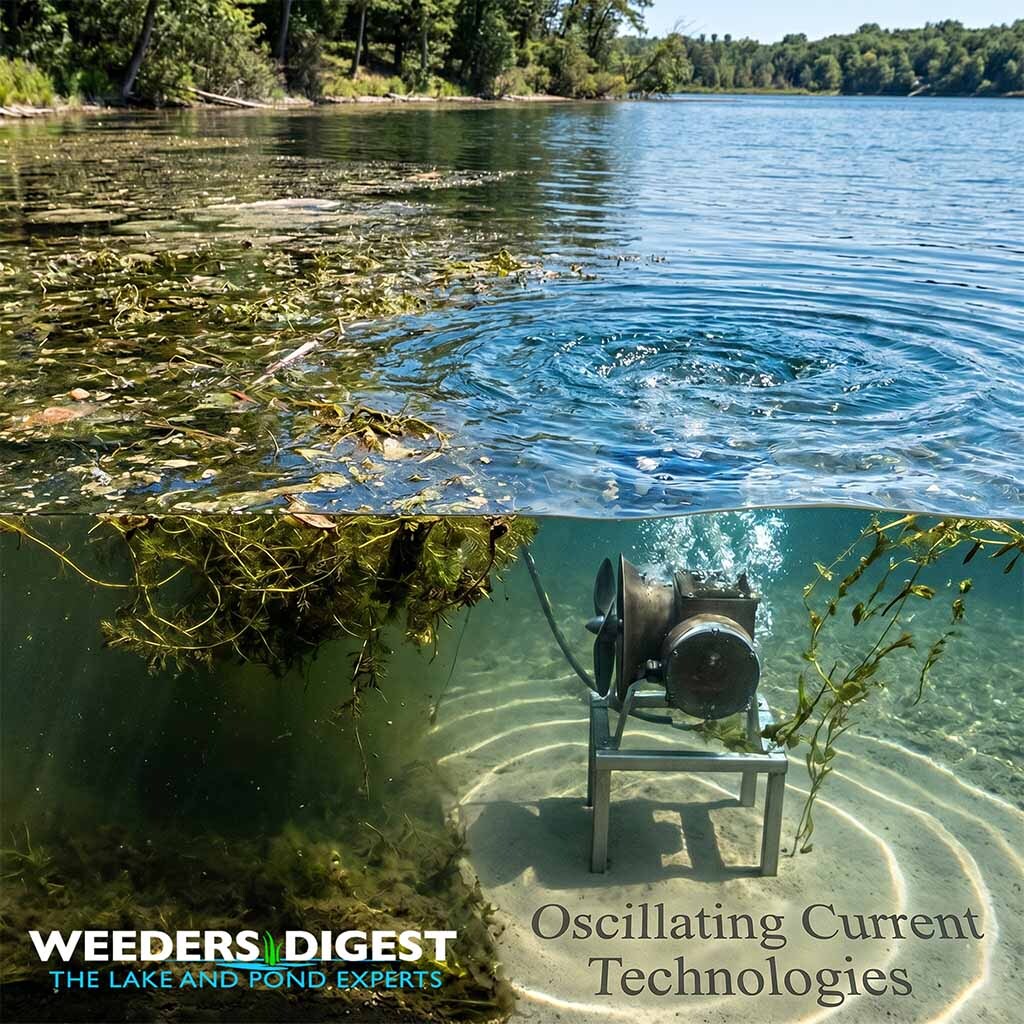
When managing a localized cove choked with Eurasian watermilfoil, the visual transformation brought by continuous water circulation becomes immediately evident. Out in the field, standing on a shoreline where an oscillating current system is actively running, you can immediately tell the difference between treated and untreated zones. In the stagnant pockets, dense mats of weeds collect floating organic debris, creating an unsightly scum layer that blocks out all sunlight. But where the oscillating water currents push through, the water column remains entirely clear, the weeds are visibly agitated, and the muck layer on the lake bed gradually thins out as the continuous movement prevents fine organic sediments from settling. This mechanical disruption destabilizes the local environment, ensuring that the water column remains too dynamic for aggressive weed species to establish a dominant hold.
The Science Behind It:
The targeted mitigation of nuisance aquatic macrophytes through oscillating water movement operates on foundational principles of fluid dynamics, mechanical stress, and plant physiology. Submersed aquatic plants have evolved to optimize nutrient absorption and structural development in low-velocity environments. When an artificial current technology introduces continuous, multi-directional flow, it subjects the plants to isotropic turbulent fluctuations. This hydrodynamic stress forces a dramatic shift in the plants' internal metabolic pathways. Specifically, continuous exposure to high turbulence velocities triggers the rapid generation of reactive oxygen species (ROS) within the plant tissues, inducing severe oxidative stress (Asaeda & Rashid, 2017).
To counter this mechanical strain, affected macrophytes are forced to divert significant metabolic energy away from normal shoot elongation and canopy development toward the production of enzymatic antioxidant systems, such as peroxidases and malondialdehyde (Asaeda & Rashid, 2017). Research evaluating the physiological response of submersed macrophytes to turbulent velocities has demonstrated that high turbulence directly inhibits normal metabolic activities. In controlled settings, completely submerged species exposed to elevated turbulence velocities show a sharp decrease in shoot elongation rates, stem and leaf diameters, and total chlorophyll content (Asaeda & Rashid, 2017). This structural stunting prevents the plants from reaching the upper layers of the water column, effectively limiting their access to solar radiation.
Beyond metabolic suppression, 360-degree oscillating currents fundamentally alter the boundary layers that dictate nutrient transport between the water column and the plant tissue. In completely stagnant water, a thick, stagnant boundary layer forms around the leaves and stems of macrophytes, allowing a localized equilibrium of dissolved oxygen and carbon dioxide to persist. When waves and oscillating currents flip and flex the plant blades back and forth, they generate substantial hydrodynamic forces that break down these boundary layers (Koehl & Daniel, 2022). This process accelerates mass and momentum exchange at the blade surfaces, destabilizing the fine-scale local water flow relative to the plant (Koehl & Daniel, 2022). While a steady, unidirectional current allows plants to reconfigure their shapes downstream to minimize drag, the multi-directional shifting of an oscillating current prevents this stream-lining effect, subjecting the vegetation to continuous structural fatigue.
Furthermore, water circulation heavily impacts the physical layout and temperature profiles of shallow littoral zones. Dense communities of littoral submerged macrophytes naturally act as severe resistance to water motion, retarding mean flows and drastically reducing vertical mixing (Torma & Wu, 2019). This reduction in flow creates localized thermal stratification and traps nutrients within the weed beds, facilitating runaway growth. By implementing active circulation technologies, water managers can break down these weak, weed-induced thermal barriers. Hydrodynamic modeling demonstrates that disrupting these stagnant configurations completely alters the velocity profiles and residence times of water near the lake bed, reversing the conditions that promote sediment-bound nutrient absorption and excessive biological transformations (Torma & Wu, 2019).
Sources / References:
- Asaeda, T., & Rashid, M. H. (2017). Effects of turbulence motion on the growth and physiology of aquatic plants. Limnologica, 62, 181–187. https://doi.org/10.1016/j.limno.2016.02.006 (Cited by: 39)
- Koehl, M. A. R., & Daniel, T. L. (2022). Hydrodynamic Interactions Between Macroalgae and Their Epibionts. Frontiers in Marine Science, 9. https://doi.org/10.3389/fmars.2022.872960 (Cited by: 17)
- Torma, P., & Wu, C. H. (2019). Temperature and Circulation Dynamics in a Small and Shallow Lake: Effects of Weak Stratification and Littoral Submerged Macrophytes. Water, 11(1), 128. https://doi.org/10.3390/w11010128 (Cited by: 30)