

My Guide to Aquatic Weed Identification: Best Practices for Your Lake or Pond
 |

Summary:
Managing your lake or pond starts with knowing exactly what is growing beneath the surface. It is incredibly easy to look at a thick mat of green plants and assume it is all just nuisance weed growth that needs to be removed. However, misidentifying these plants can lead to major headaches down the line. Proper aquatic weed identification allows you to understand whether you are dealing with a harmless native plant that actually keeps your water clean, or a highly invasive species threatening to take over your entire shoreline.
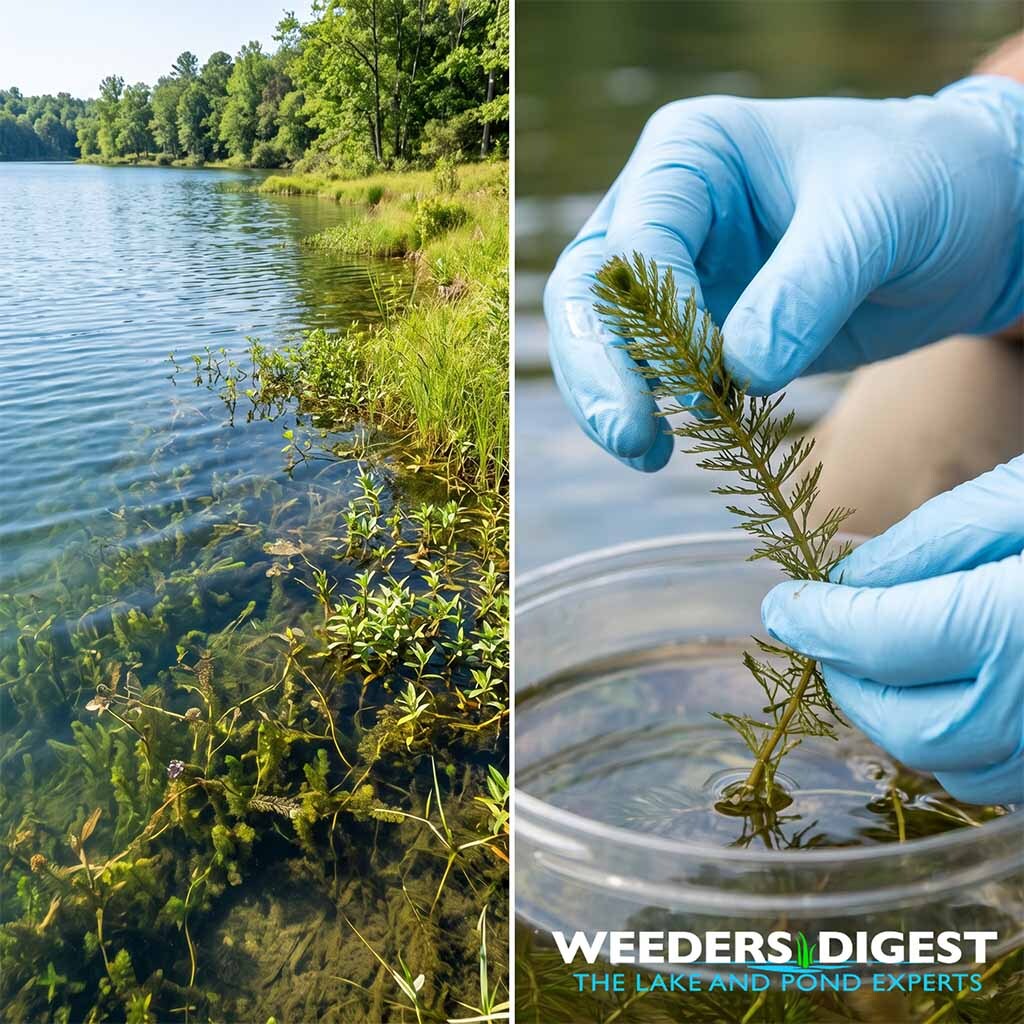
Aquatic plants generally fall into a few easy-to-spot categories based on where and how they grow. Submerged plants grow entirely underwater, often forming dense underwater forests that fish love. Floating plants have leaves that sit right on the surface, like lily pads or tiny duckweed. Finally, emergent plants are rooted in the shallow water near the shore but have stems and leaves that stand tall out of the water, like cattails. Knowing which category your plant belongs to is always the best first step in figuring out what it is.
Once you know the growth category, you can start looking closely at the plant's unique physical traits. Take note of how the leaves are arranged on the stem, the shape of the leaf edges, and whether the plant produces any small flowers. Some invasive plants look almost identical to beneficial native ones at first glance, but a closer look at the leaf structure will give away their true identity. Taking the time to properly identify your aquatic plants ensures that you protect the good vegetation that provides habitat for fish while successfully targeting the actual nuisance weeds causing problems on your property.
The Science Behind It:
The morphological classification of aquatic plants, or macrophytes, typically divides them into distinct functional groups based on their biological adaptations and zonation. Each group exhibits highly specialized tissues adapted to the physical constraints of aquatic environments. For instance, submerged aquatic vegetation (SAV) like Vallisneria americana and Ruppia maritima exhibit specific structural adaptations that allow them to accumulate nutrients and trace metals directly from the surrounding aquatic environment, playing a crucial role in overall carbon and nutrient cycling (Bielmyer-Fraser et al., 2022).
Beyond morphological identification, understanding the ecological context of a macrophyte community requires examining spatial distribution and environmental interactions. Submersed macrophytes act as essential habitats for aquatic organisms while simultaneously serving as bio-accumulators that trap sediment, reduce turbidity, and filter water column pollutants (Bielmyer-Fraser et al., 2022). Identifying variations between species often involves evaluating specific anatomical structures—such as perennating turions, winter buds, rhizomes, and whorl arrangements—that determine a plant's ability to propagate and spread across different depth gradients and shoreline proximities.
Accurate macrophyte identification is intrinsically linked to understanding shallow lake ecology, particularly the positive feedback systems that maintain alternative stable states of macrophyte-dominated clear water versus plankton-dominated turbid water (Phillips et al., 2016). A robust, diverse standing crop of native macrophytes actively sequesters nutrients, provides spatial refugia for grazing zooplankton against visual predators, and limits the proliferation of phytoplankton through resource competition and potential allelopathic exudates (Phillips et al., 2016). Misidentification that leads to the indiscriminate removal of these native species fundamentally alters the abiotic and biotic characteristics of a waterbody, predisposing the aquatic ecosystem to accelerated eutrophication and algal dominance.
From a limnological perspective, effective habitat management relies heavily on differentiating non-indigenous, invasive taxa from ecologically vital native populations before initiating any treatment protocols. Invasive species often exhibit rapid phenotypic plasticity and aggressive clonal expansion, rapidly outcompeting native communities and altering physical hydrology by slowing water movement and increasing sedimentation rates. Taxonomic accuracy using established dichotomous keys to evaluate leaf margin serrations, vascular tissue structures, and stipule morphology remains a critical first step. This scientific precision ensures that subsequent integrated management efforts accurately target detrimental invasive species without destabilizing the beneficial benthic environment required for a healthy, self-sustaining aquatic ecosystem.
Sources / References:
- Bielmyer-Fraser, G., Llazar, K., Ward, A., Trent, T., & Goldberg, N. (2022). Metal analysis of submerged aquatic vegetation in the lower St. Johns River, Florida. Environmental Monitoring and Assessment, 194. https://doi.org/10.1007/s10661-022-10159-9 (Cited by: 5)
- Phillips, G., Willby, N., & Moss, B. (2016). Submerged macrophyte decline in shallow lakes: What have we learnt in the last forty years? Aquatic Botany, 135, 37–45. https://doi.org/10.1016/j.aquabot.2016.04.004 (Cited by: 366)