

My Guide to Mastering Emergent vs. Submersed Aquatic Weeds in Your Lake

Summary:
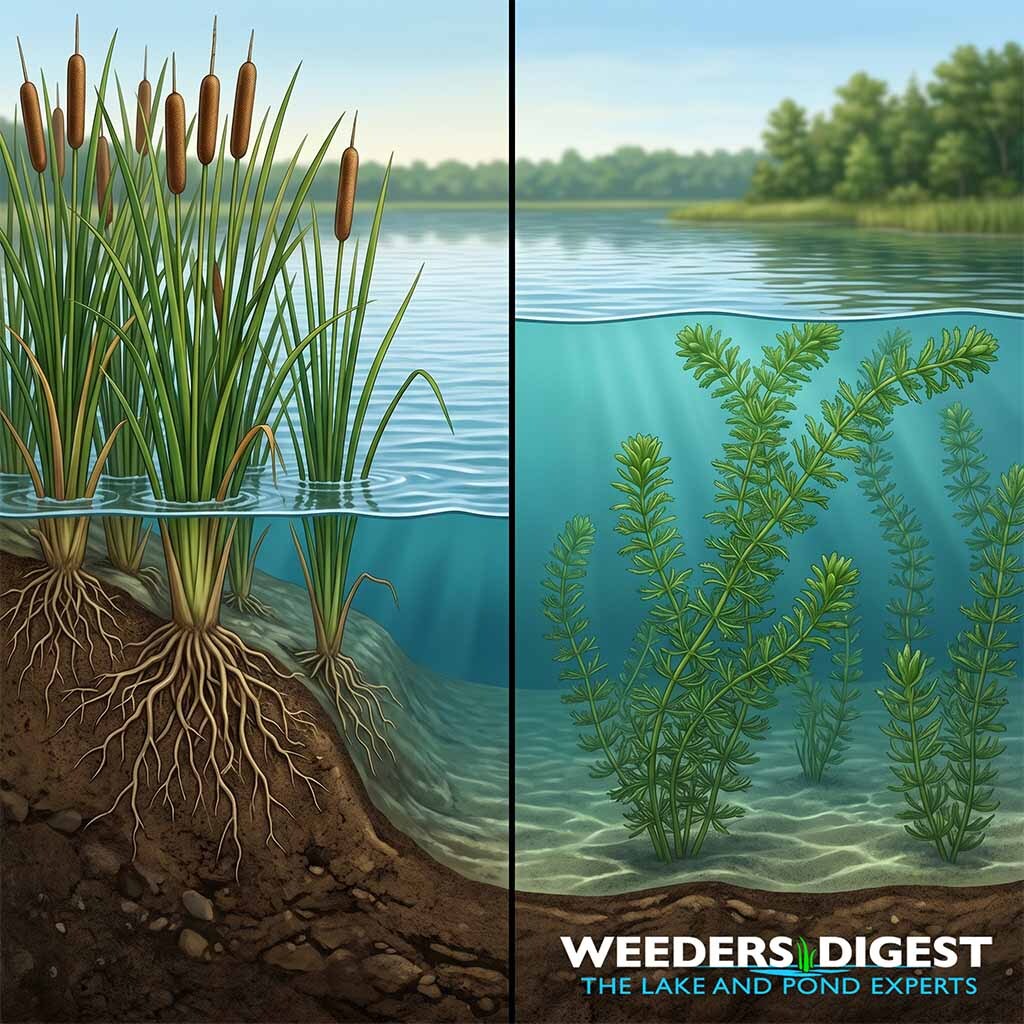
When dealing with an overgrown pond or lake, the very first thing you need to know is what kind of plant is taking over your water. Generally, aquatic weeds fall into two major groups based on how they grow: emergent and submersed. Emergent weeds are the plants you see sticking right up out of the water, usually hugging the shoreline. They have stiff, sturdy stems and look a lot like regular land plants that just happen to like wet feet. Cattails, reeds, and alligator weed are classic examples of this group. Because they grow mostly above the surface, managing them feels a lot like managing the tough weeds in your backyard garden.
Submersed weeds, on the other hand, are the sneaky ones. They grow almost entirely underwater and have soft, flexible stems that rely on the water's buoyancy to hold them up. You might not even notice them until they reach the surface and form thick, tangled mats that wrap around your boat propeller or snag your fishing line. Hydrilla, coontail, and Eurasian watermilfoil fall into this category. Because they live their entire lives underwater, they require a completely different set of rules when it comes to clearing them out of your lake.
You simply cannot treat these two types of plants the same way. If you try to manage submersed weeds using a method designed for emergent ones, or vice versa, you will end up frustrated and wasting your energy. For instance, submersed plants reproduce easily from tiny cut fragments, meaning the wrong kind of removal can accidentally spread them across your entire lake. Meanwhile, emergent plants have massive, tough root systems hidden deep in the mud, meaning basic surface-level cutting won't stop them from roaring right back. Understanding the difference is the crucial first step to getting your water clear again.
The Science Behind It:
Morphological and anatomical differences define the ecological niches of emergent and submersed aquatic macrophytes, fundamentally dictating the efficacy of specific management interventions. Emergent plants possess rigid, highly lignified stems and extensive rhizome networks that support aerial growth and carbohydrate storage. In contrast, submersed species feature soft, flexible stems lacking structural lignin, supported entirely by water buoyancy, and often exhibit finely dissected leaves adapted for underwater gas exchange and nutrient absorption (Stallings et al., 2015). Because submersed aquatic vegetation completes its life cycle primarily below the water surface, it interacts uniquely with the surrounding hydrodynamics, making its management highly dependent on water column conditions.
Chemical control mechanisms must be precisely tailored to these distinct structural and vascular traits. For emergent macrophytes, chemical management relies heavily on foliar application, requiring active ingredients to penetrate the waxy cuticle of the aerial leaves and translocate downward into dense rhizome structures to achieve total plant mortality. Submersed species, however, are surrounded by an aqueous medium, necessitating herbicide formulations that maintain specific concentration and contact times within the water column so they can be absorbed directly through submerged epidermal tissues (Richardson, 2008). Consequently, submersed treatments are highly susceptible to dilution, flow dynamics, and thermal stratification, whereas emergent foliar treatments are primarily impacted by environmental factors like rain wash-off.
Mechanical and physical management strategies also diverge significantly between the two plant categories. Managing emergent vegetation often requires specialized mechanical strategies to deal with the robust root and rhizome masses embedded in the shoreline substrate, as simply severing the aerial stalks without addressing the root structures usually results in rapid regrowth from stored energy reserves. Conversely, submersed aquatic plants are highly susceptible to mechanical fragmentation. While specialized weed cutters are highly effective at severing submersed plants at the roots to clear the water column, species like Hydrilla possess the evolutionary adaptation to reproduce vegetatively from severed stem fragments, meaning mechanical cutting must often be paired with concurrent biomass removal to prevent exacerbating an infestation (Stallings et al., 2015).
Biological controls further highlight the necessity for targeted approaches based on plant morphology. Herbivorous fish, such as the triploid grass carp, are frequently deployed as biological control agents for submersed species due to the soft, palatable nature of the underwater foliage and the accessibility of the plants within the water column (Schad & Dick, 2018). These biological agents are largely ineffective against emergent species, as the rigid, lignified tissues and above-water growth habit render emergent vegetation inaccessible and unpalatable to the fish. Ultimately, the successful, long-term restoration of aquatic environments relies on correctly identifying the structural classification of the target weed and deploying specialized, science-backed methodologies that exploit its specific physiological vulnerabilities.
Sources / References:
- Stallings, K. D., Seth-Carley, D., & Richardson, R. J. (2015). Management of Aquatic Vegetation in the Southeastern United States. Journal of Integrated Pest Management, 6(1), 3-3. https://doi.org/10.1093/jipm/pmv002(Cited by: 20)
- Richardson, R. J. (2008). Aquatic Plant Management and The Impact of Emerging Herbicide Resistance Issues. Weed Technology, 22(1), 8-15. https://doi.org/10.1614/wt-07-034.1 (Cited by: 71)
- Schad, A. N., & Dick, G. O. (2018). Aquatic vegetation community structure response to hydrilla management with triploid grass carp, herbicide, and native vegetation planting. Lake and Reservoir Management, 34(4), 417-425. https://doi.org/10.1080/10402381.2018.1475434 (Cited by: 8)