

My Lake is Changing: How Seasonal Stratification and Turnover Control Weed Growth
 |

Summary:
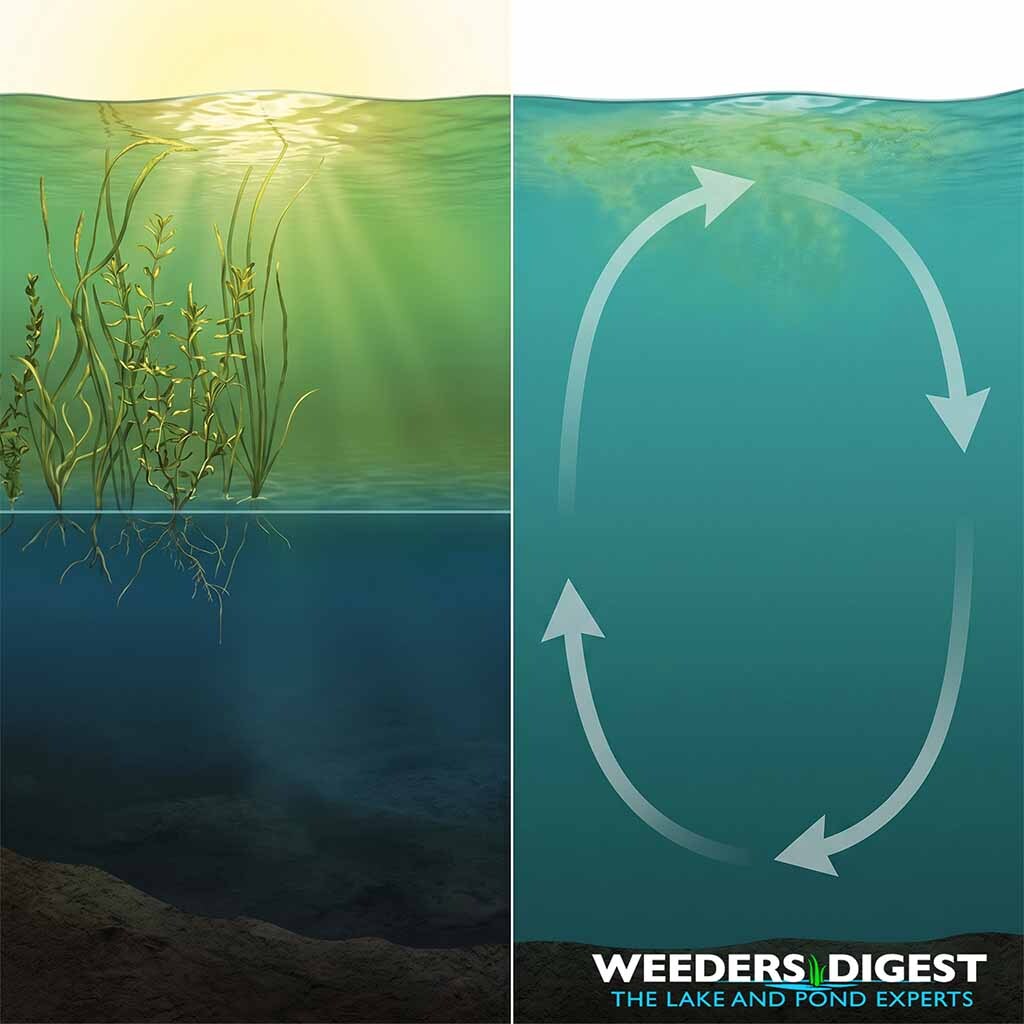
If you have ever noticed that your lake or pond suddenly transforms from a crystal-clear swimming hole in the spring into a choked, weed-infested soup by late summer, you are witnessing the direct effects of seasonal thermal stratification and lake turnover. This natural phenomenon acts as an invisible environmental clock, dividing your waterbody into distinct, isolated layers during the warm months and violently mixing them when the weather cools. This shifting physical structure acts as the primary governor for aquatic plant and algae growth, determining exactly when and where nuisance weeds can access the light and food they need to overtake your shoreline.
During my years as a Certified Lake Manager, I have frequently stood on docks in mid-July with frustrated homeowners who cannot understand why their shorelines are suddenly overwhelmed by dense matting weeds. When I lower a digital water quality probe into their water column, the data almost always tells the same story: a blistering hot, oxygen-rich upper layer sitting directly over a freezing, pitch-black, and completely suffocating bottom layer. This sharp physical boundary locks vast reserves of mineral nutrients down in the lake bed all summer long, effectively starving the open water while giving deep-rooted, invasive weeds like Eurasian watermilfoil a massive competitive advantage.
When autumn arrives, the cooling air temperatures trigger a dramatic reset known as fall turnover. The protective boundaries dissolve, the entire water column unifies in temperature, and the wind churns the lake from top to bottom. While this seasonal mixing is vital for the long-term health of the ecosystem, it simultaneously acts as a massive shot of adrenaline for aquatic vegetation by lifting months of accumulated phosphorus up into the sunlit surface waters. Understanding these hidden seasonal cycles is the absolute key to predicting weed outbreaks and successfully reclaiming your waterfront.
The Science Behind It:
The physical driving force behind seasonal weed dynamics is the unique thermodynamic properties of water, which achieves its maximum density at exactly 4°C (39.2°F). In temperate regions, deep waterbodies exhibit a "dimictic" pattern, meaning they undergo complete vertical mixing twice per year. As spring sunlight warms the surface water past this critical 4°C threshold, the surface water becomes significantly less dense than the underlying fluid. By early summer, this density differential resists the mixing power of the wind, splitting the lake into three distinct thermal zones: the warm, well-lit epilimnion at the surface; a narrow transition zone called the metalimnion or thermocline; and the cold, dark, and dense hypolimnion at the bottom.
This structural partitioning profoundly alters the chemical landscape of the lake ecosystem, directly impacting the life cycles of aquatic macrophytes. In a stratified state, the hypolimnion is completely isolated from atmospheric aeration. As benthic bacteria decompose organic matter drifting down from the surface, they rapidly consume the available oxygen. Once the hypolimnion reaches a state of anoxia (zero dissolved oxygen), a profound chemical shift occurs at the sediment-water interface. Under oxygenated conditions, ferric iron (Fe^3+) binds strongly with orthophosphate, locking phosphorus within the bottom muds. However, under anoxic conditions, iron is chemically reduced to its soluble ferrous form (Fe^2+), causing the bound phosphorus to untether and dissolve directly into the hypolimnetic water column.
Research published in Limnology and Oceanography demonstrates that internal phosphorus loading from anoxic sediments can increase dissolved reactive phosphorus concentrations in the hypolimnion by over 1,000% compared to springtime baseline levels. This concentrated nutrient pool remains largely inaccessible to free-floating phytoplankton trapped in the sunlit epilimnion far above. However, vascular rooted weeds—particularly aggressive, non-native species like Myriophyllum spicatum (Eurasian watermilfoil) and Potamogeton crispus (curly-leaf pondweed)—exploit this setup perfectly. Their root architecture allows them to tap directly into the hyper-enriched benthic substrate, fueling rapid vertical elongation through the dark hypolimnion until their photosynthetic canopy reaches the warm surface waters.
The transition from summer stratification to fall turnover completely reshapes these growth dynamics. As autumn air temperatures drop, the epilimnion loses heat to the atmosphere, increasing its density until it matches the 4°C water below. The thermal resistance to mixing vanishes, allowing wind energy to drive complete vertical circulation. According to long-term ecological data compiled by university extension programs, this total mixing event instantly redistributes the massive accumulation of hypolimnetic phosphorus throughout the entire water column, often elevating epilimnetic nutrient levels by 50% to 200% in a matter of days.
This sudden pulse of internal nutrient enrichment explains the late-season ecological shifts familiar to lake property owners. While the cooling water and shortening photoperiod cause many delicate, native macrophyte species to senesce and die back, the sudden surge in available orthophosphate triggers massive, opportunistic blooms of filamentous algae and cyanobacteria (blue-green algae). These late-season blooms can rapidly blanket the decaying weed beds, forming dense surface scums that alter light penetration and dissolved oxygen profiles right up until the winter ice sets in.
Sources / References:
- Clean Lakes Alliance (Lake Turnover Dynamics & Iron-Phosphorus Chemistry): https://www.cleanlakesalliance.org/lake-turnover/
- IISD Experimental Lakes Area (The Mechanics of Thermal Stratification): https://www.iisd.org/ela/blog/lakes-stratify-turn-explain-science-behind-phenomena/
- Wikipedia (Lake Stratification & Ecosystem Consequences): https://en.wikipedia.org/wiki/Lake_stratification