

Navigating Winter Shorelines: Should Your Dock and De-Icer Stay or Go?
 |

Summary
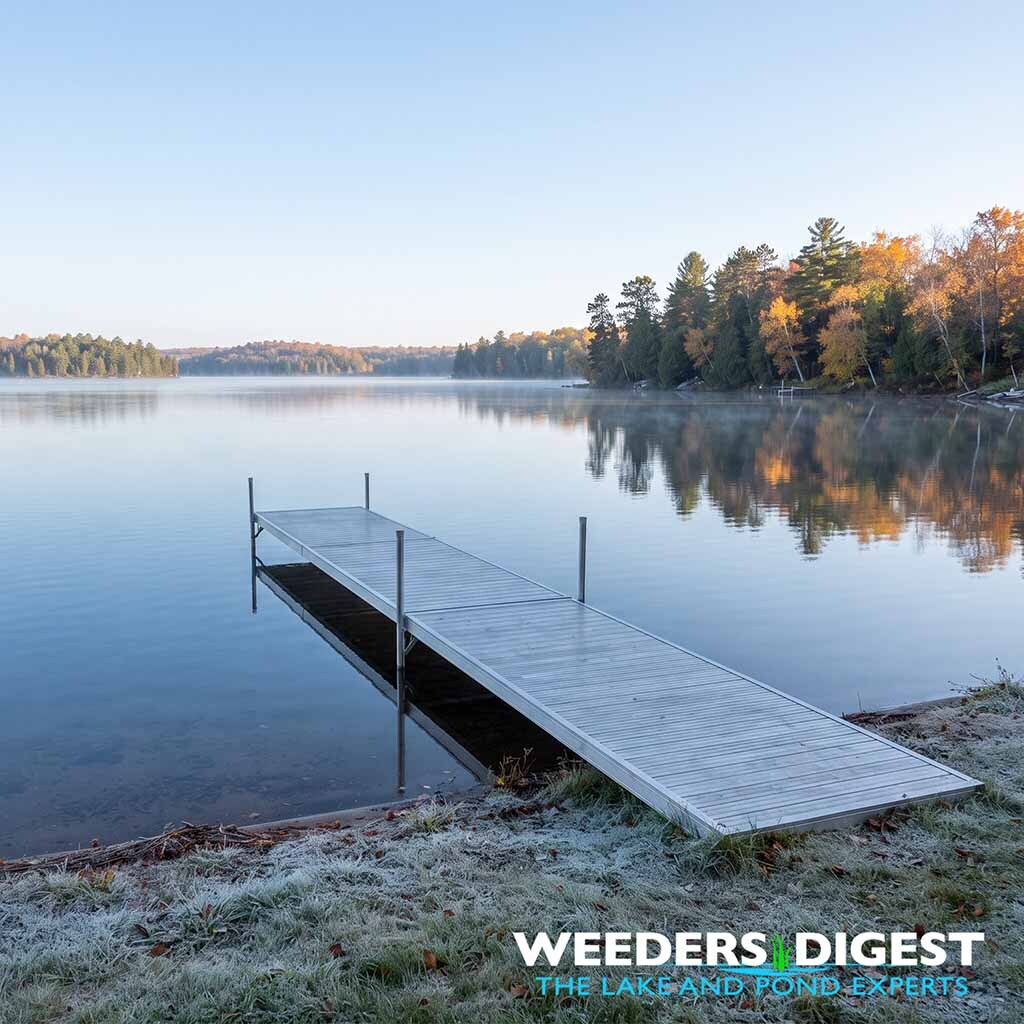
Whether you should remove your dock and aeration or de-icing system before the first hard freeze depends entirely on your dock construction, localized ice dynamics, and winter water management goals. Sectional or lightweight aluminum standing docks are best pulled ashore before sub-zero temperatures arrive to avoid structural failure from ice expansion and ice-jacking, whereas heavy commercial or permanent piling structures must remain in place and require active management. When our lake experts evaluate residential and commercial shorelines during late-autumn transitions, we frequently observe property owners leaving heavy static infrastructure completely unprotected, or conversely, running unmanaged sub-surface agitators that create hazardous open-water zones without proper safety positioning. Balancing infrastructure protection with aquatic ecosystem health requires understanding how ice forces interact with submerged materials.
The Science Behind It: Ice Mechanics and Thermal Stratification
Water exhibits a unique physical property: it reaches its maximum density at approximately 39 degrees Fahrenheit (4 degrees Celsius). As surface temperatures drop toward freezing, colder and less dense water rises to form a surface layer that eventually transitions into solid ice. Once established, ice sheets react dynamically to ongoing atmospheric temperature fluctuations. Research on ice mechanics highlighted in engineering and limnological studies demonstrates that as ambient temperatures swing below freezing, ice sheets expand horizontally, exerting immense mechanical pressure—often ranging up to thousands of pounds per square foot—against stationary dock pilings, cribs, and retaining structures.
This horizontal thermal expansion is compounded by vertical water level fluctuations driven by winter precipitation, runoff, or dam management, initiating a destructive process known as ice-jacking. According to historical field assessments on northern water bodies and marina pilings by researchers such as Edil, Roblee, and Wortley, ice-jacking causes the cyclic, incremental upward pullout of structural pilings as the freezing water grips the shaft and moves vertically with changing water levels. Without proper pullout resistance or removal, this cumulative force warps frames, splits lumber, and shears structural fasteners.
To mitigate these forces on permanent structures, lake managers deploy sub-surface water circulators and dock de-icers to pull warmer bottom water (near 39 degrees Fahrenheit) to the surface, preventing a rigid ice sheet from locking onto pilings. However, limnological principles dictate that de-icers must be operated with precision. Continuous, unmanaged high-output agitation can prematurely disrupt winter thermal stratification, churn benthic sediments, and release stored phosphorus from the hypolimnion into the water column, fueling subsequent seasonal algae blooms. Furthermore, oversized de-icers can open excessively large areas of thin ice, creating severe winter safety hazards and allowing wind-driven ice floes to batter exposed dock frames during early thaws.
Our Recommendation for Managing Your Dock and Winter Equipment
If your waterfront utilizes sectional, pipe, or wheel-in dock systems that can be safely disassembled and stored onshore prior to freeze-up, removing them is the most effective way to eliminate ice damage risks entirely. For permanent installations or situations where removal is physically impossible, transitioning to an active, controlled ice-prevention strategy is essential.
Rather than relying on continuous, unmonitored agitation that risks high energy consumption and localized bottom scour, utilizing targeted, adjustable sub-surface water movement tools—similar to how an AquaThruster Muck & Weed Blower collection operates on adjustable oscillation mounts—allows you to precisely direct water flow where it protects structural pilings. By mounting your de-icing equipment correctly and pairing it with a thermostat and timer to operate only during peak sub-freezing conditions, you maintain a narrow, protective thermal opening around your investment without destabilizing the surrounding aquatic ecosystem.
Sources / References:
- Edil, T. B., Roblee, C. J., & Wortley, C. A. (1988). Design Approach for Piles Subject to Ice Jacking. Journal of Cold Regions Engineering, 2(2), 65-86. Available via ASCE Library and ResearchGate: ASCE Library DOI / ResearchGate Publication
- Kasco Marine / Cremin, D. (2023). Understanding Ice Expansion, Ice Jacking, and Ice Floes on Winter Waterways. Technical Field Guidelines & Blog. Available online: Kasco Marine Blog
- Marina Dock Age (2023). Winterization and Ice Mitigation Strategies. Industry Operations and Engineering Insights. Available online: Marina Dock Age