

Organic vs. Inorganic Sediment: Identifying What Is Fueling Your Weed Growth
 |

Summary:
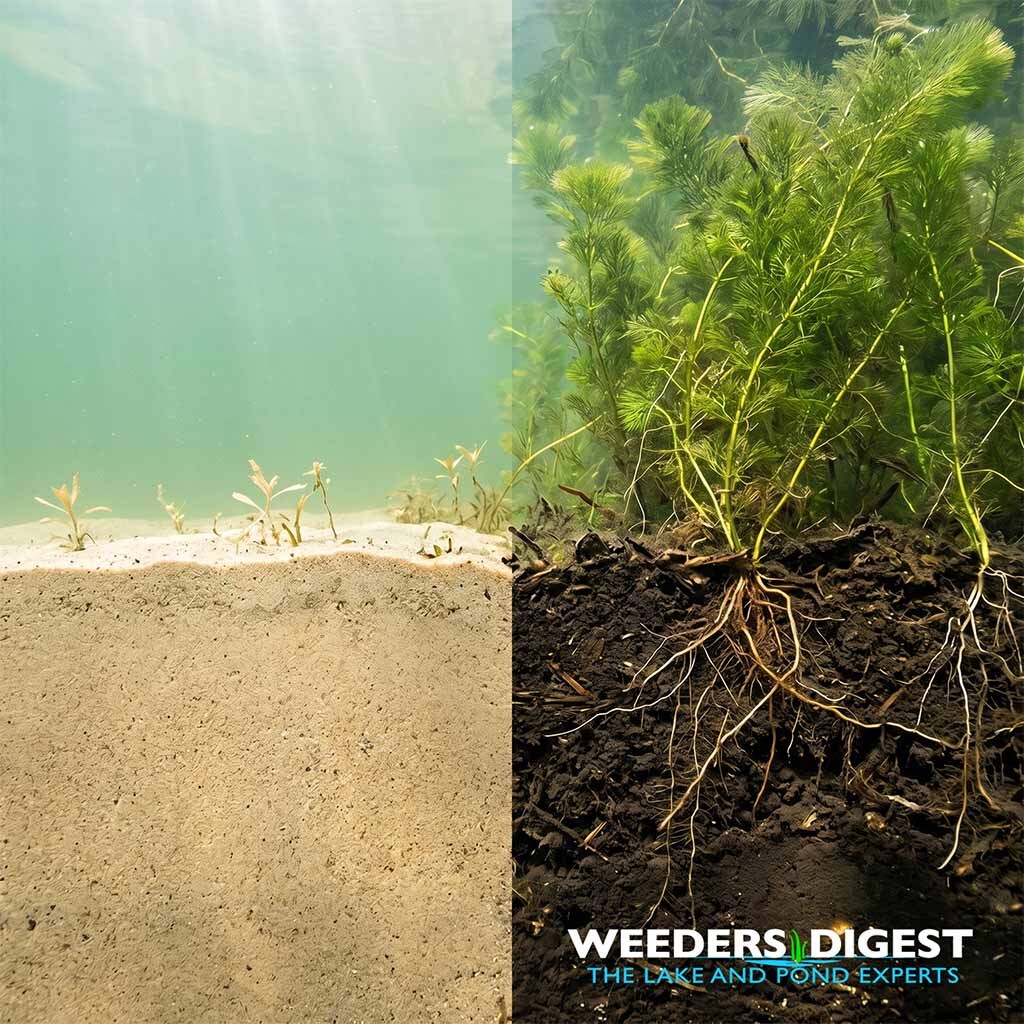
The primary fuel for explosive aquatic weed growth in your lake or pond is a balanced mixture of fine inorganic sediment and decomposing organic matter, which together act as a continuous, nutrient-dense fertilizer for plant roots. While inorganic sediment—made up of sand, silt, and clay—provides essential structural anchoring and holds onto minerals, the organic sediment (commonly referred to as muck) supplies a steady, slow-release diet of vital nutrients like nitrogen and phosphorus. When a waterbody accumulates the right ratio of these two materials, it creates an ideal underwater soil that sustains dense, aggressive weed beds year after year.
As a Certified Lake Manager, I routinely plunge sediment corers into various waterbodies, and I can tell you firsthand that the composition of the lake bottom dictates exactly what will grow there. I frequently see property owners frustrated by recurring weed blooms because they focus entirely on treating the water column instead of inspecting the bottom. Tackling these issues almost always means addressing the accumulated sediment itself; and let me be clear, muck removal is a big project and does require a lot of labor, but leaving it untouched guarantees those weeds will have an endless food supply.
By understanding what type of sediment makes up your lake or pond bottom, you can accurately predict and manage the types of aquatic vegetation that will thrive. Because the vast majority of aquatic plants absorb their required nutrients directly through their root systems rather than from the surrounding water, the sediment floor acts as the true engine of weed proliferation.
The Science Behind It:
Submersed aquatic macrophytes (rooted aquatic plants) rely heavily on the benthic zone (the ecological region at the lowest level of a body of water) for their nutritional requirements. The composition of this bottom sediment is fundamentally classified into two categories: inorganic and organic. Inorganic sediment consists of mineral particles such as sand, silt, and clay that are transported into the waterbody via runoff, wind, and erosion. Organic sediment, conversely, is composed of decaying biological matter, including leaf litter, dead algae, and senescent (aging and dying) aquatic plants. The physical and chemical interplay between these two sediment types dictates the environment of the lake bottom, directly influencing the bioavailability of nutrients essential for plant growth.
The fine inorganic fractions of sediment, particularly clay and silt, possess a high surface area and a strong cation exchange capacity (the ability of soil to hold onto positively charged nutrient ions). This characteristic allows them to bind tightly to vital nutrients, preventing them from washing away in water currents. However, it is the organic fraction that undergoes microbial decomposition, a continuous biological process that mineralizes complex organic compounds into plant-available forms of nitrogen and phosphorus. Extensive research by Barko and Smart (1986) demonstrated the profound efficiency of this benthic relationship, finding that submersed macrophytes can mobilize phosphorus from sediments in quantities up to 1,000-fold greater than the phosphate concentration naturally present in the sediment's interstitial water (the water filling the microscopic spaces between sediment particles).
Interestingly, the relationship between organic sediment concentration and aquatic weed growth is not strictly linear; it follows a parabolic curve driven by distinct physical and chemical constraints. Ecological studies evaluating sediment composition have consistently revealed that macrophyte growth is typically maximized in sediments containing an intermediate organic matter content of approximately 10 percent. When the sediment's organic matter content exceeds 20 percent, the growth and biomass accumulation of many submersed aquatic plants are actually suppressed (Barko and Smart, 1986). This suppression occurs because highly organic sediments lack structural integrity due to lower bulk density, which physically destabilizes root systems, and they foster extreme biochemical stress.
When organic matter accumulates excessively into deep muck layers, the intense microbial activity required to decompose the material rapidly consumes all available dissolved oxygen in the sediment layer. This biological oxygen demand forces the benthic environment into an anaerobic (oxygen-depleted) state. Prolonged anaerobic conditions lead to the production and accumulation of severe phytotoxins (plant-inhibiting chemical compounds), such as hydrogen sulfide, volatile organic acids, and methane. While certain highly specialized floating-leaved or emergent plants can tolerate these toxic, oxygen-deprived environments through specialized root aeration structures, the rapid accumulation of pure organic muck ultimately alters the broader biological community, shifting the ecosystem away from diverse submersed vegetation.
Therefore, the most aggressive proliferation of nuisance aquatic vegetation occurs in sediment transition zones where mineral inorganic sediments are sufficiently enriched with organic matter to provide nutrients, but not so heavily saturated that they become toxic and anoxic. The continuous settling of suspended organic detritus into fine inorganic substrates guarantees a constant regeneration of this localized nutrient pool. Recognizing this highly specific biogeochemical balance is critical for aquatic ecosystem management, as mitigating excessive macrophyte growth fundamentally requires altering the sediment composition to disrupt the benthic nutrient cycling pathways.
Sources / References:
- https://apps.dtic.mil/sti/tr/pdf/ADA118147.pdf (Barko and Smart, Sediment-Submersed Macrophyte Relationships in Freshwater Systems)
- https://upload.wikimedia.org/wikipedia/commons/6/6b/Effects_of_sediment_composition_on_growth_of_submersed_aquatic_vegetation_-_USACE-p266001coll1-7503.pdf (Barko and Smart, Effects of Sediment Composition on Growth of Submersed Aquatic Vegetation)