

Protecting Your Shoreline: Why I Respect No-Wake Zones in Quiet Bays
 |

Summary:
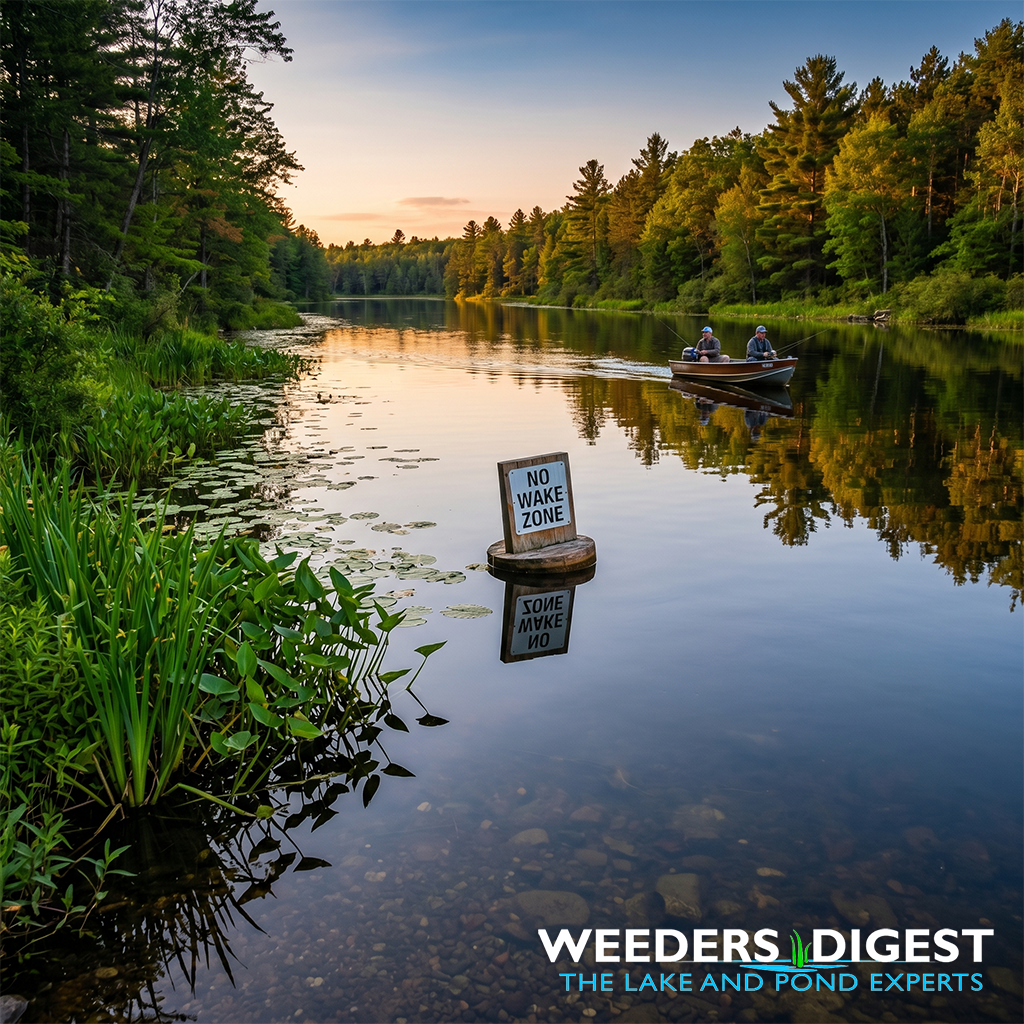
When you are out on the water, seeing a "no-wake" sign in a narrow channel or a secluded bay might feel like a minor inconvenience, but these zones are actually vital for the health of your lake. A "wake" is the wave created by the displacement of water as your boat moves through it. In tight spaces, these waves don't have enough room to dissipate naturally. Instead, they hit the shoreline with significant force, acting like a constant hammer that chips away at the land, causing your property to literally wash away over time.
Beyond just the physical loss of land, these artificial waves stir up the bottom of the lake, turning clear water into a murky mess. This process, known as turbidity, makes it harder for fish to find food and smothers the underwater plants that keep the ecosystem balanced. By slowing down in these specific areas, you are helping to keep the water clear, the fish healthy, and your shoreline intact. It is a small adjustment in speed that makes a massive difference for the longevity of the lake environment we all enjoy.
The Science Behind It:
The enforcement of no-wake zones is grounded in the principles of fluid dynamics and wave energy propagation. When a vessel moves through a restricted waterway, it generates a wake system consisting of bow and stern waves. In narrow channels and shallow bays, the energy of these waves is not attenuated by distance; rather, it is concentrated. As these waves approach the shoreline, they undergo "shoaling," where the wave height increases as the water depth decreases. This results in high-energy impacts on the littoral zone, leading to significant bank erosion and the structural undermining of riparian vegetation.
Research indicates that boat-generated waves often carry higher energy densities than wind-generated waves in protected inland waters. According to studies conducted by university extensions focusing on aquatic impact, the shear stress exerted by these wakes can dislodge benthic sediments. This resuspension of sediments releases sequestered nutrients, such as phosphorus, back into the water column. The sudden influx of bioavailable phosphorus frequently triggers accelerated eutrophication and harmful algal blooms (HABs), which can severely deplete dissolved oxygen levels and lead to localized fish kills.
Furthermore, narrow channels and bays often serve as critical "nursery" habitats for various aquatic species. The mechanical energy of a wake can physically uproot submerged aquatic vegetation (SAV) and destroy the nesting sites of littoral-zone spawners. In shallow environments, the "prop wash" associated with higher speeds also causes direct physical damage to the lakebed, creating a turbid environment that limits light penetration. Reduced light availability inhibits photosynthesis in bottom-dwelling plants, further destabilizing the ecological foundation of the water body.
The enforcement of a "no-wake" speed—defined typically as the slowest speed necessary to maintain steerage—minimizes the displacement of water and the subsequent generation of destructive wave energy. By maintaining a sub-critical velocity, the vessel prevents the formation of the large transverse waves that characterize "plowing" or "planing" speeds. This regulatory approach is a data-driven strategy intended to mitigate anthropogenic stress on fragile lacustrine ecosystems and preserve the physical integrity of the shoreline interface.