

Securing Your Lake's Ecosystem: My Guide to Managing Post-Storm Nutrient Influxes
 |

Summary:
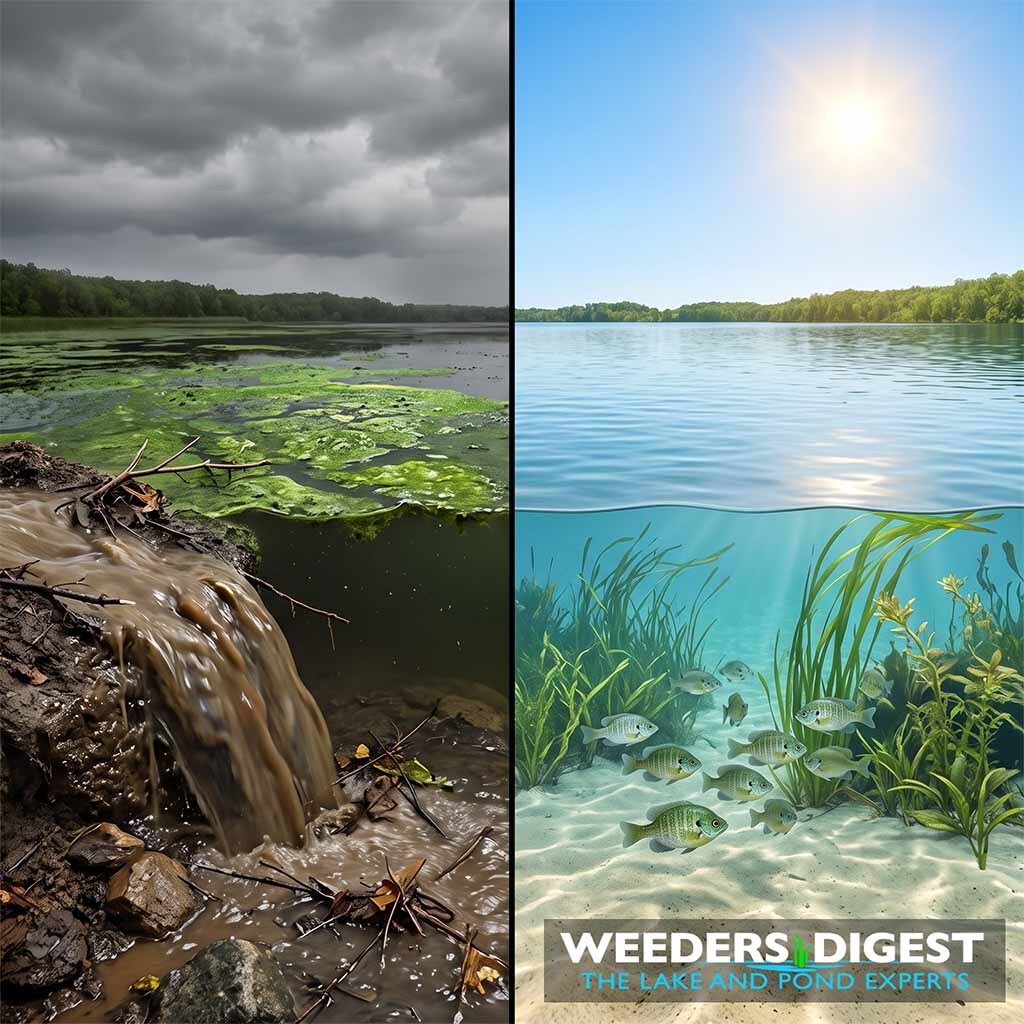
Managing sudden nutrient influxes after a storm requires immediately restoring dissolved oxygen levels in the water column, physically removing large organic debris, and applying targeted nutrient binders to neutralize dissolved phosphorus before algae can consume it. When severe rainstorms hit a watershed, the heavy runoff acts like a conveyor belt, sweeping lawn fertilizers, animal waste, and loose terrestrial soils directly into your lake or pond. This massive influx of nitrogen and phosphorus creates an all-you-can-eat buffet for nuisance algae and aquatic weeds, which can rapidly degrade water quality and trigger sudden, massive blooms.
In my years working as a Certified Lake Manager, I have seen exactly how fast this biological transition happens; I once arrived at a 10-acre community lake just two days after a major summer deluge, only to find that the water clarity had plummeted from six feet to mere inches, topped with a thick, foul-smelling layer of bright green cyanobacteria. Homeowners often assume that heavy rain will safely flush their pond clean, but in reality, the storm introduces a concentrated shock of nutrients that the native ecosystem simply cannot digest fast enough. The sudden darkening of the water is usually the first visual indicator that the ecosystem is becoming unbalanced.
By proactively addressing the water column immediately following a severe weather event, you can halt this biological chain reaction. Oxygenating the water supports the beneficial aerobic bacteria that break down suspended organics naturally, fighting the influx at a microbial level. Meanwhile, utilizing biological augmentations and specialized phosphorus-binding minerals will lock away those excessive storm-driven nutrients, restoring ecological balance and keeping your water clear, safe, and healthy.
The Science Behind It:
Post-storm ecosystem degradation is primarily driven by a phenomenon known as allochthonous nutrient loading, which refers to the rapid introduction of organic and inorganic nutrients originating from outside the immediate aquatic system. During severe precipitation events, the surface runoff coefficient increases dramatically as surrounding soils become saturated. This overland flow mobilizes massive quantities of terrestrial inputs, including synthetic fertilizers, agricultural waste, and leaf litter. Once this runoff enters the lentic (still-water) environment, it rapidly alters the stoichiometric balance of the water column, artificially lowering the nitrogen-to-phosphorus ratio and creating ideal metabolic conditions for rapid phytoplankton proliferation.
The disproportionate mobilization of phosphorus during these heavy rain events is a critical concern for limnologists and aquatic biologists. According to longitudinal watershed research published in Environmental Science & Technology, storm events disproportionately mobilize dissolved phosphorus compared to nitrogen, often contributing the vast majority of an aquatic system's annual nutrient budget in just a few days of heavy precipitation. In their extensive twenty-year study, researchers documented that constituent concentrations in storm-affected streams averaged 5,966 µg/L for Nitrate-Nitrogen ($NO_3-N$) and 63 µg/L for Soluble Reactive Phosphorus (SRP). Because phosphorus is almost always the limiting nutrient in freshwater ecosystems, even a fractional, microscopic increase in SRP can trigger exponential cyanobacteria growth.
When these sudden nutrient spikes induce massive algal blooms, the subsequent biological fallout severely impacts dissolved oxygen (DO) concentrations. As the rapidly reproducing phytoplankton complete their short life cycles and die off, their cellular biomass sinks to the benthic zone (the sediment layer at the bottom of the lake). Here, aerobic heterotrophic bacteria begin the process of decomposition, a metabolic pathway that consumes vast amounts of dissolved oxygen. If the biological oxygen demand (BOD) exceeds the rate of atmospheric diffusion and photosynthetic oxygen generation, the system can quickly become hypoxic, leading to sudden fish kills and the localized extinction of sensitive macroinvertebrates.
To mitigate these sudden influxes, aquatic ecologists utilize a combination of mechanical aeration, biological augmentation, and chemical sequestration. Aeration systems increase the gas exchange rate at the air-water interface and prevent thermal stratification, ensuring that oxygen-rich water continually reaches the benthic boundary layer to support decomposition. Furthermore, the application of lanthanum-modified clays or aluminum sulfate is frequently used to chemically bind with the free reactive phosphorus in the water column. This process, known as precipitation and flocculation, turns the dissolved phosphorus into an inert mineral complex that settles safely into the sediment, rendering it completely biologically unavailable to future algal populations.