

Should You Stack Rip-Rap or River Rock Along Your Bank Before the Winter Freeze?
 |

Summary:
Stacking loose river rock or unanchored rip-rap along your shoreline right before the winter freeze is one of the quickest ways to lose your bank to ice jacking and seasonal scour. While fortifying an eroding bank before winter seems proactive, simply placing smooth, rounded stones or dry-stacking boulders without proper grading, keyed-in toe trenches, and heavy geotextile underlayment sets up structural failure. Ice does not push water alone; expanding sheets grip loose surfaces, pluck rounded river rock like loose pebbles, and push improperly sloped barriers inland into destructive ridges.
We frequently consult with waterfront owners every spring who are baffled to find thousands of pounds of stone displaced into their lakebed or shoved deep into their lawns. In our field observations across northern lakes, shoreline repairs attempted in late fall without embedded toe protection or at slopes steeper than a 3:1 ratio inevitably buckle under thermal ice expansion. Water enters the voids behind dry-stacked rocks, freezes, and physically heaves the entire mass away from the bank.
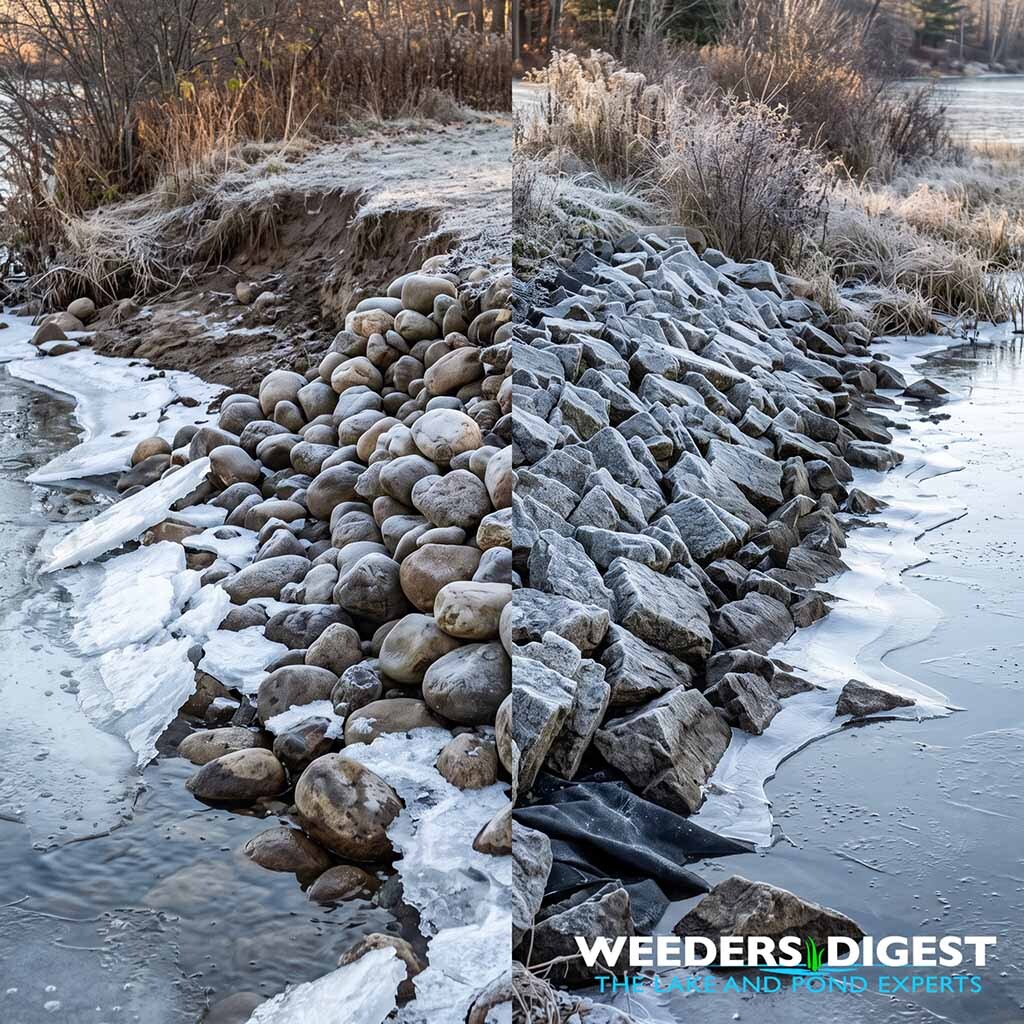
If your shoreline is actively carving out, an emergency late-season armoring must adhere to strict hydraulic principles rather than cosmetic rock stacking. Smooth river rock should never be used as structural armor because it lacks the interlocking friction required to resist lateral freeze forces. Angular, fractured stone laid over a properly prepared slope is essential if you want the investment to survive winter thaw cycles intact.
The Science Behind It:
The destruction of winter shorelines stems from two primary mechanical processes: thermal ice expansion—commonly termed "ice jacking"—and frost heave within saturated bank soils. As surface water drops below 0°C (32°F), water undergoes phase change, expanding by roughly 9% in volume. In enclosed or semi-enclosed freshwater bodies, a solid ice sheet contracts as air temperatures plummet at night, opening stress fractures. Water fills these cracks from below and immediately freezes. When midday temperatures warm the ice sheet, the ice expands outward toward the margins, exerting lateral pressures reaching 10,000 to 20,000 pounds per square foot (480 to 960 kPa) against the shoreline.
According to engineering specifications established by the USDA Natural Resources Conservation Service (NRCS) and ecological state guidelines from bodies such as the Minnesota Department of Natural Resources (MNDNR), structural revetments require a finished slope no steeper than 3:1 (three feet of horizontal run for every one foot of vertical rise). When an ice sheet expands against a 3:1 or flatter incline, the angular face directs lateral thrust upward, allowing the ice to slide over the stones rather than gouging directly into the bank. Conversely, when property owners dry-stack rocks vertically (1:1 or 2:1 slopes) before winter, the expansive sheet impacts a near-vertical plane, concentrating the sheer horizontal thrust against individual stones and shearing the entire revetment off its base.
Material geometry is equally critical. The Federal Highway Administration (FHWA Hydraulic Engineering Circular No. 11) and US Army Corps of Engineers standards mandate the use of angular, fractured rock possessing a minimum specific gravity of 2.5 to achieve inter-particle friction. Angular stone edges interlock, creating a cohesive, semi-flexible armor blanket capable of redistributing point loads across adjacent stones. Smooth, tumbled "river rock" possesses an extremely low angle of internal friction. Under lateral ice expansion or interstitial freeze-thaw cycles, rounded stones behave like ball bearings, rolling downslope under freeze expansion and slumping permanently into the lakebed.
Furthermore, stacking rock directly onto bare shoreline soil without an engineered non-woven geotextile underlayment induces hydrodynamic piping. As winter waves lap beneath forming ice shelves, hydrodynamic pressures cycle through stone voids. Without a geotextile barrier to retain fine sediment, soil particles are vacuumed outward into the water column. This subterranean void creation deprives the overlying rock of structural foundation, causing rotational slumping and catastrophic collapse during the spring thaw.
Our Recommendation for Managing Shoreline Freeze & Erosion:
If you are facing late-season shoreline erosion, do not pile loose river rock onto the bank. Scientifically sound erosion management requires addressing the dynamic movement of water and ice before physical armor is even installed. Stacking unanchored rock creates artificial shelves where decaying weeds, leaves, and organic sediment settle, decomposing into thick anaerobic muck that softens the bank base and accelerates winter bank failure.
To prevent cold-weather shoreline damage, maintain an active water boundary using automated water movement systems. Continuous directional thrust keeps shoreline zones open, preventing thick ice sheets from anchoring directly to your bank face and eliminating the devastating shearing action of ice jacking. For shorelines already troubled by fine silt deposition and weed decay at the bank's base, deploying continuous water circulation tools from our AquaThruster Muck & Weed Blower collection cleans out soft muck beds and sweeps loose sediments away before the freeze locks them in. Once the base substrate is firm and clean, any permitted rip-rap installations must utilize angular rock on a gradual 3:1 grade over non-woven geotextile fabric to stand up against seasonal freeze dynamics.
Sources / References:
- Minnesota Department of Natural Resources. Shoreline Alterations: Riprap & Ice Ridges Information Guide. https://www.dnr.state.mn.us/waters/shoreline-alteration-riprap.html
- United States Environmental Protection Agency (EPA). Stormwater Best Management Practice: Riprap. https://www.epa.gov/system/files/documents/2021-11/bmp-riprap.pdf
- British Columbia Ministry of Environment. Riprap Design and Construction Guide. https://www2.gov.bc.ca/assets/gov/environment/air-land-water/water/integrated-flood-hazard-mgmt/riprap_guide.pdf