

The Hidden Threat to Your Pond: How Aquatic Weed Decomposition Changes Your Water Chemistry
 |

Summary:
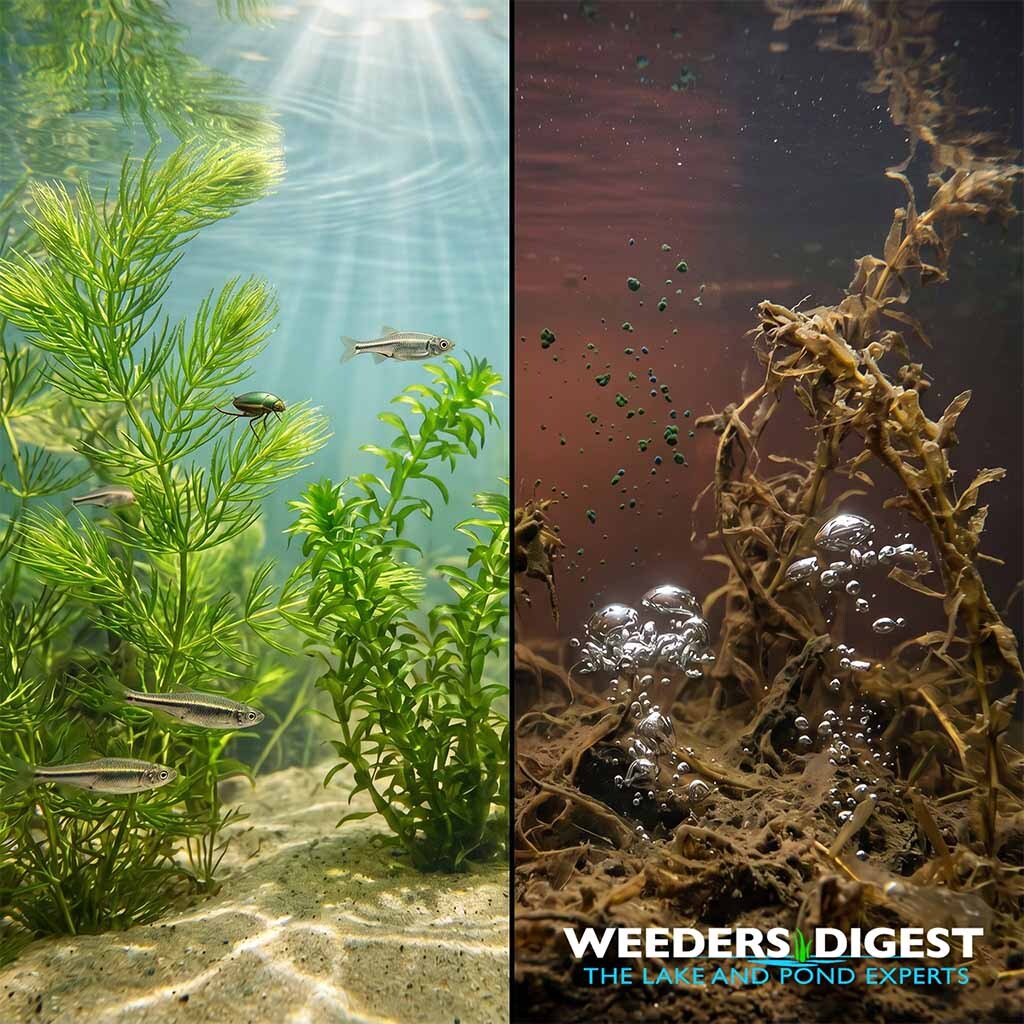
We usually think of aquatic weeds as just a visual nuisance or a hassle when we want to take the boat out. It is easy to assume that once these weeds die off—whether from a change in the seasons or after a treatment—the problem is solved. However, the death of an aquatic plant is actually the beginning of a complex, invisible process that can severely damage the overall health of your water. When weeds start to break down and rot, they trigger a chain reaction that completely alters your water chemistry.
As the dead plants decay, the bacteria responsible for breaking them down consume massive amounts of oxygen. This natural composting process steals the breathable oxygen right out of the water, suffocating fish and beneficial organisms. If you have ever noticed your pond developing a foul odor or seen fish gasping at the surface after a massive weed die-off, this oxygen crash is the direct culprit.
Worse yet, all the nutrients those plants absorbed while they were growing are suddenly dumped back into your lake or pond. Think of an aquatic weed like a sponge that has been soaking up fertilizer all summer. When it dies and decomposes, it is like wringing that sponge out directly into the water. This massive release of nutrients essentially fertilizes the water, creating the perfect environment for toxic algae blooms and green, murky water to take over.
Ultimately, leaving dead weeds in the water creates a vicious cycle. The rotting plants ruin your water clarity, drop your oxygen levels, and feed the next generation of weeds and algae. Understanding this natural breakdown process is the first step toward achieving a balanced, healthy aquatic ecosystem that looks great and supports thriving aquatic life.
The Science Behind It:
When aquatic macrophytes undergo senescence, the resulting structural breakdown initiates intense microbial colonization. Heterotrophic bacteria begin to decompose the organic tissue, a biological process with an exceptionally high biochemical oxygen demand. As bacterial respiration surges, the dissolved oxygen in the surrounding water column exhibits a severe negative trend, frequently driving the local aquatic ecosystem toward hypoxia (Wang et al., 2023). This rapid depletion of dissolved oxygen disrupts the survival of benthic macroinvertebrates and fish, effectively creating ecological dead zones within the water body.
Beyond severe oxygen depletion, decomposing aquatic vegetation is a primary driver of secondary pollution. Throughout their active growth cycle, submerged macrophytes assimilate key elements such as nitrogen and phosphorus from both the benthic sediment and the overlying water. However, when large populations of these plants senesce and degrade, the decaying residue releases these concentrated nutrients back into the water column, profoundly altering the biogeochemical cycle and threatening the broader aquatic ecosystem (Wang et al., 2022).
The biochemical transformation of phosphorus during this decomposition phase is particularly impactful on limnological health. Macrophyte breakdown shifts the phosphorus composition in the water toward highly bioavailable forms. Specifically, the decomposition process increases the concentrations of dissolved organic phosphorus and soluble reactive phosphorus. Because these forms of phosphorus are easily and rapidly assimilated by phytoplankton, they act as the direct catalyst for secondary cyanobacteria blooms and accelerated lake eutrophication.
As dissolved oxygen levels plummet and the sediment-water interface becomes anaerobic, the decomposition pathway inevitably transitions from aerobic respiration to fermentation and methanogenesis. This shift dramatically alters the carbon cycling dynamics of the environment. Research indicates that the die-back periods of dense submersed macrophytes trigger significant fluctuations in aquatic greenhouse gas dynamics, turning the waterbody into a major source of atmospheric methane and carbon dioxide emissions (Theus et al., 2023).
Ultimately, allowing unmanaged macrophyte biomass to decompose within a lake establishes a detrimental feedback loop of internal nutrient loading. The continuous mineralization and recycling of nitrogen and phosphorus from detritus ensure that the system remains in a highly eutrophic state. Disrupting this autogenic cycle requires the physical mitigation of the biomass itself, as failure to extract the plant litter guarantees that the water body will suffer from persistent secondary pollution and compromised ecological stability.
Sources / References:
- Theus, M. E., Ray, N. E., Bansal, S., & Holgerson, M. A. (2023). Submersed macrophyte density regulates aquatic greenhouse gas emissions. Journal of Geophysical Research: Biogeosciences, 128. https://doi.org/10.1029/2023jg007758 (Cited by: 28)
- Wang, L., Wu, X., Dong, B., Song, H., An, J., Wu, Y., Wang, Y., Li, B., & Liu, Q. (2022). Influence of Potamogeton crispus harvesting on phosphorus composition of Lake Yimeng. https://doi.org/10.21203/rs.3.rs-1592007/v1 (Cited by: 6)
- Wang, L., Zhang, L., Song, H., Dong, B., Wang, Y., Yu, W., Wu, Y., Wu, X., & Ge, X. (2023). The effect of the Potamogeton crispus on phosphorus changes throughout growth and decomposition: A comparison of indoor and outdoor studies. Sustainability, 15(4), 3372. https://doi.org/10.3390/su15043372 (Cited by: 1)