

The Physics of My Boat: Why Can’t I Push My Hull Any Faster?
 |

Summary:
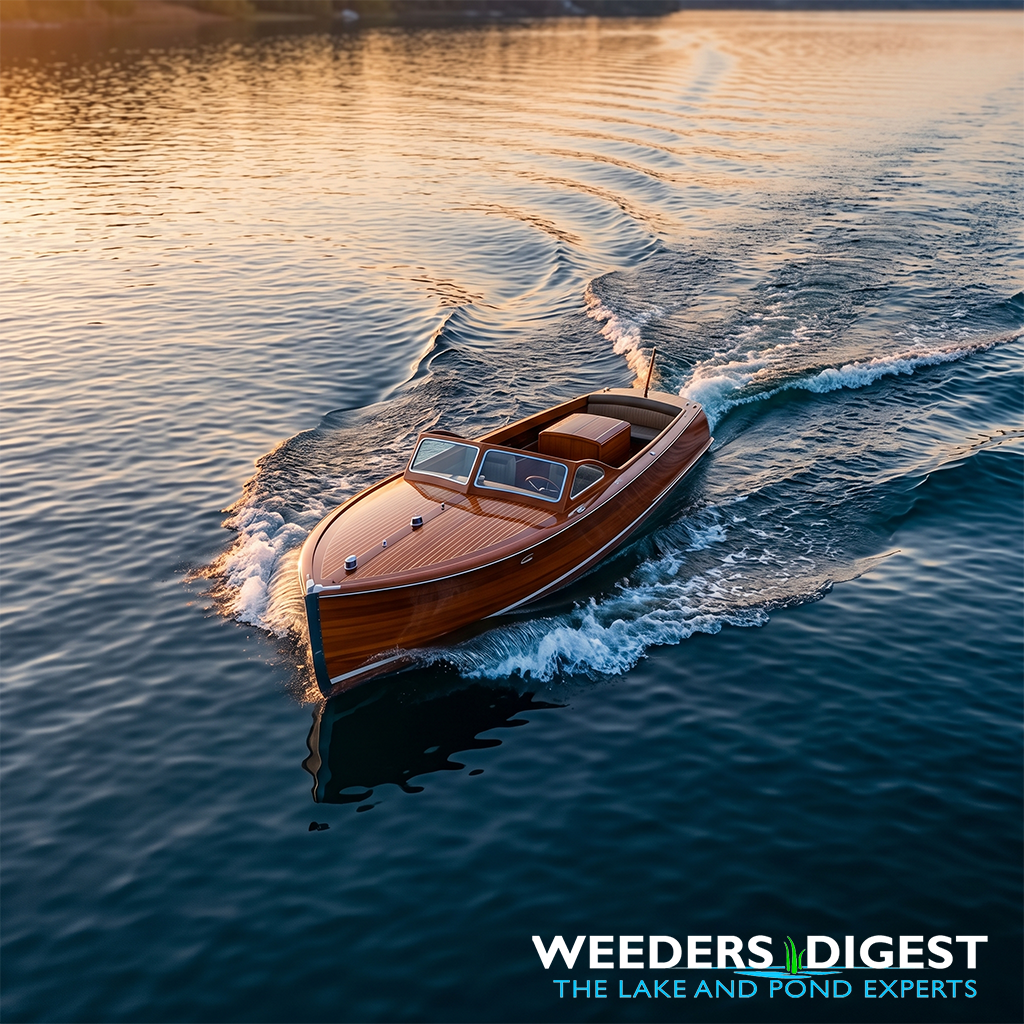
If you have ever spent an afternoon on the lake, you have likely noticed that as you increase the throttle on a traditional displacement boat, there comes a point where the bow rises, the engine roars, and the wake becomes massive, yet the boat barely gains any speed. It feels as though you have hit an invisible wall in the water. This phenomenon is not a limitation of your engine's horsepower, but rather a fundamental law of fluid dynamics known as hull speed.
Essentially, a boat moving through water creates a wave system. As the boat speeds up, the wavelength of the bow wave increases. Eventually, the wavelength matches the length of your boat’s waterline. At this precise moment, your boat is effectively trapped between the crest of its own bow wave and the crest of its stern wave. To go any faster, the boat would have to "climb" up its own bow wave, which requires an exponential amount of energy that most displacement hulls simply cannot generate.
Understanding this limit is crucial for any pond or lake manager who utilizes work boats or harvesters. Pushing a hull beyond its design speed doesn’t just waste fuel; it creates excessive turbulence and shore-eroding wakes without providing any functional gain in transit time. It is a classic case of working against nature rather than with it.
The Science Behind It:
The maximum speed of a displacement hull is governed by the principles of wave-making resistance and the Froude number (Fr), a dimensionless quantity representing the ratio of inertial forces to gravitational forces. When a vessel moves through a fluid, it displaces a volume of water equal to its weight, creating a pressure disturbance that manifests as a transverse wave system. According to the research documented by the University of New Hampshire’s Center for Ocean Engineering, the velocity of these gravity waves is directly proportional to the square root of their wavelength.
As the vessel's velocity (v) increases, the wavelength of the bow wave (λ) elongates. The theoretical hull speed (v_h) is reached when the wavelength of the bow wave equals the length of the boat at the waterline (L_wl). At this specific point, the Froude number is approximately 0.4. The hull becomes "locked" in a wave trough, supported at the bow and stern by wave crests. Any further increase in speed requires the vessel to overcome the "wave barrier," effectively attempting to climb a hill of water that it is creating in real-time.
For a standard displacement hull, the formula to calculate this maximum velocity in knots is (v_h) = 1.34 \times \sqrt(L_wl). This constant, 1.34, is derived from the acceleration of gravity and the density of water. Scientific analysis in the Journal of Ship Research indicates that as a boat approaches this speed, wave-making resistance increases cubically. While planing hulls are designed to generate hydrodynamic lift and "break over" this wave to skim the surface, true displacement hulls are physically limited by the buoyancy and gravity balance of the wave system they inhabit.
Furthermore, the transition into the "trans-critical" speed range results in a significant increase in the amplitude of the stern wave. This energy is redirected from forward propulsion into the vertical displacement of water, explaining why increased RPMs result in a deeper "squat" at the stern rather than increased knots. In sensitive aquatic ecosystems, this excess energy manifests as high-energy wakes that can cause significant bank erosion and uprooting of littoral zone vegetation, making the adherence to theoretical hull speed a matter of ecological stewardship as much as mechanical efficiency.
Sources / References:
- https://unh.edu/unhtales/the-science-of-sailing/
- https://www.nap.edu/read/12450/chapter/6 (National Academies of Sciences, Engineering, and Medicine - Naval Hydrodynamics)