

The Truth About Your Lake's Bottom: Why Managing Muck is a Massive Undertaking
 |

Summary:
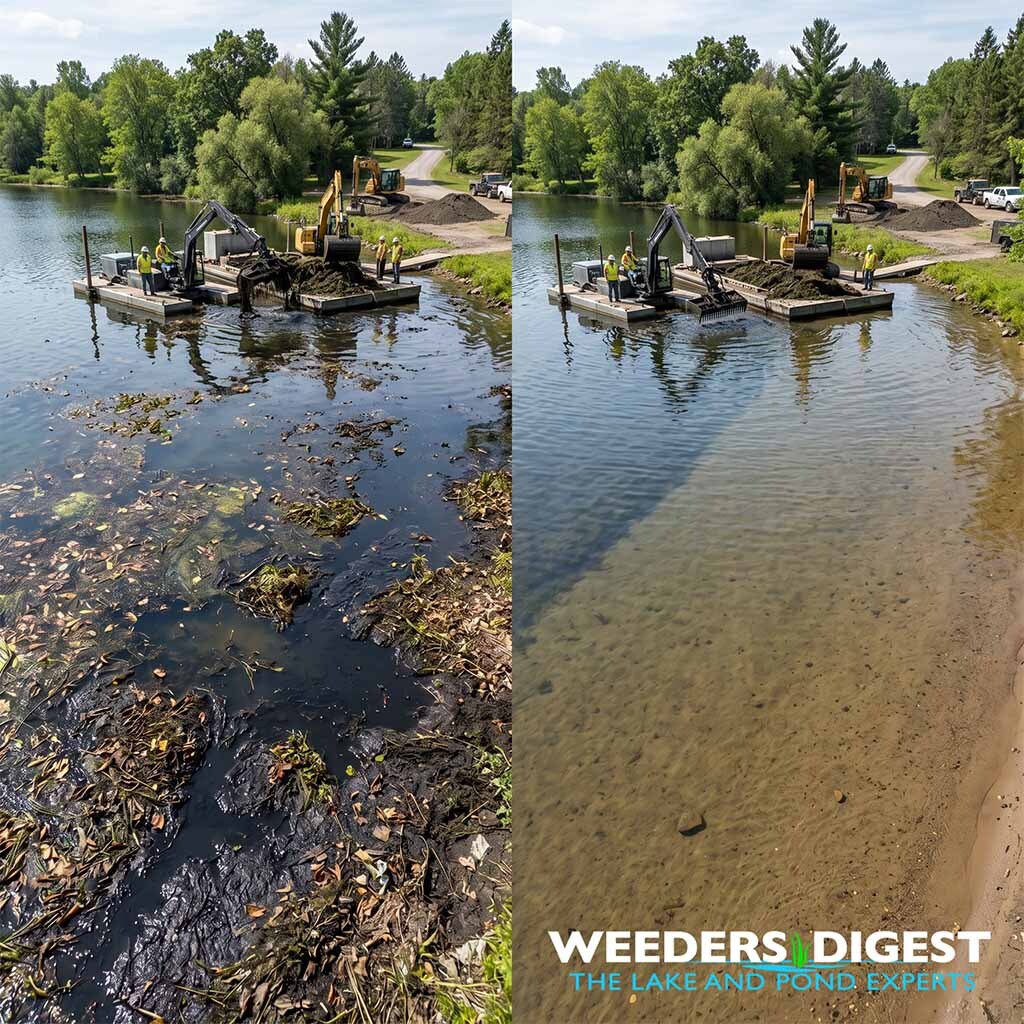
Muck management is a large-scale, labor-intensive undertaking that requires physically extracting or biologically degrading decades of accumulated organic decay from your lake's bottom. Despite what you might hear, there is no overnight fix for a mucky shoreline, as true sediment reduction requires heavy machinery, professional labor, and significant time. This thick, black sludge is formed when organic materials like dead weeds, algae, and leaves sink to the bottom and decompose in an oxygen-depleted environment.
As a Certified Lake Manager, I often walk shorelines with homeowners who hope a simple rake or single treatment will instantly restore their sandy beach. During a recent site visit, a property owner was shocked when we surveyed their cove and found three feet of soft sediment; I had to explain that reversing thirty years of organic loading is not easy—it is a big project and does require a lot of labor, from securing dredging permits to managing the excavated material. It is never a simple weekend chore.
Understanding the reality of muck means recognizing that your lake is a dynamic, aging ecosystem. When vegetation dies off year after year, it layers onto the lakebed faster than natural bacteria can digest it. Resolving this issue requires a long-term commitment to addressing both the physical removal of the sludge and the environmental factors that caused it to accumulate in the first place.
The Science Behind It:
The formation and accumulation of benthic organic sediment, commonly referred to as muck, is driven by the eutrophication process and the subsequent settling of autochthonous (internal) and allochthonous (external) organic matter. In a healthy aquatic ecosystem, aerobic bacteria efficiently metabolize dead plant and animal matter. However, when nutrient loading accelerates the growth of aquatic flora and algae, the sheer volume of decaying biomass exceeds the oxidative capacity of the benthic zone. This rapid biological oxygen demand (BOD) creates an anoxic (oxygen-depleted) environment at the sediment-water interface, shifting decomposition from efficient aerobic pathways to slow, incomplete anaerobic processes. The result is the accumulation of fine-grained, highly organic sediment.
Scientific consensus strictly defines this sediment based on its physical and chemical properties. According to research published in the Journal of Marine Science and Engineering, muck is formally classified as sediment containing greater than 75 percent water by weight, more than 60 percent silt or clay, and exceeding 10 percent total organic matter (TOM). Because this material is so highly organic and fine-grained, it traps toxic gases like hydrogen sulfide and continually releases dissolved nutrients, such as inorganic phosphorus and nitrogen, back into the water column. This internal nutrient loading creates a feedback loop, fueling further algal blooms and compounding the sediment accumulation rate.
Remediating these conditions through environmental dredging is a biologically significant, albeit physically disruptive, intervention. A comprehensive study on the ecological effects of environmental dredging in Turkey Creek, Florida, detailed the massive scale required to alter sediment chemistry. Researchers noted the removal of 160,000 cubic meters of targeted muck from the waterway. This extensive mechanical extraction successfully reduced the mean organic matter in the sediment from an uninhabitable 20.8 percent down to 16.0 percent. Consequently, the removal of this oxygen-demanding sludge facilitated a critical environmental shift.
Following the physical extraction of the highly organic sediment, the localized water chemistry demonstrated immediate and vital improvements. The same study recorded that dissolved oxygen concentrations in the water directly above the sediment layer rebounded from a near-anoxic state of 0.2 milligrams per liter to over 2.0 milligrams per liter. This elevation in dissolved oxygen is paramount for the recolonization of benthic macroinvertebrates, such as amphipods, which cannot survive in hypoxic conditions.
Ultimately, the empirical data underscores that sediment remediation is fundamentally a matter of shifting the stoichiometric balance of the lakebed. Whether managed through massive mechanical dredging efforts or long-term biological augmentation, the objective is to reduce the percentage of total organic matter to a threshold that supports aerobic respiration. Until the organic load is sufficiently reduced, the sediment will continue to drive internal nutrient cycling, perpetuate anoxia, and inhibit the restoration of a balanced aquatic food web.