

The Truth Beneath Your Feet: The Real Science of Pond Muck Pellets and Bio-Augmentation
 |

Summary:
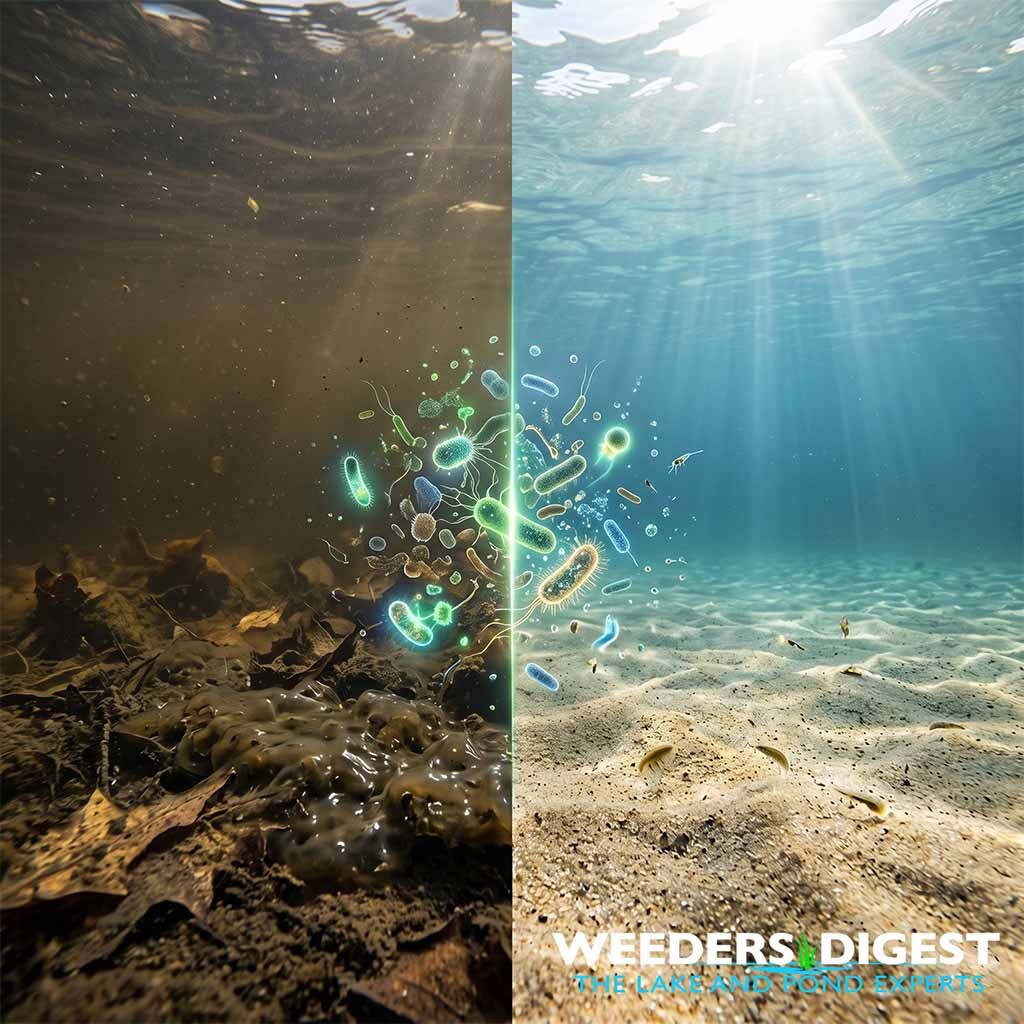
Muck pellets are concentrated, highly dense blends of naturally occurring bacteria and enzymes designed to sink to the bottom of a waterbody and accelerate the biological breakdown of organic sludge. When organic debris like dead algae, leaves, and aquatic weeds sink, they create a thick layer of oxygen-depleted muck. Bio-augmentation introduces a massive influx of beneficial microbes directly to this benthic zone to digest the waste, breaking it down into odorless gases and water. While the concept sounds like a straightforward cure for aging ponds, these microbes require very specific environmental parameters, such as adequate dissolved oxygen and water temperatures above 60 degrees Fahrenheit, to survive and reproduce effectively.
In my years working as a Certified Lake Manager, a classic field observation I regularly encounter is the stark difference between aerated and stagnant shorelines. I once treated a moderately sludgy private cove where the property owner had installed a bottom-diffused aeration system, and within a single season, the muck felt noticeably firmer and less gelatinous underfoot. Conversely, when tossing pellets into stagnant, heavily shaded, and oxygen-depleted backwaters, the sludge barely changes at all. This highlights a crucial reality in aquatic management: you cannot simply throw microbes into a hostile, oxygen-starved environment and expect a miracle. True biological digestion requires an integrated approach where we fundamentally improve the habitat so these bacteria can actually thrive and perform their job.
The Science Behind It:
Bio-augmentation in aquatic ecosystems is the deliberate addition of specific, cultured microorganisms to a natural environment to enhance the degradation of organic compounds. In lakes and ponds, benthic organic matter (OM) accumulates rapidly when the rate of detrital input—from phytoplankton, macrophytes, and terrestrial runoff—exceeds the natural mineralization rate of the system. Mineralization is the fundamental biological process by which heterotrophic bacteria convert complex, particulate organic matter into simple inorganic compounds, carbon dioxide, and water. Muck pellets function as a targeted delivery mechanism, utilizing heavy binding agents to sink through the water column and release highly concentrated microbial colonies directly into the sediment-water interface where the sludge layer resides.
Because bacteria cannot absorb large, complex organic polymers directly through their cellular membranes, these commercial pellets also typically contain exogenous extracellular enzymes. The standard enzymatic profile includes lipase to break down localized lipids, protease for protein degradation, amylase for starches, and cellulase to degrade the rigid cell walls of decaying plant material. These enzymes act as biochemical catalysts, cleaving large macromolecules into smaller, soluble monomers such as amino acids and simple sugars. Once the surrounding organic matrix is reduced to this bio-available state, the localized bacterial colonies can readily ingest and metabolize the nutrients.
Despite the theoretical soundness of this microbiological pathway, empirical efficacy in field and controlled conditions remains highly variable and heavily debated within limnological circles. A 2022 peer-reviewed study published in Lake and Reservoir Management strictly assessed the effectiveness of commercial muck-digesting bacterial pellets on organic matter reduction across three different lakes. The researchers found no statistically significant differences in the change in organic matter (OM) between the pelleted sediment treatments and the non-pelleted control groups. The study noted that while the microbial applications introduced massive quantities of digestive bacteria, the baseline decomposition rates in closed, unaerated experimental settings did not improve, proving that microbial efficacy is fundamentally constrained by environmental variables rather than a sheer lack of baseline bacteria.
The discrepancy between theoretical sludge digestion and documented field efficacy largely hinges on the biochemical pathways of cellular respiration. Aerobic respiration, which requires abundant dissolved oxygen acting as the final electron acceptor, is vastly more efficient and yields significantly more cellular energy for the bacteria than anaerobic digestion. When organic sediments are highly anoxic—which is the default state of dense lake muck—the added bacteria are forced to utilize anaerobic metabolic pathways. These pathways are agonizingly slow and produce undesirable byproducts like hydrogen sulfide and methane. Therefore, for bio-augmentation to be scientifically viable and mathematically measurable, the aquatic environment must typically maintain temperatures above 15 degrees Celsius and possess sufficient dissolved oxygen to sustain high-rate aerobic microbial metabolism.
Ultimately, the successful microbiological digestion of aquatic sludge is not achieved merely by increasing the volume of introduced bacteria, but by mitigating the environmental limiting factors that restrict biological decay. Academic literature consistently emphasizes that microbial-mediated bioremediation is a promising ecological tool, yet it cannot override fundamental limnological principles. Without structural interventions, such as artificial aeration or hydro-circulation to increase the oxidation-reduction potential at the sediment boundary, introducing exogenous microbes will likely yield minimal quantitative changes to benthic organic mass.
Sources / References:
- Assessment of the effectiveness of muck-digesting bacterial pellets (Lake and Reservoir Management, 2022): https://www.tandfonline.com/doi/full/10.1080/10402381.2022.2029635
- In-Situ Bioremediation of Ground Water and Geological Material: a Review of Technologies (U.S. Environmental Protection Agency): https://nepis.epa.gov/Exe/ZyPURL.cgi?Dockey=9101LVUK.TXT