

Timing is Everything: Why Your Pond's Chemical Treatments Fail When You Wait Too Long
 |

Summary:
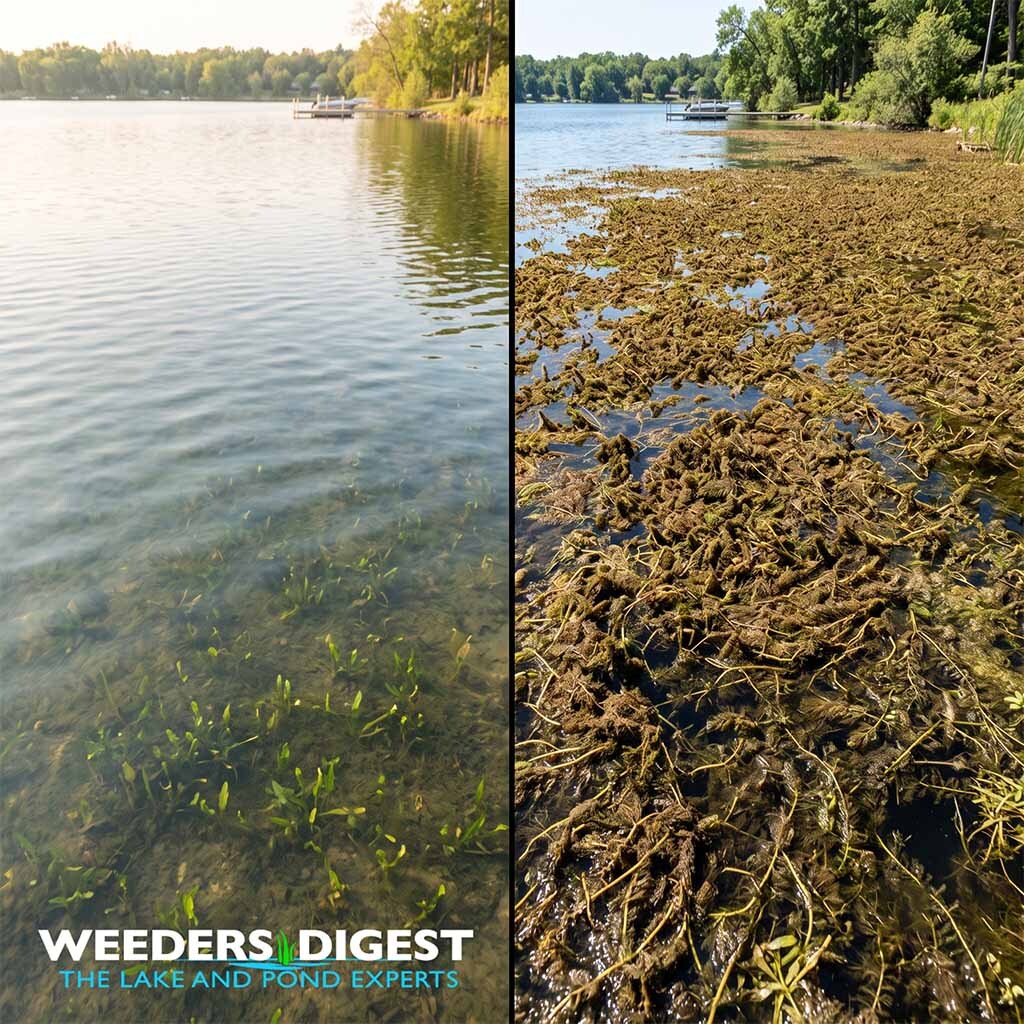
The optimal time to apply aquatic herbicides is during early spring when water temperatures are consistently between 70°F and 80°F, targeting plants in their earliest active growth stages. Waiting until mid-summer when weeds have fully matured and formed thick, impenetrable mats at the surface severely decreases the effectiveness of chemical treatments and introduces severe risks to the aquatic ecosystem. During the early spring growth phase, aquatic plants are rapidly absorbing nutrients to fuel their development, making them highly susceptible to chemical uptake. They have not yet developed the dense root crowns or thick protective surface layers that mature plants use to block out environmental stressors. Furthermore, treating a massive amount of overgrown vegetation later in the season generates a massive volume of decaying organic matter, which strips the water of its oxygen and frequently causes devastating fish kills.
In my years managing lakes and diagnosing post-treatment failures, your biggest enemy is usually patience. I routinely visit properties where a landowner waited to treat until an invasive pondweed infestation had completely choked off their dock access in late July. By the time I get the call to assess the waterfront, applying a full-scale treatment is incredibly risky, and I have to explain that we are forced to treat the lake in small puzzle pieces over several weeks just to keep their fish alive. Catching the vegetation early not only requires a lower volume of chemicals to achieve control, but it ensures your waterbody remains stable, clear, and usable all season long.
The Science Behind It:
The physiological relationship between plant maturity and herbicide efficacy is rooted in the fundamental differences between juvenile and senescent (aging and deteriorating) plant tissue. As aquatic macrophytes (plants large enough to be seen with the naked eye) progress from seedling emergence to full maturity, morphological changes occur that actively inhibit chemical absorption. Mature aquatic vegetation develops thicker cuticular waxes (protective, water-repelling outer layers) on their leaf surfaces and shifts biological energy allocation from rapid cellular division to reproduction and carbohydrate storage. Consequently, systemic herbicides—which must be absorbed through the leaf or stem and translocated (transported) via the vascular system down to the root crown—face significant biological barriers when applied to late-season plants.
Environmental variables closely tied to seasonality also dictate chemical performance and absorption rates. According to research published by the Southern Regional Aquaculture Center, the critical window for aquatic weed management opens during the spring months when water temperatures reach 70 to 80 degrees Fahrenheit (21.1 to 26.7 degrees Celsius). At this specific thermal threshold, aquatic plants are metabolically highly active, ensuring maximum herbicide uptake and translocation. Furthermore, systemic chemical applications require extensive contact time to fundamentally alter plant biology. As noted by the University of Florida Institute of Food and Agricultural Sciences, systemic options like fluridone function by inhibiting carotene synthesis—a process that requires 30 to 90 days of continuous chemical exposure to successfully break down chlorophyll in target weeds. Applying such herbicides in late summer simply does not allow sufficient temporal exposure before the onset of natural fall die-back, rendering the application a waste of resources.
The most critical scientific parameter governing treatment timing is dissolved oxygen (DO) dynamics and biochemical oxygen demand (BOD). When a large biomass of mature aquatic vegetation is chemically eradicated, the decaying plant tissue is immediately metabolized by aerobic bacteria. This bacterial decomposition consumes massive quantities of dissolved oxygen from the water column. The Southern Regional Aquaculture Center explicitly warns that treating heavily vegetated ponds during the hot summer months—when the dissolved oxygen carrying capacity of the water is naturally at its lowest due to elevated water temperatures—poses a severe, immediate risk of hypoxic (low oxygen) fish kills.
To mitigate this catastrophic drop in dissolved oxygen, late-season interventions must be heavily restricted and mathematically calculated. When dealing with mature summer biomass, the Southern Regional Aquaculture Center dictates that managers must treat no more than 25 to 33 percent of the total pond surface area at one time. This staggered, fractional approach slows the bacterial decomposition rate and allows unaffected phytoplankton and remaining vegetation to continue photosynthesizing and oxygenating the water. By aligning treatment with the early spring growth stage instead, the total vegetative biomass is significantly lower and baseline dissolved oxygen concentrations are naturally higher, altogether eliminating this extreme biochemical oxygen demand and preserving the ecological balance of the waterbody.
Sources / References:
- Source 1: Southern Regional Aquaculture Center (SRAC). "Aquatic Weed Management: Herbicides" (Publication No. 361). URL: https://srac.msstate.edu/pdfs/Fact%20Sheets/361%20Aquatic%20Weed%20Management-%20Herbicides.pdf
- Source 2: University of Florida, Institute of Food and Agricultural Sciences (UF/IFAS). "Background on Registered Aquatic Herbicides" Center for Aquatic and Invasive Plants. URL: https://plants.ifas.ufl.edu/control-methods/chemical-control/background-on-registered-aquatic-herbicides/