

Tracking Your Lake's Health: How to Evaluate Your Aquatic Weed Management Program
 |

Summary:
Managing aquatic weeds in your pond or lake is rarely a one-time chore, but rather an ongoing commitment to the health of your entire ecosystem. When you invest time and energy into controlling nuisance plants, you need to know if those efforts are actually working. Monitoring and evaluating your management program simply means taking a structured, consistent look at how the plant life and water quality in your waterbody change over time following an intervention. It is the only way to confirm if the actions you took accomplished what you set out to do without causing unintended harm to your fish or native plant populations.
To figure out if your strategy is successful, you must establish a clear baseline before you even begin. By taking a snapshot of what your lake looks like right now—noting which plants are present, how dense the weed beds are, and the clarity of the water—you give yourself a benchmark to compare against later. After you apply your chosen management technique, whether that involves aeration, mechanical harvesting, or using specialized weed cutters that cleanly cut the vegetation at the roots rather than uprooting them, you return to those same spots to see what has changed. If the invasive weeds are retreating and your native species are thriving, your plan is on the right track.
Evaluation is also about setting realistic expectations for your waterbody. Complete eradication of a nuisance plant is often impossible and usually not healthy for the lake, as aquatic plants provide essential oxygen and wildlife habitat. Instead, success looks like restoring a natural balance so you can enjoy recreational activities while supporting local ecology. By consistently checking on your lake's progress season after season, you can adapt your approach, catch new invasive growth early, and ensure the long-term vitality of your aquatic environment.
The Science Behind It:
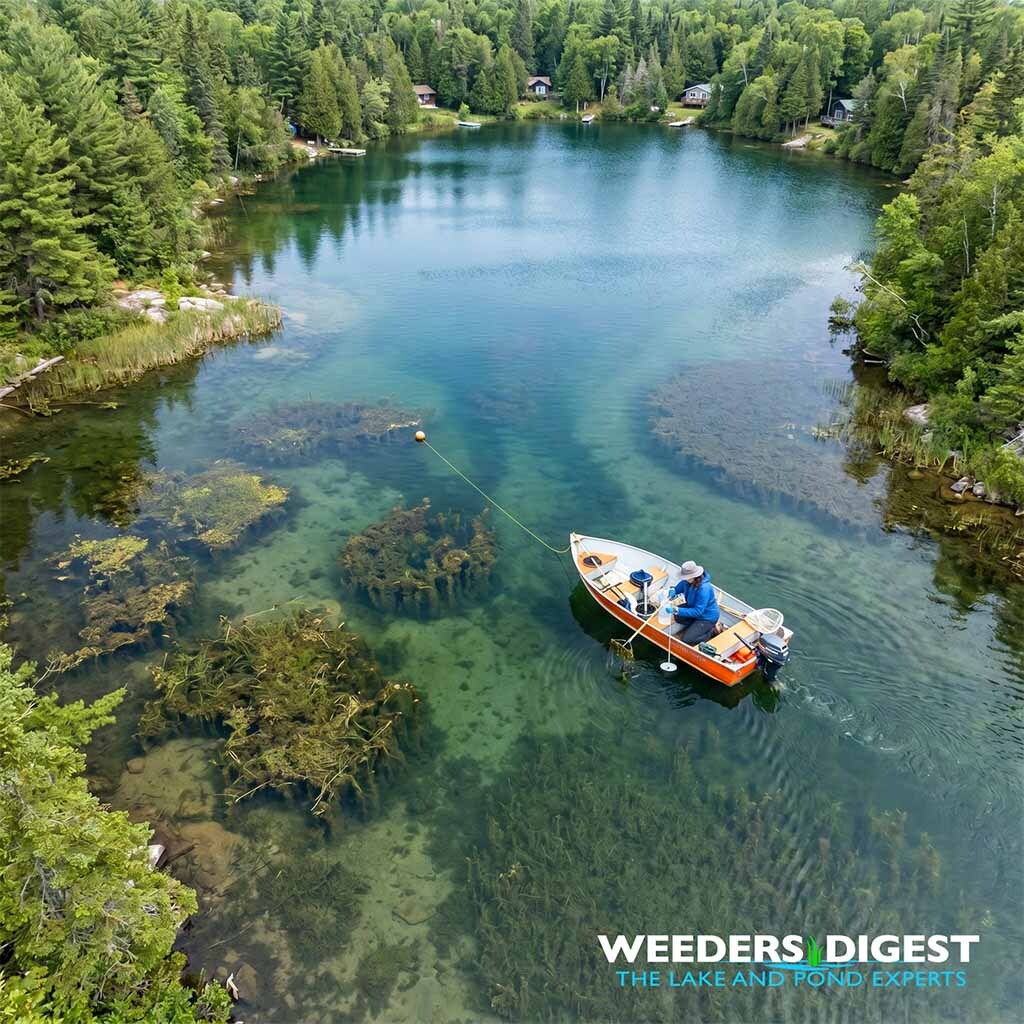
Quantitative baseline monitoring and post-management evaluation are fundamental requirements for assessing the ecological efficacy of any aquatic plant management initiative. According to standardized monitoring protocols developed by institutions such as the University of Wisconsin-Stevens Point, resource managers and limnologists primarily rely on spatial sampling frameworks, most notably the point-intercept method, to objectively characterize species richness, abundance, and the spatial distribution of aquatic vegetation. In a standard point-intercept survey, a geo-referenced grid is superimposed over the bathymetric map of the target waterbody, and sampling locations are navigated to using GPS coordinates. At each predetermined coordinate, a sampling rake is deployed through the water column and retrieved to assess macrophyte presence, species composition, and overall biomass density. This systematic approach standardizes data collection, eliminating the subjective bias inherent in visual shoreline assessments and providing statistically robust data for comparative analysis.
Comparing pre-treatment and post-treatment point-intercept data allows aquatic ecologists to calculate critical limnological metrics, such as the frequency of occurrence for specific target species, the maximum depth of plant colonization within the photic zone, and overall community diversity indices. By quantifying these shifts, managers can ascertain whether an intervention successfully reduced the footprint of an invasive macrophyte, such as Eurasian watermilfoil, without extirpating beneficial native flora. A statistically significant reduction in the target species' frequency of occurrence coupled with a stable native species diversity index strongly indicates a highly selective and successful management application. Furthermore, tracking these metrics helps delineate the light limitations and benthic substrate preferences that drive macrophyte proliferation in specific littoral zones.
Evaluating management success also necessitates the continuous monitoring of abiotic water quality parameters alongside biotic vegetation shifts. Aquatic plant respiration, photosynthesis, and decomposition heavily influence dissolved oxygen (DO) dynamics, pH fluctuations, and nutrient cycling within the water column. The rapid die-off of substantial vegetative biomass following a large-scale treatment can lead to a drastic increase in biochemical oxygen demand (BOD) due to aerobic bacterial decomposition, potentially inducing localized hypoxia that threatens fish populations. Therefore, a comprehensive ecological evaluation includes deploying multiparameter sondes to measure DO profiles, specific conductance, temperature stratification, and Secchi disk transparency before, during, and after management activities.
Ultimately, long-term evaluation demands an adaptive management framework built upon iterative data collection and analysis. As outlined by the University of Florida IFAS Center for Aquatic and Invasive Plants, establishing a rigid, quantitative definition of "control" is challenging because environmental variables—such as internal phosphorus loading, nutrient runoff, and seasonal temperature anomalies—continuously alter the carrying capacity of the ecosystem. Data compiled from repeated spatial surveys and limnological profiles must be centralized and analyzed over multiple growing seasons to differentiate between short-term seasonal diebacks and actual, long-term ecological restoration. The integration of high-resolution mapping software with point-intercept data provides spatial heat maps of infestation densities, empowering researchers to strategically allocate resources, adjust methodologies, and model the predictive trajectories of aquatic ecosystems under various management pressures.
Sources / References:
- University of Wisconsin-Stevens Point (UWEX Lakes). "Recommended Baseline Monitoring of Aquatic Plants in Wisconsin: Sampling Design, Field and Laboratory Procedures, Data Entry and Analysis." https://www3.uwsp.edu/cnr-ap/UWEXLakes/Documents/ecology/Aquatic%20Plants/PI-Protocol-2010.pdf
- University of Florida IFAS Center for Aquatic and Invasive Plants. "A Manager’s Definition of Control." https://plants.ifas.ufl.edu/management-plans/scope-of-aquatic-plant-management/a-managers-definition/