

Under the Ice: Where Do Frogs, Turtles, and Leeches Go in Our Winter Ponds?
 |

Summary:
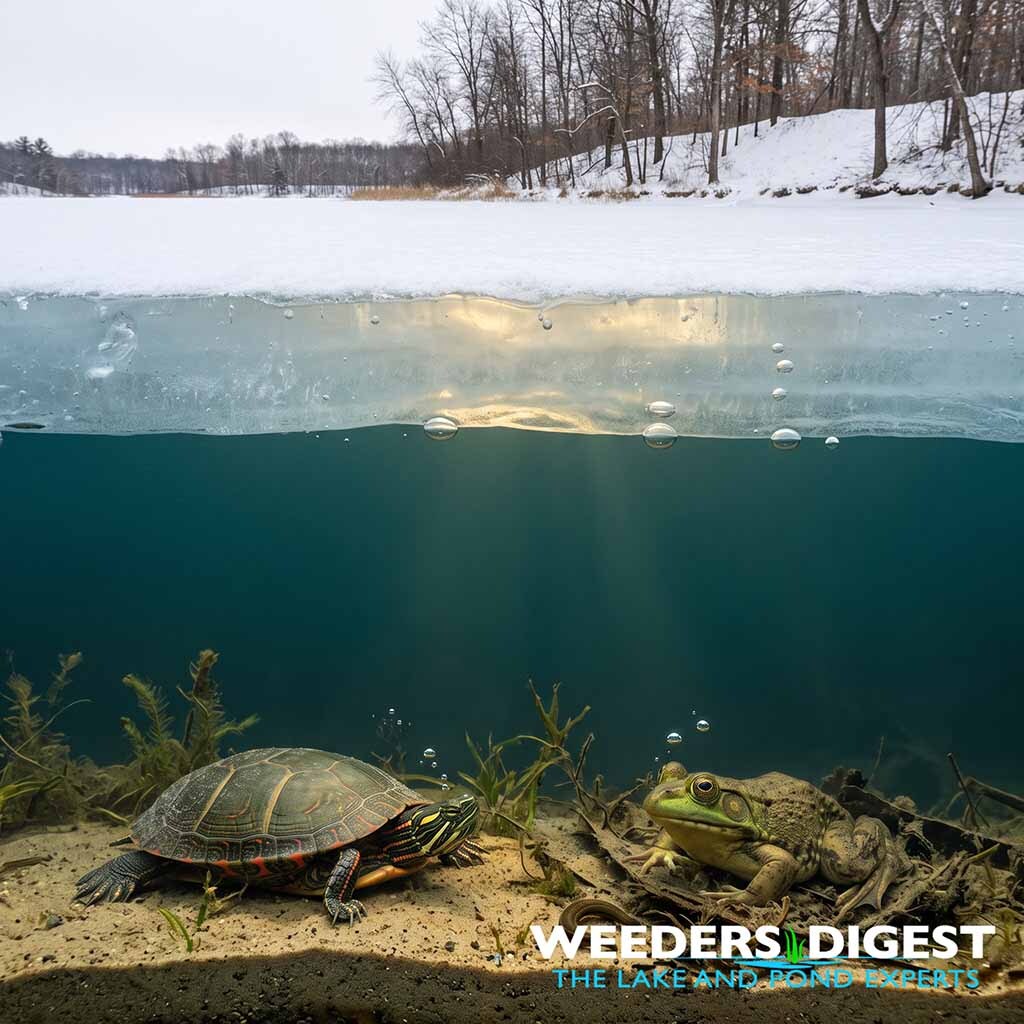
When winter caps our ponds with solid ice, frogs, turtles, and leeches do not migrate away; instead, they retreat to the benthic zone at the bottom of the water column to enter dormancy. Aquatic frogs such as bullfrogs rest directly on top of the muddy sediment or partially tuck under organic debris, relying on cutaneous respiration to absorb oxygen directly from the water. Turtles settle on or just beneath the silty substrate, drastically dropping their metabolic rate and utilizing extrapulmonary respiration through vascularized tissues in their skin and cloacal cavities. Leeches burrow deeper into benthic silt and muck, entering a cold-induced torpor where they endure near-freezing temperatures and minimal oxygen levels.
During our late-autumn field assessments before the deep freeze sets in, our pond experts frequently observe amphibians and reptiles congregating in quiet shallows with decaying vegetation. We often find juvenile turtles and dormant frogs resting alongside shoreline shelves where water temperatures stabilize right around 4°C (39.2°F). However, when thick layers of black organic muck blanket these zones, dissolved oxygen rapidly plummets, turning what should be a safe wintering refuge into an anoxic trap that risks winterkill for native wildlife.
The Science Behind It:
The survival of poikilothermic organisms beneath a frozen surface is governed by inverse thermal stratification and severe metabolic depression. When freshwater reaches 4°C, it attains maximum density and sinks to the bottom, creating a relatively warm, liquid benthic habitat beneath the lighter, floating surface ice sheet. Because these organisms cannot migrate to the surface to breathe atmospheric air, they enter brumation—a state of dormancy characterized by reduced core body temperature, depressed cardiovascular function, and minimal cellular energy consumption.
For aquatic frogs, survival depends almost exclusively on cutaneous respiration. Anurans possess thin, vascularized, permeable skin that facilitates passive gas exchange with the surrounding water column. Unlike turtles, most aquatic frog species lack the biochemical pathways required to endure prolonged anoxia; burying themselves deeply in oxygen-depleted sediment would cause rapid cellular asphyxiation. As a result, species like the American bullfrog (Lithobates catesbeianus) overwinter directly exposed on the sediment surface or among submerged aquatic plants, requiring continuous levels of dissolved oxygen above the benthic boundary layer.
Freshwater turtles, particularly the painted turtle (Chrysemys picta) and common snapping turtle (Chelydra serpentina), demonstrate remarkable adaptations to withstand severe hypoxia and total anoxia. Under well-aerated conditions, these reptiles utilize extrapulmonary gas exchange via vascularized bucco-pharyngeal and cloacal bursae. However, when continuous ice cover seals the surface and microbial decomposition consumes benthic oxygen, species like C. picta transition entirely to anaerobic glycolysis. Research published in Comparative Biochemistry and Physiology demonstrates that painted turtles can survive complete oxygen deprivation for over 170 days when submerged in anoxic water at 3°C. During this state of profound metabolic depression, blood lactate concentrations can surge dramatically from baseline levels of 1.8 mmol/L to an astonishing 168.1 mmol/L after 100 days. To survive this severe metabolic acidosis, turtles buffer hydrogen ions by dissolving calcium and magnesium carbonate directly from their bony shells and skeletal structures, causing extracellular calcium to increase from 2.0 to 36.6 mmol/L.
Aquatic leeches (subclass Hirudinea) employ a combination of cryobiosis, freeze avoidance, and extreme metabolic reduction to survive in northern waterbodies. As littoral zones freeze, leeches actively migrate downward into soft, organic sediment below the frost line, curling into tight, mucus-covered coils. In research detailing the extreme freeze tolerance of freshwater turtle-parasitizing leeches (Ozobranchus jantseanus) in PLOS ONE, individuals survived ultra-low temperatures and rapid desiccation, achieving a 100% survival rate after severe water loss up to 84.8% through cryoprotective vitrification. Common pond leeches manage subzero bottom conditions by synthesizing natural cryoprotectants—including intracellular glycerol and glycogen derivatives—which depress their internal freezing point and prevent lethal intracellular ice formation.
The critical limiting factor in this entire overwintering ecology is biological oxygen demand (BOD) in the sediment. In ponds burdened by deep layers of decomposing lake weeds and organic muck, heterotrophic anaerobic bacteria consume the meager dissolved oxygen reserves beneath the ice. Once benthic dissolved oxygen collapses below 2.0 mg/L, non-anoxic organisms, including frogs and essential invertebrate food webs, experience fatal respiratory collapse—a phenomenon known as pond winterkill.
Our Recommendation for Managing Winter Pond Ecology & Sediment Quality:
Preventing anoxic conditions and safeguarding dormant pond life requires breaking the cycle of decaying organic matter before freezing temperatures lock down your shoreline. Deep sediment accumulation drives high chemical and biological oxygen demand, transforming the bottom of the pond into a toxic, hydrogen-sulfide-rich layer rather than a safe sanctuary.
To maintain healthy benthic conditions and support balanced aquatic life, waterfront property owners must address sediment build-up and stagnant water layers. Utilizing automated bottom-sweeping systems like the AquaThruster Muck & Weed Blower collection allows you to clear out thick layers of silt, leaves, and decaying aquatic biomass from docks and shoreline zones. By physically moving sediment and preventing the continuous accumulation of soft organic muck, you help maintain a firm, oxygenated bottom substrate. Pairing mechanical sediment control with continuous autumn aeration ensures that dissolved oxygen levels remain sufficient throughout the water column, preventing winterkill and protecting the wildlife that calls your pond home.
Sources / References:
- Ultsch, G. R., & Jackson, D. C. (1982). Long-term submergence at 3°C of the turtle, Chrysemys picta bellii, in normoxic and anoxic water. Journal of Experimental Biology, 96(1), 11–28.
- Warren, D. E., & Jackson, D. C. (2017). The metabolic consequences of repeated anoxic stress in the turtle Chrysemys picta bellii. Comparative Biochemistry and Physiology Part A: Molecular & Integrative Physiology, 203, 1–8. https://doi.org/10.1016/j.cbpa.2016.07.012
- Suzuki, D., et al. (2014). A leech capable of surviving exposure to extremely low temperatures. PLOS ONE, 9(1), e86807. https://doi.org/10.1371/journal.pone.0086807
- Reese, S. A., Crocker, C. E., Jackson, D. C., & Ultsch, G. R. (2002). The physiology of overwintering in a turtle that occupies multiple habitats, the common snapping turtle (Chelydra serpentina). Physiological and Biochemical Zoology, 75(5), 432–441. https://doi.org/10.1086/342801