

Unlocking Your Pond's True Potential: My Guide to Identifying Common Aquatic Weeds
 |

Summary:
One of the most frustrating things as a pond owner is watching your pristine water get taken over by green muck or tangled vines. I have been there, and I know how overwhelming it feels when you do not even know what you are looking at. Before you can fix the problem, you have to know exactly what is growing in your water. Identifying aquatic plants is the first and most critical step in taking back control of your lake or pond environment and finding a lasting solution.
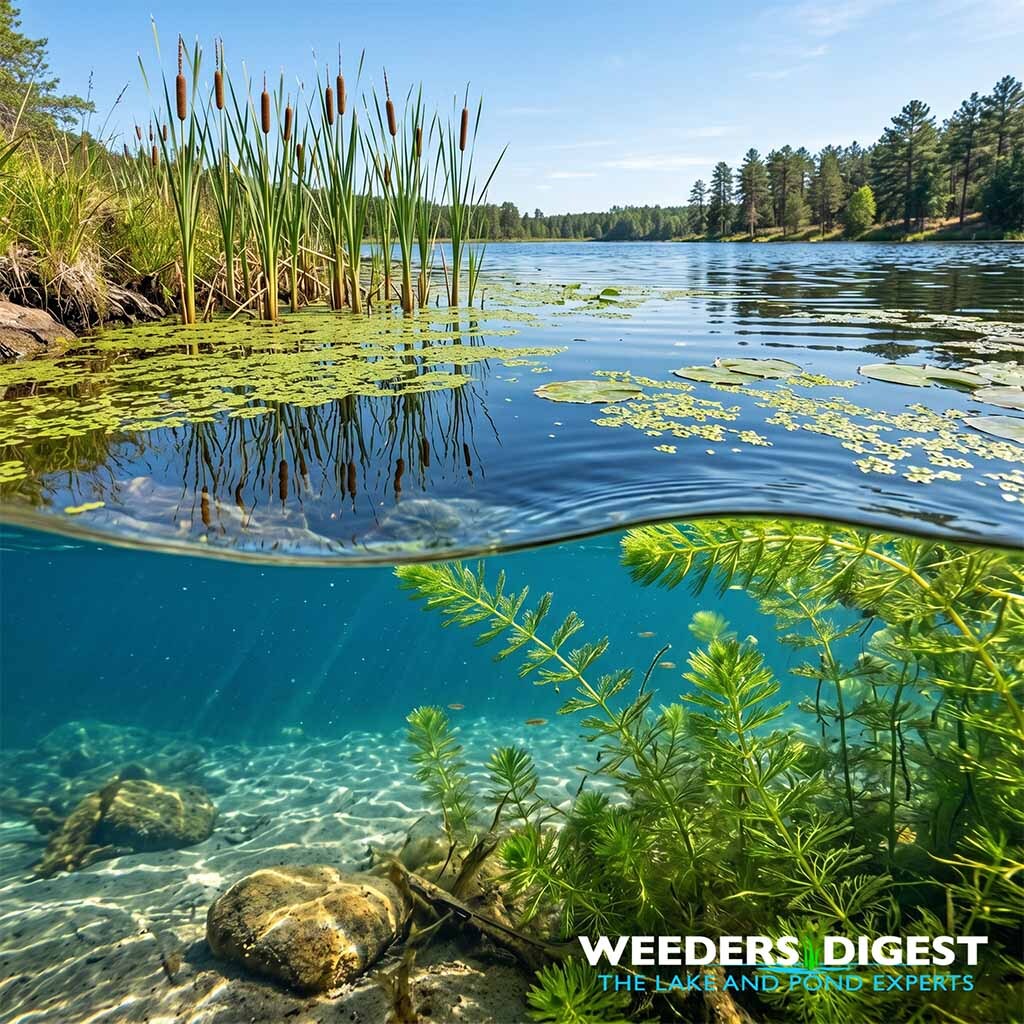
There are four main categories of aquatic plants you will encounter on your property: algae, floating plants, submerged plants, and emergent plants. Algae can look like spilled green paint or thick, stringy hair resting on the water. Floating plants, just like the name suggests, sit right on the surface with their tiny roots dangling below them, often multiplying until they look like a solid green carpet.
Submerged plants grow entirely under the water, often tangling around boat propellers and making swimming incredibly unpleasant. Finally, emergent plants have roots planted firmly in the shallow water but stand tall above the surface along your shoreline. By figuring out which of these four categories your specific weed falls into, you can quickly narrow down the exact species, making management a straightforward process rather than a stressful guessing game.
The Science Behind It:
Proper identification of aquatic macrophytes and macroalgae is a fundamental component of limnological management and aquatic ecosystem preservation. Aquatic vegetation is taxonomically and morphologically categorized into four primary functional groups: planktonic and filamentous algae, free-floating macrophytes, submersed macrophytes, and emergent macrophytes. According to research from the Mississippi State University Extension Service, these classifications are based on the growth habits of the organism and its structural relationship to the water column and benthic substrate. Algae, which lack true roots, stems, or vascular leaves, represent the primitive base of the aquatic food web, whereas vascular plants exhibit advanced anatomical structures adapted for specific hydrological zones.
Submersed macrophytes, such as Hydrilla verticillata or Elodea canadensis, complete their vegetative life cycles entirely below the water surface. These vascular plants are typically rooted in the benthic substrate and rely on the diffusion of dissolved inorganic carbon directly from the water for photosynthesis. The Purdue College of Agriculture's Department of Botany and Plant Pathology notes that excessive proliferation of submersed species often correlates with hyper-eutrophic conditions, where elevated concentrations of nitrogen and phosphorus dictate the overall biological productivity of the water body. Submersed weeds frequently possess highly dissected leaves to maximize surface area for nutrient assimilation and gas exchange in an aqueous environment.
Emergent and free-floating species inhabit entirely different ecological niches within the littoral and pelagic zones. Emergent plants, such as Typha species, exhibit significant structural rigidity, allowing their photosynthetic tissues to extend well above the water's surface to access atmospheric carbon dioxide directly. Conversely, free-floating plants remain unattached to the benthos, drawing nutrients directly from the water column through adventitious root systems. The rapid reproductive rates of free-floating species can lead to dense surface mats that severely attenuate light penetration, subsequently inhibiting benthic photosynthesis and driving localized anoxia during decomposition processes.
The ecological implications of misidentification are profound, particularly when considering the morphological similarities between distinct biological classifications. For instance, the macroalgae Chara, often referred to as stonewort, physically resembles submersed vascular plants due to its whorled structure and benthic anchoring. However, as highlighted by Penn State Extension researchers, Chara is an alga that lacks a true vascular system and requires distinctly different biological and environmental management protocols than rooted macrophytes. Accurate taxonomic identification ensures that ecological management strategies align perfectly with the specific physiological traits of the target organism, promoting long-term aquatic health.