

Weeders Digest Comprehensive Guide to Aquatic Weed Identification: Unlocking the Secrets of Your Lake's Ecosystem
 |

Summary:
Understanding exactly what is growing beneath the surface of your water is the single most important step in reclaiming your shoreline. When you look out at a lake, it is easy to view all vegetation simply as a nuisance that needs to be removed. However, correctly identifying the specific types of aquatic plants in your waterbody is the ultimate solution to achieving a balanced, healthy aquatic ecosystem. Knowing your plants allows you to separate the beneficial native species that support fish habitats from the aggressive invasive weeds that choke out water flow.
Aquatic vegetation is generally broken down into three easy-to-understand categories based on where it grows. Emergent plants are the rigid, stiff-stemmed varieties you see standing tall along the shoreline, like cattails and bulrushes. Floating plants range from the classic lily pads anchored to the bottom to tiny free-floating duckweed that drifts across the surface. Finally, submerged plants are the soft-stemmed varieties that grow almost entirely underwater, which are often the true culprits when swimmers or boat motors get tangled.
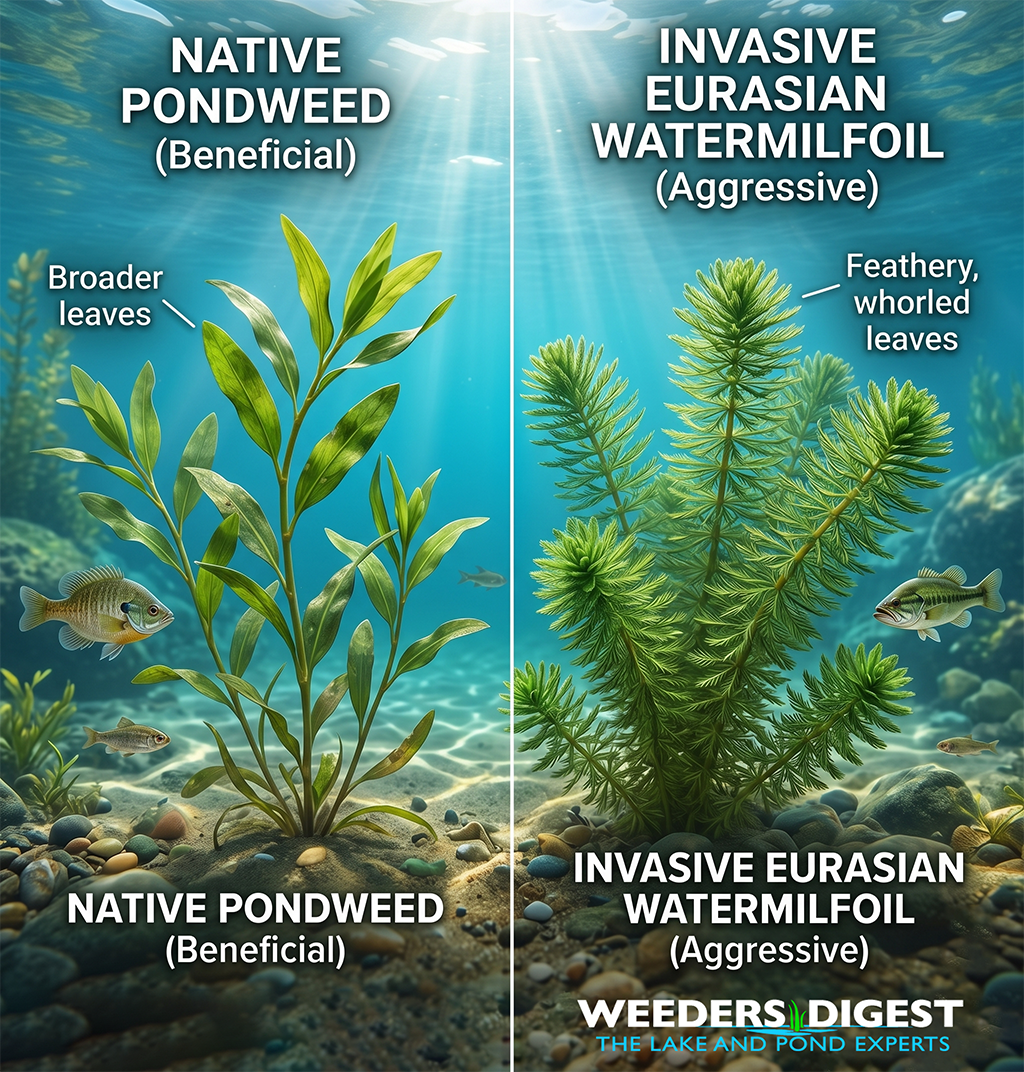
Taking the time to identify whether you are dealing with a native pondweed or a highly invasive species completely changes your management approach. A healthy lake relies on beneficial plants to produce oxygen, stabilize the muck at the bottom, and compete with algae for nutrients. By identifying and targeting only the problematic weeds, you save yourself massive amounts of time and energy, ensuring your waterfront remains a beautiful, functional asset for years to come.
The Science Behind It:
The taxonomic classification of aquatic macrophytes relies heavily on morphological characteristics, but the phenotypic plasticity of these plants often complicates visual identification. Macrophytes adapt drastically to localized hydrodynamic conditions, nutrient availability, and sediment composition. Botanists and limnologists categorize these organisms into functional groups based on their structural relationship to the water column: emergent, floating-leaved, submersed, and free-floating. This spatial zonation is primarily governed by light availability and water clarity, as submersed vegetation can only photosynthesize within the boundaries of the photic zone.
The physical distribution and successful identification of submersed aquatic vegetation are inextricably linked to light extinction coefficients within the water column. The amount of photosynthetically active radiation reaching the benthic zone is limited by color-producing agents, specifically chlorophyll, suspended minerals, and colored dissolved organic matter (Brooks et al., 2022). As these variables fluctuate, they define the ecological boundaries where specific submersed taxa can thrive. Understanding this light attenuation is a critical component of mapping plant beds, as the optical properties of the water dictate both the biological growth limits of the vegetation and the efficacy of the remote sensing technologies used to identify them.
Because invasive species often exhibit morphological similarities to native counterparts, advanced diagnostic methodologies have become necessary for accurate identification. For example, visually differentiating invasive Eurasian watermilfoil from native milfoils is notoriously difficult in turbid environments. To solve this, researchers utilize drone-enabled multispectral imagery analysis, leveraging a modified Normalized Difference Vegetation Index (mNDVI) that utilizes shorter 720-nanometer wavelengths to better penetrate the water column (Brooks et al., 2022). This spectral profiling allows ecologists to identify distinct biochemical signatures, mapping the exact extent of invasive taxa based on light reflectance rather than relying solely on physically laborious and destructive sampling methods.
Furthermore, subsurface hydroacoustic imaging combined with machine learning algorithms represents the current state-of-the-art approach to classifying and identifying aquatic weeds. Autonomous methodologies now bypass the limitations of optical water clarity by using high-frequency sonar to generate spatial point clouds of underwater plant beds. Researchers deploy sophisticated feature extraction algorithms to analyze the texture, shape, and acoustic histograms of these scans, successfully identifying specific invasive species based on their unique acoustic geometries (Patel et al., 2019). These computational advances ensure that highly targeted, species-specific ecological data can be gathered rapidly, forming the robust foundation of modern lake management protocols.
Sources / References:
Brooks, C., Grimm, A., Marcarelli, A. M., Marion, N. P., Shuchman, R., & Sayers, M. (2022). Classification of Eurasian Watermilfoil (Myriophyllum spicatum) Using Drone-Enabled Multispectral Imagery Analysis. Remote Sensing, 14(10), 2336. https://doi.org/10.3390/rs14102336 (Cited by: 8)
Patel, M., Jernigan, S., Richardson, R., Ferguson, S., & Buckner, G. (2019). Autonomous Robotics for Identification and Management of Invasive Aquatic Plant Species. Applied Sciences, 9(12), 2410. https://doi.org/10.3390/app9122410 (Cited by: 24)