

Why Are Fish Schooling Under Your Dock Before Water Temperatures Plunge?
 |

Summary
Fish school tightly around shallow docks right before autumn water temperatures drop because nearshore structures serve as critical thermal refuges, forage magnets, and protective staging zones before the lake destratifies. As chilly nights cool open waters, wooden and dark composite dock pilings absorb solar radiation during daylight hours, warming micro-pockets of shallow water by several degrees. At the same time, declining aquatic weeds push baitfish, juvenile bluegill, and minnows out of open weed beds into artificial cover, drawing larger predatory fish directly toward our shorelines.
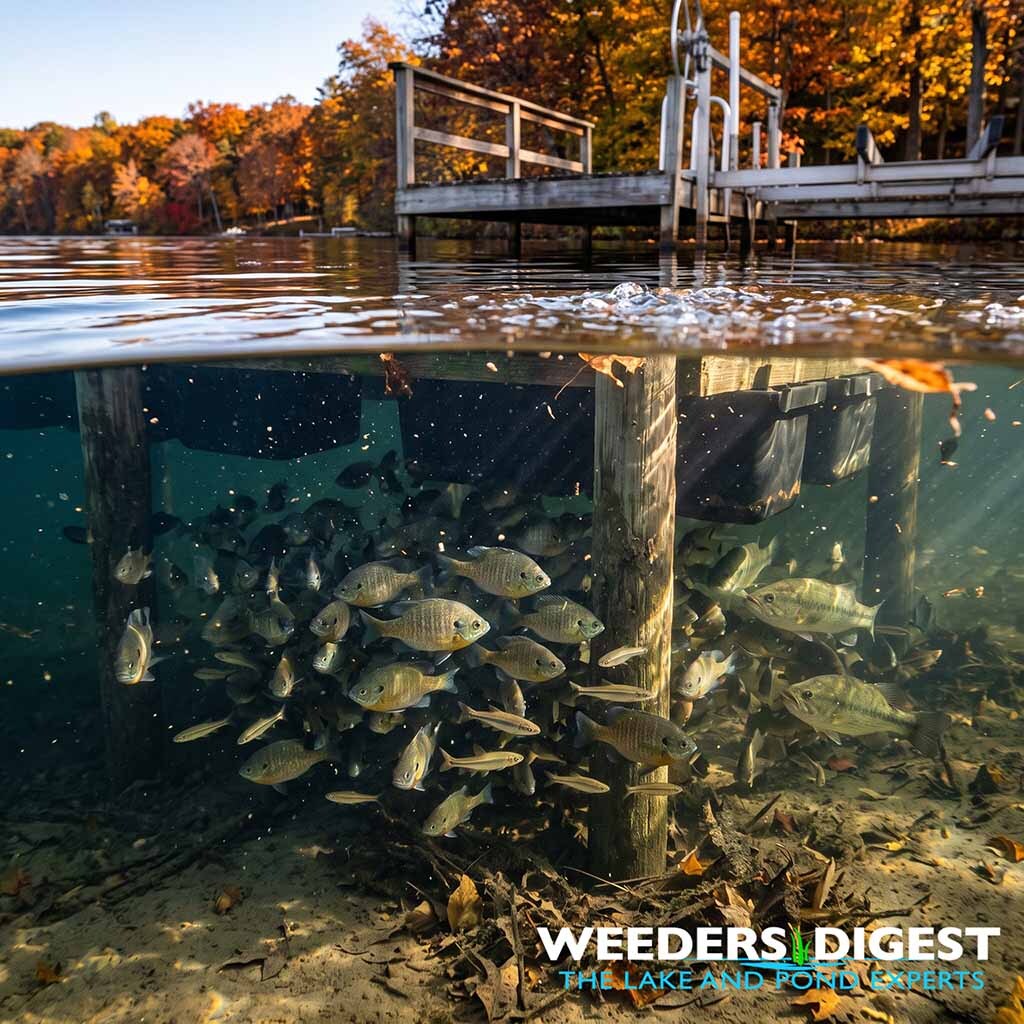
When our lake experts conduct shoreline audits in late September and October, we frequently observe massive, dense clusters of panfish, bass, and forage fish packed tightly beneath dock floats and gangways. These fish are visibly utilizing man-made shade and pilings to conserve caloric energy while feeding aggressively before winter sets in.
The Science Behind It
The sudden aggregation of fish under littoral structures in late summer and early autumn is governed by fundamental limnological and bioenergetic shifts. Temperate lakes throughout the summer maintain strong thermal stratification, separated into the warm upper epilimnion, the intermediate metalimnion (thermocline), and the cold, dense hypolimnion. As photoperiod shrinks and ambient autumn temperatures plummet, the epilimnion loses heat rapidly to the atmosphere. Because water reaches its maximum density at approximately 3.98°C (39.2°F), cooling surface water becomes significantly heavier than the water directly beneath it, prompting the early phases of convective mixing that culminate in autumn lake turnover.
Before this full destabilization occurs, the littoral zone—the shallow area along our shores—cools and warms at radically higher rates than the offshore pelagic zone due to low thermal volume. Dock structures, particularly dark gangways, wooden support posts, and aluminum frames, act as thermal radiators. Solar insolation during peak daytime hours warms nearshore structure microclimates. University limnological studies examining thermal refugia have demonstrated that structural shore zones can exhibit local water temperatures that are 1.5°C to 3.0°C warmer than adjacent pelagic surface waters. For ectothermic freshwater teleosts, whose metabolic rates drop precipitously as water temperatures fall, these micro-degree increments represent substantial metabolic savings. Research published in the Journal of Fish Biology demonstrated that standard metabolic rates in common freshwater species can decrease by nearly 50% when ambient water temperatures drop from 15°C down to 5°C. Staying in slightly warmer micro-pockets permits fish to maintain higher digestive efficiency and muscle function.
Simultaneously, seasonal macrophyte senescence triggers a trophic collapse in open flats. Submerged aquatic plants like curly-leaf pondweed, milfoil, and coontail begin to die back due to decreasing light penetration and cooling water columns. In healthy lake ecosystems, littoral weed beds can harbor macroinvertebrate and baitfish densities exceeding 1,000 to 3,500 organisms per square meter. As these vegetation beds collapse, forage species lose their primary structural shelter and are forced into adjacent hard structures—predominantly dock posts, seawalls, and boat hoists—to escape open-water pelagic predators.
Predatory species such as largemouth bass (Micropterus salmoides) and northern pike (Esox lucius) follow this prey migration into shallow water, utilizing the complex structural shadow of docks for ambush predation. Under dock platforms, light levels drop by over 70% to 90% compared to surrounding open water, granting ambushing predators a strong visual contrast advantage against schooling prey entering the perimeter. Furthermore, early lake turnover phases periodically upwell anoxic, hydrogen sulfide-rich water from the decomposing hypolimnion into the middle depths. This sudden dissolved oxygen drop in deeper basins temporarily drives game fish upward and outward into oxygenated, wind-mixed shoreline shallows.
Our Recommendation for Managing Waterfront Fish Refuges & Shoreline Health
While schooling fish under a dock create an exciting fishing environment, excessive structural stagnation often traps dying organic matter, nuisance weeds, and floating debris in the exact same footprint. As autumn vegetation collapses, decomposing plant mass settles around dock pilings and under floats, consuming dissolved oxygen and forming dense, sulfuric bottom muck that destroys natural fish spawning beds for the following spring.
To maintain crystal-clear swimming areas while supporting a thriving aquatic ecosystem, dock owners must establish dynamic water flow. Installing continuous water movement systems—specifically directional underwater blowers like our AquaThruster Muck & Weed Blower collection—mechanically sweeps away decaying silt and organic debris before it settles into muck. By replicating natural current, these high-velocity circulation systems eliminate stagnant, weed-choked dead zones around our docks, maintain high localized dissolved oxygen levels, and preserve clean, sandy bottoms that game fish and waterfront property owners both enjoy.
Sources / References
- Fisheries Research Services & Angling Trust Limnology Group: How Water Temperatures Affect Fish Metabolism and Locational Behavior
- Wetzel, R. G. Limnology: Lake and River Ecosystems (3rd Edition). Academic Press: ScienceDirect Reference Overview
- Journal of Fish Biology: Metabolic Scaling and Temperature Decrements in Temperate Freshwater Teleosts