

Why Black Sludge Is Collecting Near Your Dock Right as Leaves Fall
 |

Summary:
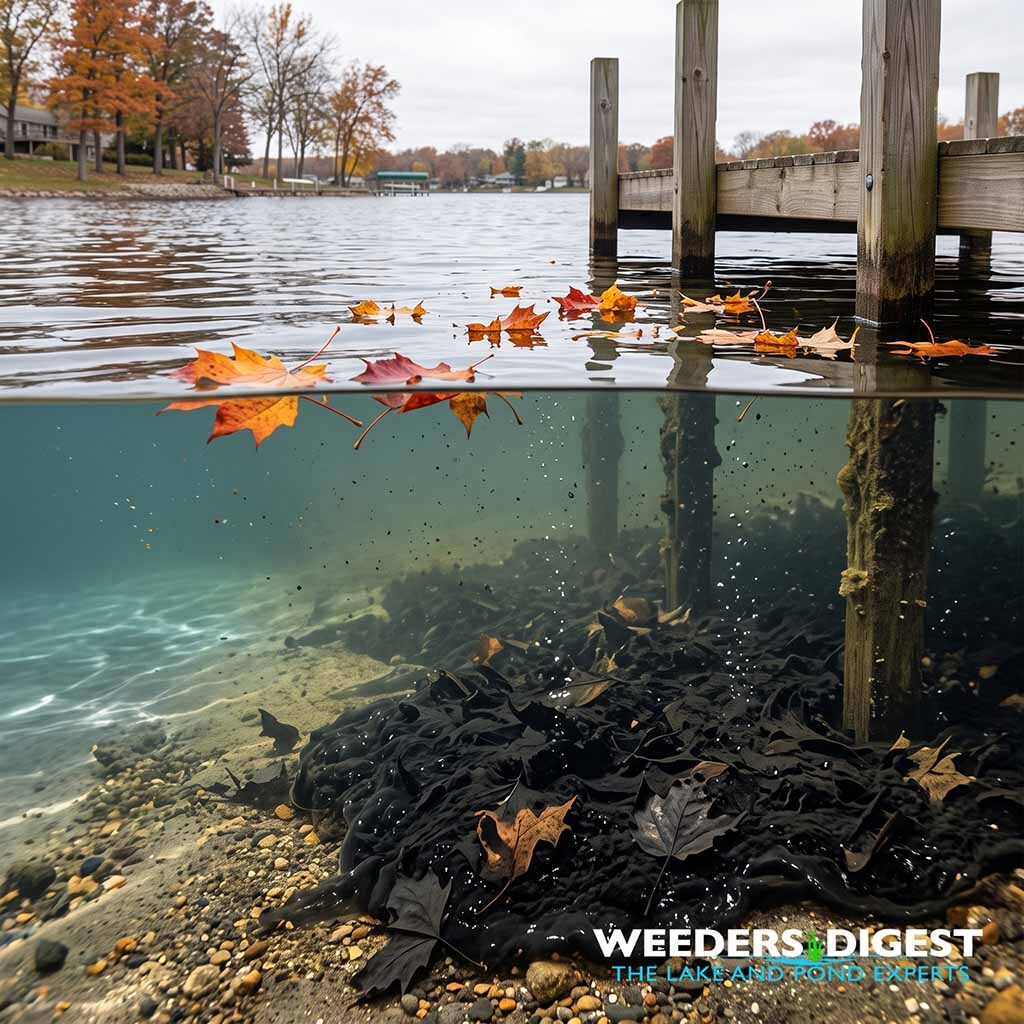
The black sludge collecting around your dock during autumn is the direct result of rapid, anaerobic decomposition triggered by a sudden influx of decaying organic matter settling in stagnant littoral zones. When deciduous trees shed their foliage, tons of allochthonous organic material fall directly into the water and drift toward shorelines. Because docks, pilings, and boat lifts naturally impede natural current and wave action, these calm pockets act as settling basins where saturated leaves sink, compress, and smother the lakebed.
In our field evaluations across waterfront properties every October and November, our lake experts routinely find docks where clear, sandy bottoms transformed into six to twelve inches of noxious, foul-smelling black silt in a matter of weeks. When we pull core samples from under these structures, the sediment is composed of tightly packed, dark leaf fragments stripped of oxygen, giving off the classic "rotten egg" hydrogen sulfide odor that signals biological suffocation.
Once these leaves submerge, local microbial populations consume every available molecule of dissolved oxygen at the sediment-water interface trying to break down the sudden biomass. Deprived of oxygen, the benthic environment turns strictly anaerobic. Anaerobic bacteria break down the remaining plant tissues much more slowly, producing black ferrous sulfide precipitates, humic compounds, and gaseous byproducts that consolidate into the dark, gelatinous sludge covering your lakebed.
The Science Behind It:
The transition of fallen leaves into dense black sediment is governed by limnological pathways involving allochthonous carbon loading and microbially mediated redox reactions. Deciduous leaf litter introduces substantial amounts of refractory carbon, lignin, cellulose, and tannins into the littoral zone. Research evaluating organic litter decomposition in freshwater systems shows that submerged leaf litter can lose between 20% and 40% of its initial dry mass within the first 48 to 72 hours solely through abiotic leaching of soluble organic compounds, releasing massive pulses of dissolved organic carbon (DOC) and bioavailable phosphorus directly into the surrounding water column.
This rapid carbon loading creates an acute biological oxygen demand (BOD) that outpaces atmospheric diffusion and littoral mixing. In studies assessing dissolved oxygen dynamics over benthic decomposing plant matter, localized dissolved oxygen concentrations at the sediment boundary layer plummeted from normative aerobic levels (greater than 6.0 mg/L) to hypoxic and completely anoxic thresholds (below 0.5 mg/L) within days of heavy detrital deposition. In quiescent dock slips where water exchange is restricted, this oxygen depletion occurs rapidly, halting efficient aerobic mineralization.
When oxygen is exhausted, microbial decomposition transitions to anaerobic metabolic pathways, sequentially utilizing alternative electron acceptors including nitrate (NO3-), manganese (Mn4+), ferric iron (Fe3+), and sulfate (SO42-). Specialized sulfate-reducing bacteria (Desulfovibrio spp.) reduce aquatic sulfates into hydrogen sulfide (H2S). This dissolved sulfide reacts instantly with reduced ferrous iron (Fe2+) present in benthic sediments to form insoluble iron monosulfide (FeS) and pyrite (FeS2):
Fe2+ + H2O + 2H+
Iron monosulfide is an intensely black, amorphous precipitate that binds directly to partially degraded cellulose, tannins, and silts, staining the entire organic substrate jet-black. Quantitative sediment core analyses from shallow littoral environments demonstrate that unmanaged organic deposition zones can yield net muck accumulation rates exceeding 0.22 to 0.45 centimeters per year under chronic anoxic conditions, which can spike dramatically to several centimeters of unconsolidated black silt following concentrated seasonal defoliation pulses.
Without physical water movement to disperse organic debris or re-oxygenate the boundary layer, this partially digested organic mat remains locked in an anaerobic state. The accumulation of humic acids and recalcitrant lignins inhibits natural enzymatic breakdown, ensuring that the black, nutrient-rich muck persists through winter and fuels nuisance weed growth and filamentous algae blooms the following spring.
Our Recommendation for Managing Autumn Sludge Accumulation:
Stopping the formation of black sediment requires breaking the cycle of organic settlement and benthic oxygen depletion before leaves consolidate on the lake bottom. Once heavy foliage sinks into low-energy zones around docks and boat lifts, chemical treatments and manual raking become exponentially more difficult. The scientifically sound solution is to introduce continuous, directional water velocity across the sediment-water interface, preventing detritus from settling while infusing oxygen into stagnant micro-environments.
To permanently maintain a firm, sandy lake bottom, we recommend deploying a directional underwater aeration and thrust system. Installing a continuous-duty lake blower, such as our high-velocity AquaThruster Muck & Weed Blower collection, creates a sustained laminar water current that sweeps suspended leaves, organic detritus, and loose silt away from your dock footprint toward deeper, open water. By continuously moving water across the benthic floor, these systems prevent the stagnant conditions that cause localized oxygen crashes, arresting the chemical production of black iron sulfide and keeping your shoreline clear throughout the entire fall defoliation window.
Sources / References:
- Decomposing leaf litter: the effect of allochthonous degradation. PubMed / Environmental Ecological Studies: https://pubmed.ncbi.nlm.nih.gov/17976719/
- Effects of dissolved oxygen on the decomposers and decomposition of plant litter in lake ecosystems. ResearchGate: https://www.researchgate.net/publication/363061023_Effects_of_dissolved_oxygen_on_the_decomposers_and_decomposition_of_plant_litter_in_lake_ecosystem
- Littoral sediment accumulation ten years after muck removal in Lake Tohopekaliga, Florida. ResearchGate / Aquatic Benthic Studies: https://www.researchgate.net/publication/306851940_Littoral_sediment_accumulation_ten_years_after_muck_removal_in_Lake_Tohopekaliga_Florida